


- Arakan records most armed incidents, second-highest civilian casualty toll in Myanmar: NLTA
- Junta fails to regain territory despite major Arakan offensive: ISP-Myanmar
- Two Myebon fishermen missing after junta troops throw fishermen into sea
- Clashes intensify in Sittwe as junta naval forces renew assault on AA-held island
- Critical blood shortages threaten patients injured in junta airstrikes across Arakan
Wan Baik’s Breath Grows Fainter
Today, however, the mangrove forest often described as one of Arakan’s greatest environmental treasures, is scarred by widespread logging, leaving behind a landscape that resembles diseased skin covered in wounds.
16 Jun 2026
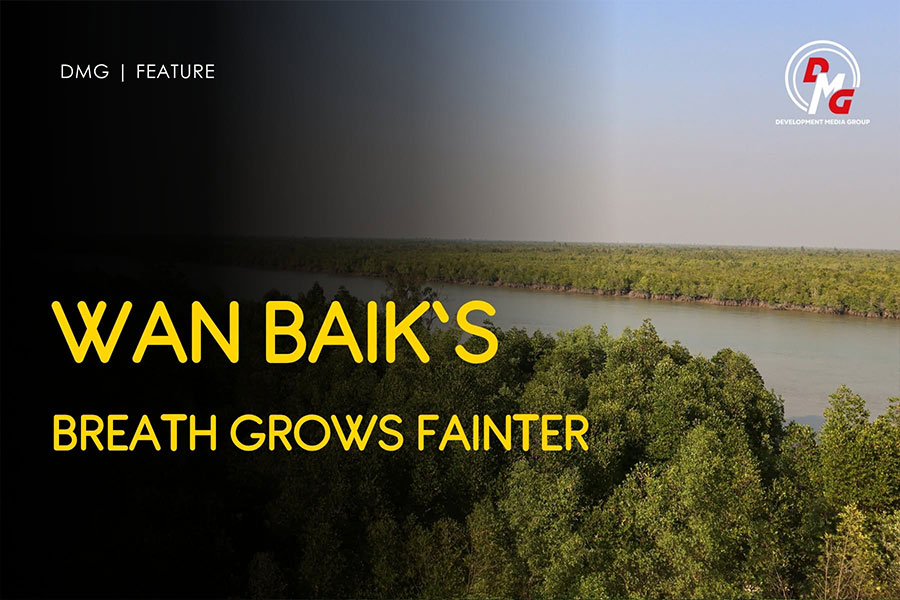
DMG | Feature
Amid the winding creeks that snake through dense mangrove forests, 56-year-old U Tin Htun steers his small boat while casting a fishing net into the water. As he slowly pulls the net back aboard, hope lingers on his face that fish or other aquatic creatures might be caught in its mesh.
For more than 30 years, U Tin Htun has made his living fishing among the mangroves. But today, his voice is filled with frustration.
“I haven’t been catching enough fish for two or three years now. I can’t even catch enough for a single meal,” he lamented.
U Tin Htun lives in Hmaw Yon Village, Ramree Township, near the Wan Baik Mangrove Forest, the second-largest mangrove forest in Myanmar.
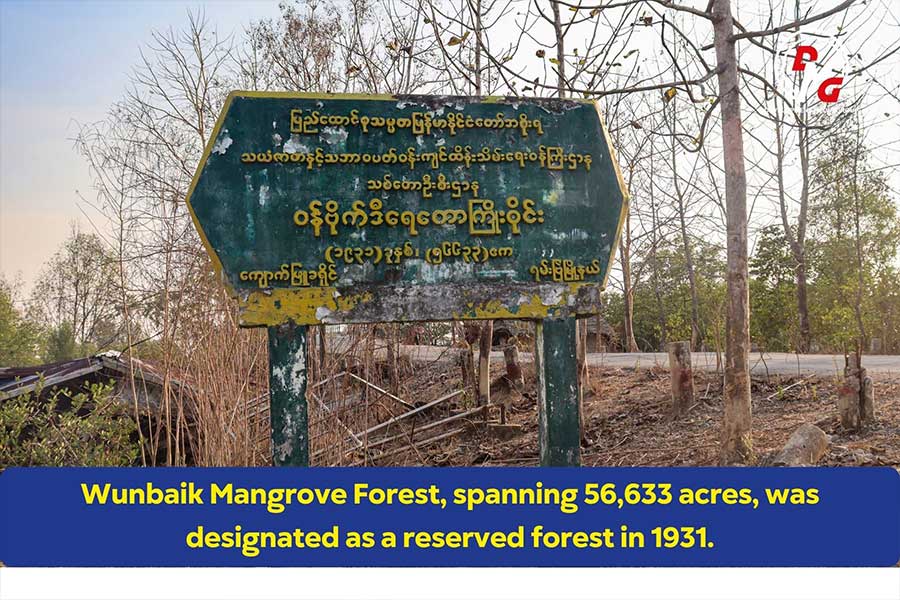
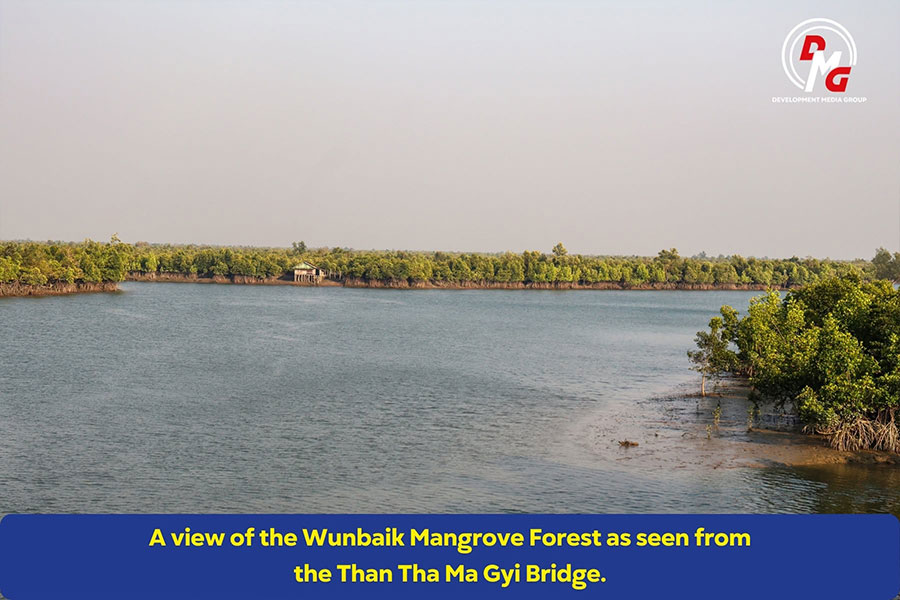
Covering approximately 56,633 acres (22,919 hectares), Wan Baik was first designated as a protected forest reserve in 1931 during British colonial rule. A 2010 assessment by the United Nations Food and Agriculture Organization (FAO) and Myanmar’s Forest Department identified Wan Baik as Myanmar’s second-largest mangrove forest and one of Southeast Asia’s most intact remaining continuous mangrove ecosystems.
The forest contains more than 100 mangrove species, along with a rich diversity of birds, fish, shellfish, and other wildlife.
U Tin Htun recalls a time, only a decade ago, when fish were abundant.
“Fish like mullet and threadfin were everywhere. You could catch as much as you wanted,” he said.
Today, however, the mangrove forest often described as one of Arakan’s greatest environmental treasures, is scarred by widespread logging, leaving behind a landscape that resembles diseased skin covered in wounds.
A Forest Under Pressure from Fuel Demand
The conflict that escalated across Arakan in late 2023 has had a devastating impact on Wan Baik, creating unprecedented threats to the survival of the mangrove ecosystem.
Ko Myo Lwin, an environmental activist from Ann Township who has monitored mangrove conservation for more than a decade, says the situation has become alarming.
“People used to cut wood from Wan Baik before, but now electricity shortages have greatly increased fuel demand. The forest is being cut from every direction,” he said.
Following the conflict, electricity supplies collapsed across much of Arakan beginning in 2024. At the same time, many people lost their jobs and livelihoods. As a result, communities increasingly turned to the mangrove forest for fuel and income.
Mangrove trees are now being cut for firewood, charcoal production, and brick-making. Residents from nearby villages have long relied on charcoal production for income, but local people say the scale of extraction has expanded dramatically. Boats from townships across Arakan now regularly enter the forest to harvest timber.
“Large boats capable of carrying more than two tons of wood enter deep into the forest and stay for ten days or even two weeks cutting timber,” U Tin Htun explained. “Once one boat is full, another arrives.”
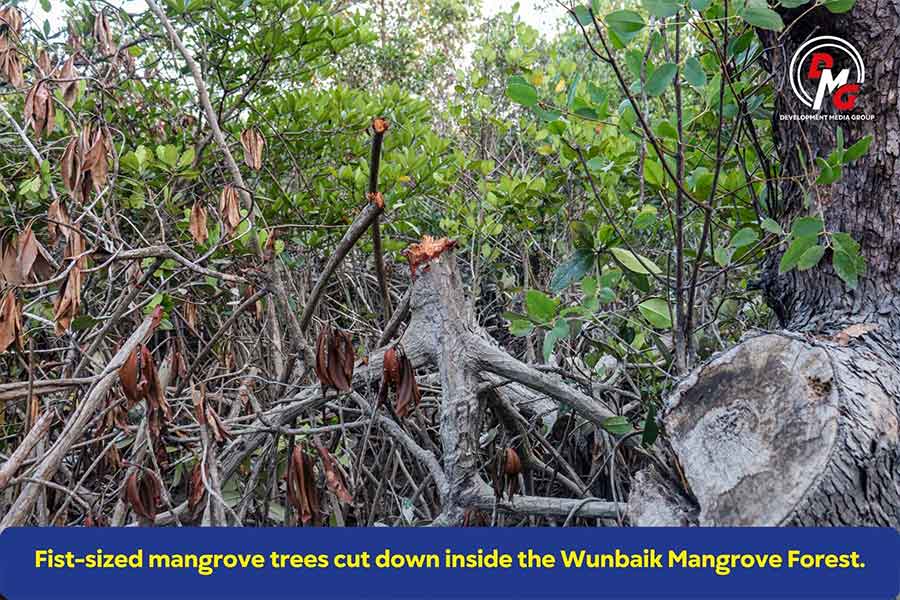
Some traders reportedly pay local residents in advance to cut mangrove trees and later return with larger boats to collect the timber.
Mangrove wood is particularly valued for charcoal production because it is dense and burns efficiently. Charcoal made from mangrove wood commands significantly higher prices than charcoal produced from upland forests.
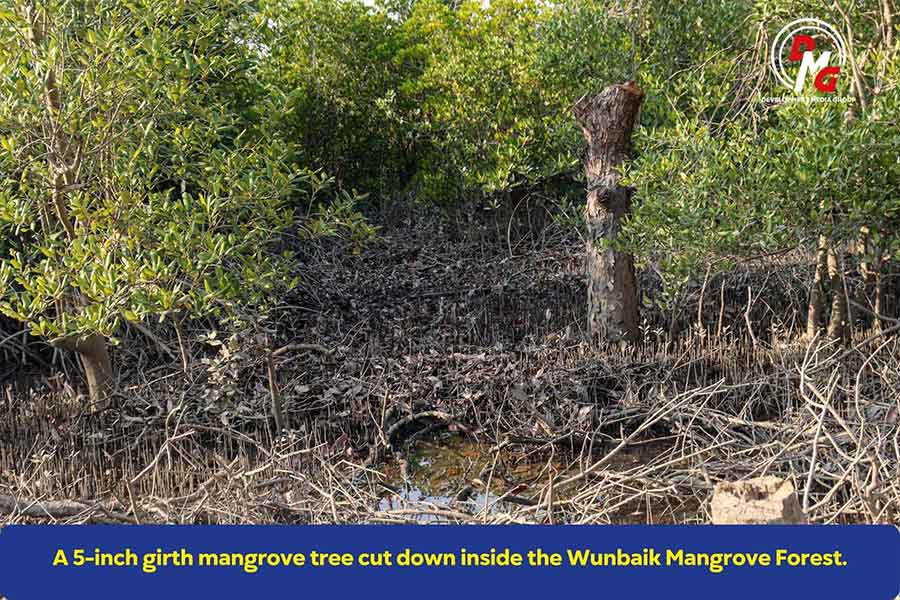
As demand rises, even the smallest trees are being cut.
According to Ko Myo Lwin, approximately 80 percent of Wan Baik now bears visible signs of logging activity.
“Even in the remaining 20 percent, large mangrove trees have almost disappeared,” he said.
The situation has been worsened by displacement. More than 600,000 people have been displaced across Arakan by conflict, according to the Humanitarian and Development Cooperation Office (HDCO) of the Arakan People’s Government. Over 30,000 internally displaced people are currently living in Ramree Township alone.
Many depend on Wan Baik for fuel and building materials to construct temporary shelters.
Longstanding Wounds
The destruction of Wan Baik did not begin with the current conflict.
Environmental degradation has accumulated over decades due to policy failures, weak governance, and inadequate protection.
During the State Peace and Development Council (SPDC) era, a section of the Yangon-Kyaukphyu highway was built directly through the mangrove forest. Construction required extensive clearing of forest areas and opened previously inaccessible parts of the ecosystem to exploitation.
“Alternative routes were available,” said U Win Maung (pseudonym), a former member of the Wan Baik Mangrove Conservation Committee.
“Building the road through the mangrove forest created long-term challenges for both the forest and biodiversity.”
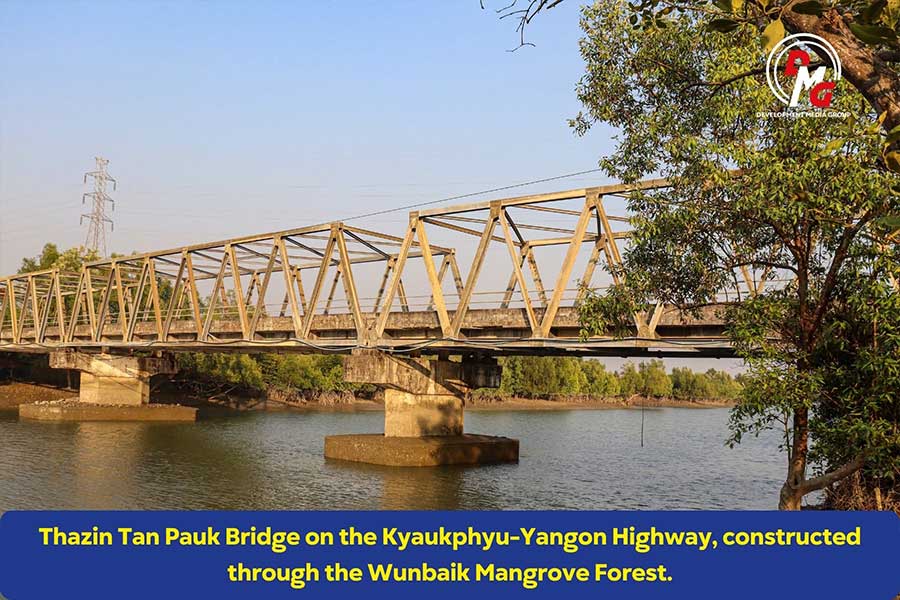
Successive governments also allowed fish and shrimp farms and agricultural projects to expand within the mangrove ecosystem.
According to Forest Department data from 2023, more than 2,400 acres of aquaculture ponds and approximately 4,000 acres of agricultural land have been established within the Wan Baik forest area.
Following Myanmar’s 2021 military coup, illegal logging increased significantly.
Local conservation efforts were also disrupted. A community-based Wan Baik Mangrove Conservation Committee established in 2021 successfully intercepted dozens of illegal logging boats, but many members later faced surveillance and security concerns, forcing conservation activities to cease.
Vanishing Biodiversity
Wan Baik was once home to an extraordinary variety of mangrove species.
Today, many large tree species have become extremely rare or are on the verge of disappearing.
“Large trees suitable for building houses have almost vanished over the past decade,” said Ko Myo Lwin. “Now we are struggling even to protect smaller species.”
The destruction of mangroves has also damaged fish breeding grounds and nursery habitats essential for aquatic life.
Species once common in the area have become increasingly scarce.
“Some fish have become so rare that we may soon have to show their names in books because people no longer see them,” U Tin Htun said.
Approximately 20 villages in Ramree Township and additional communities in Kyaukphyu and Taungup depend on the Wan Baik ecosystem for fishing and livelihoods.
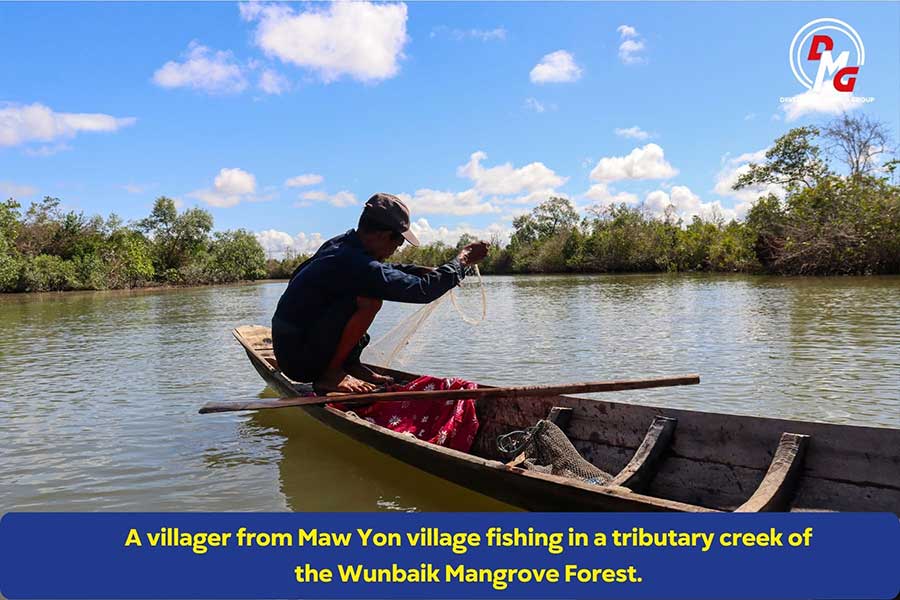
“If this continues for another five or ten years, the people who rely on these waterways will face unimaginable hardship,” U Tin Htun warned.
Wildlife has also disappeared.
Residents recall seeing monkeys, deer, and wild boar throughout the forest. Today, many of those animals have vanished almost entirely.
An Irreplaceable Green Lung
Mangrove forests are among nature’s most valuable ecosystems.
They protect coastal communities from storms, flooding, erosion, and rising sea levels. They serve as breeding grounds for fish, shrimp, and crabs, while also storing large amounts of carbon and supporting biodiversity.
Despite their importance, mangrove coverage across Arakan has declined significantly over recent decades.
Wan Baik, with more than 50,000 acres of mangroves, remains one of the region’s most important environmental assets. It supports food security, climate resilience, biodiversity conservation, and the livelihoods of thousands of people.
Yet conservation efforts remain insufficient.
Although the Arakan People’s Government has established departments responsible for forestry and environmental management, resource limitations and ongoing conflict continue to hamper effective protection.
Some illegal loggers have been detained and released after signing pledges not to continue their activities, but logging persists.
Meanwhile, fishermen like U Tin Htun continue to struggle.
“I borrowed money to buy fishing nets hoping I could make a living,” he said. “Now there are so few fish that I can’t repay my debts. Sometimes I think about selling my nets altogether.”
Conclusion
The future of Wan Baik hangs in the balance.
Without urgent action to protect and restore the mangrove forest, one of Arakan’s most important natural treasures could be lost forever.
Governments, local authorities, environmental organizations, and communities all have a role to play in preserving, restoring, and expanding mangrove forests.
Today, Wan Baik’s breathing is growing fainter.
Unless decisive action is taken soon, this magnificent mangrove forest may survive only in history books and memory.

Opinion
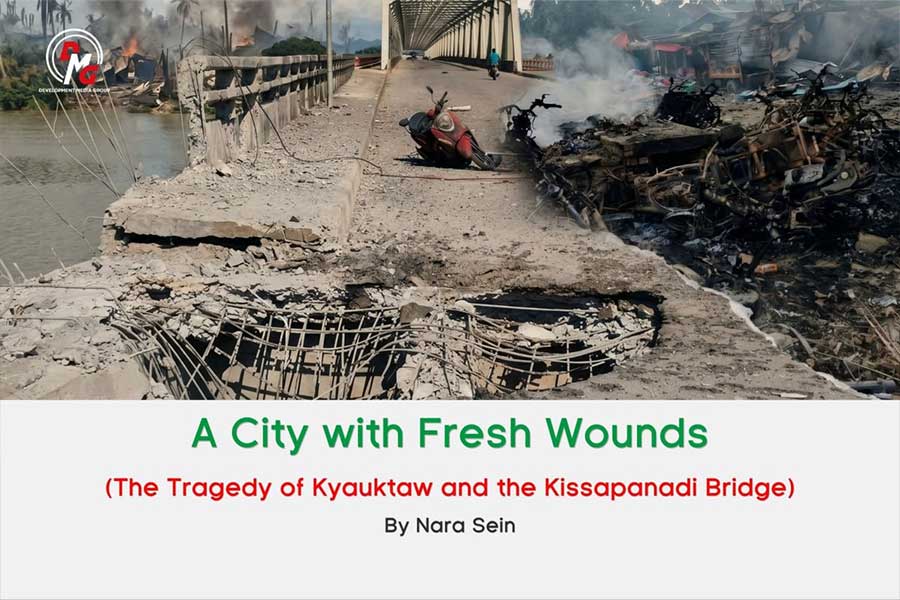
A City with Fresh Wounds (The Tragedy of Kyauktaw and the Kissapanadi Bridge)
By Admin 01 Oct 2026

Arakan Army’s Gains and the Changing Geopolitics of Arakan
By Admin 29 Sep 2026

Beyond Military Victory: What Is Myanmar’s Ultimate Political Objective?
By Admin 26 Sep 2026

UN at a Crossroads: Six Priorities for a Shared Future
By Admin 23 Sep 2026

.jpg)
How Can Myanmar’s Political Crisis Be Brought to an End?
By Admin 13 Sep 2026
POLITICS


BUSINESS
Industry to manufacture finished goods from coconut starting in early 2020
By Aung Kaung Zaw 20 Nov 2019