
- Equal Pay, Unequal Challenges
- Intense clashes erupt in Ayeyarwady as Arakan Army reports weapons seized from junta
- Potential implications of meeting between Daw Aung San Suu Kyi and ICRC representative
- Death toll rises to nine in Taungup boat capsize
- Regime launches heavy airstrikes on villages near Nat Yay Kan tactical base
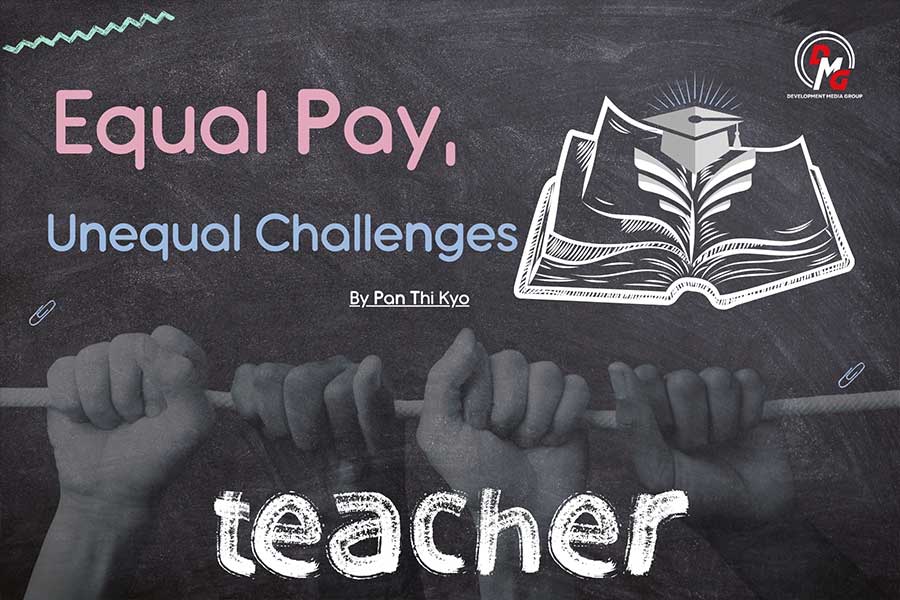
Equal Pay, Unequal Challenges
From the writer's perspective, it is understandable that teachers carrying heavier workloads should receive greater compensation. Others, however, argue that such differences are unfair because teachers holding the same positions should receive equal remuneration.
05 Aug 2026
By Pan Thi Kyo
The Arakan National Education Department has worked to ensure that students can continue their education without interruption since the 2024–2025 academic year. Those efforts have now entered the 2026–2027 school year.
As part of the system, teachers are required to sit qualification examinations administered by the Arakan Public Service Commission (APSC). In response to the current realities in Arakan, the department has also introduced a standardized salary system for teachers in an effort to improve the administration of education.
In previous academic years, financial contributions from parents commonly referred to as teacher support payments varied considerably from one township to another. In most areas, individual schools collected these contributions and managed the funds independently.
This system had both strengths and weaknesses, depending largely on the administrative capacity of each headteacher. Schools differ in terms of location, educational level, student enrolment and staffing. Naturally, schools with larger student populations collected more support payments, while smaller schools collected less. That reality has not changed and is unlikely to change in the future.
As a result, teachers at larger schools often received significantly higher support payments than those working at smaller schools. This disparity became a source of discussion among education staff. For example, one high school teacher might receive as much as 500,000 kyats per month, while another teacher holding the same position received only slightly more than 100,000 kyats. Similar disparities also existed among middle and primary school teachers.
However, teachers at schools with larger student populations also carry substantially heavier workloads. At schools where a single grade must be divided into two or three parallel classes, teachers may teach around 20 class periods each week. Compared with teachers at smaller schools, they spend considerably more time in the classroom and shoulder greater responsibilities.
From the writer's perspective, it is understandable that teachers carrying heavier workloads should receive greater compensation. Others, however, argue that such differences are unfair because teachers holding the same positions should receive equal remuneration. Whatever the viewpoint, the current reality is that the government is not yet able to provide full salaries for education staff. During this transitional period, teachers must continue serving with a sense of national commitment while supporting one another through cooperation and mutual understanding.
At present, the Arakan National Education Department has formally appointed only a limited number of senior positions, including township education officers, senior high school principals and senior middle school principals.
Most teaching staff have not yet received permanent appointments. Instead, some townships have issued temporary appointments for the current academic year. The appointment process has nevertheless created serious staffing imbalances. Some schools have an excessive number of teachers, while others face severe shortages. In some cases, schools with fewer than 20 students have as many as seven teachers.
Consequently, some schools are so heavily staffed that teachers have relatively light workloads, while teachers at understaffed schools seem to need as many arms as the many-armed goddess Kali simply to manage all of their responsibilities.
Under the new policy, every teacher receives the same standardized monthly salary. For teachers at overstaffed schools, this may seem relatively comfortable. For those working in understaffed schools, however, the situation is considerably more demanding.
During the 2025–2026 academic year, the Arakan National Education Department piloted a township-level system in Taungup, Thandwe and Gwa Townships under which teacher support payments collected from parents were distributed equally among all education staff.
That policy has now been expanded to all basic education schools under the department's administration for the 2026–2027 academic year. Under the new system, every teacher will receive a standardized monthly salary of 200,000 kyats.
If contributions collected from parents are insufficient to cover these payments, the ULA Central Party has reportedly pledged to provide additional financial support.
Students from low-income families may also apply for educational assistance. Rather than receiving cash grants, eligible students will be exempted from paying the required teacher support contributions.
Likewise, where a family has more than one child attending the same school, only the eldest child will pay the full contribution, while younger siblings will pay only half the prescribed amount.
These measures should help reduce education costs for many families.
Nevertheless, a monthly salary of 200,000 kyats is difficult to regard as sufficient under current economic conditions.
At a time when even a cup of tea costs around 1,000 kyats, how can teachers realistically support themselves on such an income?
Private tuition and supplementary employment are therefore likely to become the principal means through which many teachers seek additional income.
There is nothing inherently wrong with teachers earning extra income by teaching. Education is a profession that requires dedication, and sharing one's knowledge outside regular school hours is entirely legitimate. However, because some teachers have pursued private tuition excessively for personal gain, the practice has at times come to be viewed as unfair.
Even so, earning additional income through teaching remains a reasonable and appropriate option.
The situation becomes more complicated when teachers engage in unrelated business activities. While some forms of supplementary work can be balanced with teaching responsibilities, occupations requiring frequent travel or extensive time commitments are likely to interfere with classroom duties.
This is not to suggest that teachers should never engage in small-scale business. Many undoubtedly do so while continuing to fulfil their responsibilities conscientiously. The essential point is that any supplementary work should remain compatible with the teaching profession. Only then can teachers continue improving their own professional skills while providing students with the quality education they deserve.
At the same time, parents are facing new financial pressures.
Although the policy establishes equal salaries for teachers, it does not specify how schools will finance their routine operating expenses. Schools must therefore identify alternative sources of funding simply to continue functioning.
These operating costs include classroom supplies such as chalk, markers and ink; office materials including A4 paper, registers, notebooks and staplers; and transportation costs for teachers and administrators attending township- and sub-township-level meetings.
No separate allocation has reportedly been provided from party funding to cover these operational expenses. Instead, schools have been instructed to establish their own operating funds.
In practice, there appears to be no realistic source for these funds other than contributions from students' parents. This means that an additional financial burden for parents is already emerging.
To keep schools functioning, parents will inevitably be asked to contribute toward operating costs. At schools with large student populations, these costs can be spread across many families, reducing the burden on each household. At schools with fewer students, however, each family may have to contribute considerably more.
If the policy of equal pay is to be maintained, the authorities should also provide schools with operating budgets that reflect current economic realities.
Equal salaries may appear fair on paper, but they conceal significant differences in staffing levels, workloads and local financial capacity. If these underlying inequalities begin to undermine the quality of teaching, the future of education in Arakan will become a matter of serious concern.

Opinion
Equal Pay, Unequal Challenges
By Admin 05 Aug 2026
Reflections on the Arakanese (Rakhine) Language Curriculum
By Admin 14 Jul 2026
Holding On to Arakan
By Admin 26 Jun 2026
The Arakan Shift and the Echoes of the People
By Admin 13 May 2026
We Must Remove What Is No Longer Needed
By Admin 24 Apr 2026
Grandmother’s Little Kerosene Lamp
By Admin 08 Apr 2026
POLITICS


BUSINESS
Industry to manufacture finished goods from coconut starting in early 2020
By Aung Kaung Zaw 20 Nov 2019