
- At least five injured in junta Y-12 airstrikes on Werathani villages
- Junta orders Sittwe residents to dismantle home bomb shelters
- Arakan records most armed incidents as 78 civilians killed across Myanmar: NLTA
- Y-12 aircraft, drones circle over Sittwe as clashes intensify
- Panic grips Sittwe after deadly reported Y-12 airstrike
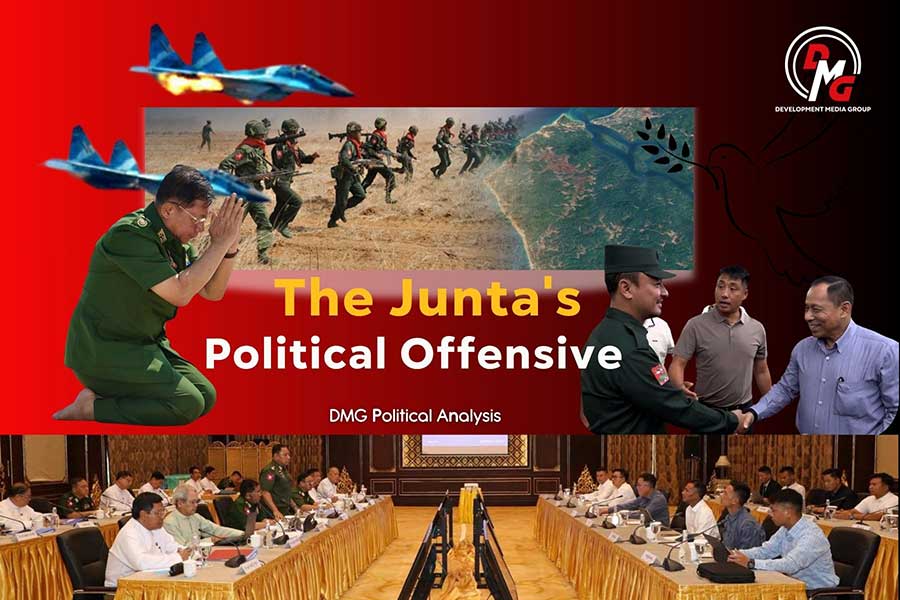
The Junta's Political Offensive
The junta appears to be combining selective political concessions, ceasefire initiatives and diplomatic engagement with continued military pressure.
25 Aug 2026
DMG Political Analysis
While the battlefield in Arakan continues to be defined by escalating airstrikes and renewed ground offensives, another offensive is unfolding in Naypyitaw not military, but political. Through successive meetings with members of the Federal Political Negotiation and Consultative Committee (FPNCC), alongside renewed engagement by Nippon Foundation Honorary Chairman Yohei Sasakawa, Myanmar's military junta appears to be pursuing a broader political strategy aimed at reshaping the conflict at a time when its military position continues to weaken.
Rather than replacing military operations, diplomacy has increasingly become another instrument of war. The junta appears to be combining selective political concessions, ceasefire initiatives and diplomatic engagement with continued military pressure. In this sense, negotiations are not occurring instead of conflict; they are becoming another arena in which the conflict itself is being fought.
The timing of this political outreach is particularly significant.
Over the past two years, the Arakan Army (AA) has consolidated control over most of Arakan while the junta has steadily lost territorial influence across the state. Recent DMG reporting shows that the military has intensified attempts to penetrate AA-controlled territory from neighboring Ayeyarwady Region while simultaneously expanding aerial bombardments across civilian areas. Between January and mid-August 2026, DMG documented at least eleven junta airstrikes in Arakan and Paletwa in which each incident caused ten or more civilian casualties. During just the first two weeks of August, airstrikes reportedly killed twenty-seven civilians and injured thirty-eight others. These battlefield realities provide the strategic context for the junta's renewed political engagement.
A Shift Toward Political Maneuvering
Since June, Lt-Gen Yar Pyae, chairman of the National Solidarity and Peacemaking Negotiation Committee (NSPNC), has personally travelled to northern Shan State to engage several FPNCC members. Those contacts have since evolved into a series of meetings in Naypyitaw involving the United Wa State Army (UWSA), National Democratic Alliance Army (NDAA), Ta'ang National Liberation Army (TNLA) and Shan State Progress Party (SSPP), each presenting its own political demands to the regime.
These discussions indicate that the junta's objective extends beyond maintaining dialogue with individual organizations. Instead, they suggest a broader effort to stabilize areas where active fighting remains limited while reducing the number of military fronts confronting the regime simultaneously.
Captain Zin Yaw, a military defector interviewed by DMG, offered one of the clearest interpretations of the process:
"From our perspective, this looks like a federalism sales campaign. Yar Pyae has gone all the way to eastern Shan State to do the marketing as if the military is trying to sell federalism at a discount."
His observation captures a striking political irony.
For decades, successive military governments rejected meaningful federal reform as a threat to national unity. Today, however, the junta appears increasingly willing to discuss political concessions with selected ethnic armed organizations not necessarily because its political philosophy has changed, but because its strategic circumstances have.
Concessions Born of Military Weakness
The organizations now engaging in dialogue have advanced significant political demands.
The UWSA and TNLA have reportedly requested recognition of their territories as states, while the NDAA has sought designation as a Special Autonomous Region. Whether the regime ultimately accepts these demands remains uncertain. Nevertheless, the very fact that such issues are under discussion reflects how dramatically Myanmar's political landscape has shifted since the 2021 coup.
The military today appears less able to dictate political outcomes unilaterally than at any point in recent decades.
Captain Zin Yaw argues that the junta's willingness to negotiate reflects military necessity rather than political transformation.
"The military will inevitably have to make concessions to some of the demands made by the ethnic organizations. Under the current situation, the Spring Revolution emerged because of the coup. Previous coups did not trigger an armed resistance of this scale, but this time the armed revolution has become highly effective. The military has come close to collapse. Therefore, I think it will first seek ceasefires with ethnic organizations before turning its attention toward the Spring Revolution forces and the conflicts in Kachin and Chin."
This assessment suggests that the current peace initiative is not primarily about ending the conflict. Rather, it may be about reducing the number of active fronts so that limited military resources can be concentrated elsewhere.
Captain Zin Yaw expressed a similar view in an earlier interview with DMG.
"The main target is the AA. The military has been unable to pressure the AA through other means. It is therefore trying to prevent fighting in northern and eastern Myanmar so it can redeploy forces from Shan State to the Arakan front."
Whether or not this strategy succeeds, it reflects an important reality: political negotiations and military planning are increasingly intertwined.
Why Arakan Remains the Central Battlefield
Among all FPNCC members, the Arakan Army occupies a unique position.
Unlike the UWSA, NDAA, SSPP and TNLA, which are currently participating in talks with the regime, the AA continues active military operations while exercising de facto administrative control across most of Arakan. Together with the Kachin Independence Army (KIA), it remains one of the junta's principal military adversaries.
This distinction matters.
If the junta succeeds in stabilizing relations with other FPNCC members, it could potentially redirect greater military attention toward Arakan and Kachin. Such a scenario would not necessarily produce immediate territorial gains, but it could increase military pressure through continued ground offensives, intensified airstrikes and expanded logistical operations.
Recent developments in Arakan appear consistent with this possibility.
Ground offensives from neighboring regions have intensified while aerial bombardments continue to target civilian areas. Rather than signaling de-escalation, the political process appears to be unfolding alongside an increasingly aggressive military campaign.
Sasakawa's Return and the Diplomatic Dimension
Another significant development is the return of Yohei Sasakawa.
The Nippon Foundation Honorary Chairman arrived in Myanmar in early August and met former junta chief and current President Min Aung Hlaing on 10 August. Officially, the visit focused on humanitarian assistance and post-disaster recovery.
Yet Sasakawa's long history in Myanmar inevitably gives the visit broader political significance.
He previously facilitated temporary ceasefires between the AA and the military in both 2020 and 2022, making him one of the few international figures with an established working relationship with both sides.
Political analyst Dr. Sai Kyi Zin Soe believes the humanitarian agenda and renewed ceasefire discussions may overlap.
"Sasakawa has maintained relations with the AA for many years. Given the humanitarian challenges currently facing Arakan, he may seek to expand humanitarian assistance. At the same time, it is reasonable to expect that ceasefire issues could also be discussed. He is likely to encourage efforts toward ceasefires involving both the AA and the KIA."
Whether such efforts can succeed today is another question entirely.
The political landscape has changed fundamentally since previous ceasefire arrangements.
The AA now administers much of Arakan, overseeing public services, policing, border management and local governance. The military, meanwhile, has become increasingly dependent upon air power as its territorial control has contracted.
Any future negotiations would therefore occur under a vastly different balance of power.
Can the FPNCC Be Drawn Into a Broader Peace Process?
Another question concerns the future cohesion of the FPNCC itself.
Dr. Sai Kyi Zin Soe believes the current meetings may represent the early stages of a wider diplomatic effort.
"The groups currently meeting under the FPNCC framework may also be exploring a negotiation path for the FPNCC as a whole. The current format appears intended to eventually bring all members into the process."
If this proves accurate, the junta's long-term objective may extend beyond bilateral discussions toward encouraging broader participation in political negotiations, potentially including renewed engagement with the Nationwide Ceasefire Agreement (NCA) framework.
Whether such an outcome is achievable remains uncertain.
The FPNCC is not a unified military alliance with identical objectives. Its members differ significantly in territorial control, strategic priorities, external relationships and current military situations. The interests of the UWSA are not identical to those of the AA or the KIA, making a comprehensive negotiating framework difficult to achieve.
Diplomacy and War Moving Together
Perhaps the most important conclusion emerging from recent developments is that diplomacy and military operations are no longer occurring separately.
As the junta intensifies talks in Naypyitaw, it simultaneously continues large-scale airstrikes and renewed ground offensives in Arakan.
This reflects a dual-track strategy.
Negotiations may reduce conflict in some regions while allowing the military to concentrate resources elsewhere. Political engagement therefore does not necessarily indicate a broader commitment to peace; it may instead serve as a mechanism for managing military priorities.
For Arakan, this distinction is critical.
Even if ceasefires emerge elsewhere, the state's strategic importance, combined with the AA's expanding administrative authority, means Arakan is likely to remain one of Myanmar's principal theatres of conflict.
Looking Ahead
Current trends suggest that Myanmar is entering a new phase of the post-coup conflict.
The military increasingly appears to recognize that it cannot restore nationwide control through military force alone. Consequently, it is supplementing battlefield operations with political outreach, selective concessions and diplomatic engagement.
At the same time, organizations such as the AA continue consolidating governance in territories under their control while humanitarian needs continue to expand and military confrontations remain intense.
Whether the junta's political offensive ultimately produces meaningful negotiations or merely rearranges the geography of conflict will depend largely on whether diplomacy addresses the underlying political causes of Myanmar's wars rather than simply redistributing military pressure.
For now, recent developments indicate that Myanmar's conflict is no longer defined solely by battles on the ground. Increasingly, it is also being shaped around negotiating tables, where diplomacy has become another instrument in a continuing struggle for political power.

Opinion
Can the UN Restore Trust in a Fractured World?
By Admin 23 Oct 2026
Arakan Amid the Storm: From Survival to Rebuilding a People
By Admin 22 Oct 2026
Surviving Amid the Bombs: Arakan's Quiet Resistance
By Admin 19 Oct 2026
Shadows Over Childhood: Confronting the Reality of Missing Children
By Admin 16 Oct 2026
A City with Fresh Wounds (The Tragedy of Kyauktaw and the Kissapanadi Bridge)
By Admin 01 Oct 2026
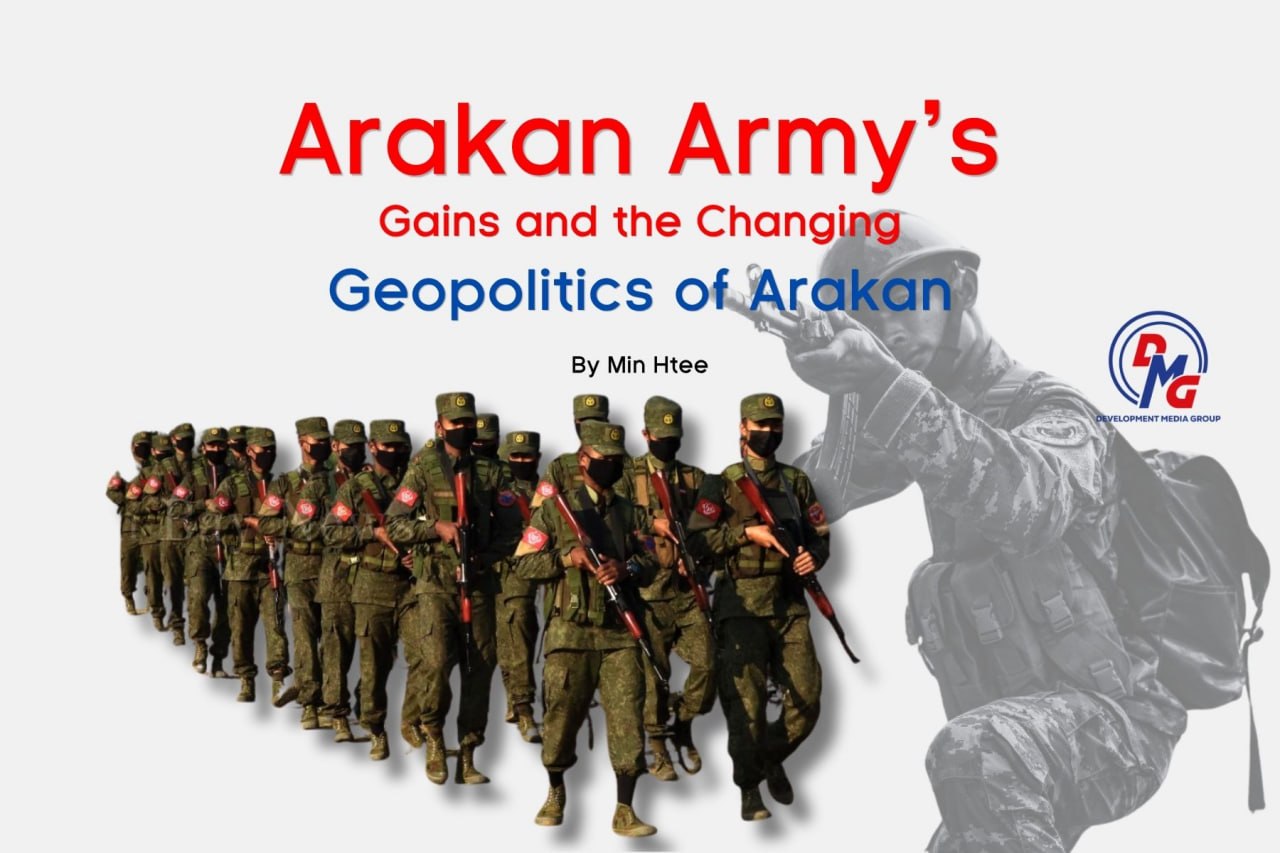
Arakan Army’s Gains and the Changing Geopolitics of Arakan
By Admin 29 Sep 2026
POLITICS

BUSINESS
Industry to manufacture finished goods from coconut starting in early 2020
By Aung Kaung Zaw 20 Nov 2019