


- Junta seeks foothold on strategic island in Kaladan River as Arakan Army counterattacks
- Begging nearly doubles amid livelihood crisis in southern Arakan
- Heavy fighting near junta-held Sittwe fuels fear as frontlines approach city
- Displaced civilians struggle to access healthcare after junta airstrike destroys Ponnagyun clinic
- Kyauktaw market closure disrupts trade and drives up prices across Arakan
Weekly Highlights from Arakan (October 5 -11, 2026)
In an era when daily news from Arakan is often fragmented and fast-changing, DMG's Weekly Highlights of Arakan brings clarity, depth, and context to the stories that matter most.
12 Oct 2026

In an era when daily news from Arakan is often fragmented and fast-changing, DMG's Weekly Highlights of Arakan brings clarity, depth, and context to the stories that matter most.
Each week, we round up key political, military, social, and humanitarian developments across Arakan State - connecting the dots between events and offering analysis to help audiences see the bigger picture.
This series is designed for readers and viewers seeking a concise yet comprehensive understanding of how ongoing conflict, governance shifts, and community issues continue to shape lives across Arakan.
Junta troops suffer heavy casualties in failed landings on AA-held Ngapyi Island
The military junta has suffered heavy casualties during repeated failed attempts to launch large scale amphibious landing operations targeting Ngapyi Island, which is controlled by the Arakan Army along the Kaladan River border shared by Sittwe, Ponnagyun, and Werathani townships, according to local military sources.
Deploying from the Shwe Min Gan Naval Base in Sittwe, junta forces attempted amphibious landings on the Arakan Army-held island in Werathani Township for three consecutive days starting October 7.
However, intense counterstrikes involving artillery bombardment and drone attacks by the Arakan Army prevented the troops from coming ashore, forcing junta warships to pull back.
Military sources confirmed that at least 40 junta soldiers who managed to reach land were killed during the three days of fighting.
Following their failed amphibious assaults, junta forces have launched continuous airstrikes, drone strikes, and heavy artillery shelling targeting villages on Ngapyi Island.
Under Operation 4926, the military regime has maintained relentless daily air and artillery bombardments across townships in Arakan State under Arakan Army control.
Local residents reported that at least six junta warships remain deployed from the Shwe Min Gan Naval Base in Sittwe and are actively conducting naval maneuvers.
In Werathani Township, local civilians and displaced persons face severe daily livelihood hardships due to naval shelling, arbitrary detentions, and strict maritime blockades imposed by the regime.
With ground troops unable to secure a foothold due to Arakan Army artillery strikes, the junta has turned heavily to air power to bombard Ngapyi Island, according to local residents.
Situated in the Kaladan River at the junction of Sittwe, Ponnagyun, and Werathani townships, Ngapyi Island holds critical strategic value in northern Arakan State.
Man sentenced to death for rape and murder of nine-year-old girl in Anjanapura
A district court has sentenced a man to death after finding him guilty of raping and murdering a young girl in Pharpyo Village, Anjanapura Township, Arakan State.
The Anjanapura District Court handed down the death sentence on October 9 following a trial.
The condemned man was identified as 38-year-old U Maung Hla Than, a resident of Pharpyo Village. He was convicted of raping and murdering a nine-year-old girl before hanging her body from a tree to stage a suicide.
In addition to sentencing the man to death, the court acquitted and released seven other Pharpyo residents who had initially been detained on suspicion during the investigation.
Formal court proceedings began on May 15, 2025. After examining 10 prosecution witnesses and conducting cross examinations involving both sides, the court found the accused guilty beyond a reasonable doubt and imposed the death penalty.
The crime occurred on May 6, 2025, when U Maung Hla Than sexually assaulted and murdered the nine-year-old child in Pharpyo Village before hanging her body from a tree.
Officers from the Department of Law Enforcement and Public Security (DLEPS), under the United League of Arakan (ULA), arrested U Maung Hla Than on May 7, 2025. A month later, authorities detained seven other local residents for questioning as part of the broader investigation before clearing them of all charges.
In a similar case on August 5, 2026, the Sittwe District Court sentenced three men to death and long-term imprisonment for their involvement in a fatal sexual assault case in Aungseik Village, Ponnagyun Township.
The Arakan Army (AA) has established specialized judicial courts across Arakan State to handle serious criminal offenses, including statutory rape, sexual violence, and homicide, and to ensure legal accountability.
According to human rights records, at least 17 cases of sexual violence, including rape and murder, were documented across Arakan State and Paletwa Township in Chin State between January 2024 and August 2026, with perpetrators remaining at large in several unsolved cases.
Kyauktaw market closure disrupts trade and drives up prices across Arakan
Local trade, commerce, and the flow of goods have slowed drastically across Kyauktaw Township, Arakan State, following the military junta's deadly aerial bombardment of the town's Indian Market, according to local residents and traders.
More than 10 days have passed since the Indian Market was shuttered in the wake of the airstrike. Merchants report that lingering fears of renewed aerial attacks have forced them to suspend business operations entirely.
With the Indian Market closed, wholesale buyers from across Arakan State can no longer source goods locally, severely disrupting local supply chains.
The paralysis of local trading hubs has also disrupted commodity flows from India, plunging local trade and commercial enterprises into severe disarray.
Alongside the contraction in commerce, basic food items and consumer goods are seeing spiraling price hikes across Kyauktaw Township.
The price of Indian eggs has surged from K500 to between K600 and K700 per egg, while a carton of red Indian cooking oil has jumped from K75,000 to K85,000.
The Indian Market in Kyauktaw serves as the primary distribution hub for goods imported from India, supplying townships throughout Arakan State and supporting hundreds of daily wage laborers and vendors.
On September 28, the military junta launched airstrikes targeting Kyauktaw's Indian Market and the nearby Kissapanadi Bridge, killing 50 civilians and injuring 57 others.
The bombardment incinerated market stalls, cars, and motorcycles, triggering severe and lasting consequences for regional commerce, supply chains, and food security.
Death toll rises to eight following consecutive junta airstrikes on IDP camps in Ponnagyun
Consecutive days of aerial bombardments by the military junta targeting internally displaced persons (IDP) camps and nearby villages in Ponnagyun Township, Arakan State, have left eight civilians dead and 11 others wounded, according to a statement released by the Arakan Army (AA).
On October 4, two junta jet fighters dropped bombs on Byarla IDP Camp, situated between Thayetcho and Yoengu villages in Ponnagyun Township.
The airstrike killed six displaced civilians and injured 10 others, with five victims sustaining critical injuries, the Arakan Army reported on October 5.
The bombardment incinerated numerous IDP residential quarters, personal belongings, motorcycles, and sidecar motorbikes.
On October 5, junta warplanes launched a fresh, half-hour-long bombing run targeting Pannilar IDP Camp, the camp's temporary Saytana Clinic, and nearby Aungphyupyin Village, according to the Arakan Army.
The military regime utilized cluster bombs and 300-pound high-explosive aerial bombs during the attack, the Arakan Army stated.
The temporary clinic inside Pannilar IDP Camp sustained direct structural damage. Ma Khine Thazin Soe, an 18-year-old trainee nurse working at the facility, suffered severe shrapnel wounds to the head and succumbed to her injuries while undergoing medical treatment.
In Aungphyupyin Village, 54-year-old Daw Hla May Thein, who had fled to the village to escape conflict in Ponnagyun, was killed instantly by shrapnel to the head. Another displaced resident, 63-year-old U Nyi Chay, sustained shrapnel wounds to his chest and legs, the Arakan Army reported.
These latest attacks come amid an intensified wave of aerial bombardments across Arakan State, following the military's September 28 airstrike on the Indian Market and the Kaladan River Bridge area in Kyauktaw, which resulted in massive civilian casualties.
Arakan has Myanmar’s highest multidimensional poverty, 1.66 million affected: UNDP
Arakan State has the highest level of multidimensional poverty in Myanmar, with more than two-thirds of its population facing overlapping hardships involving healthcare, education and basic living conditions, according to a new United Nations Development Programme (UNDP) report.
The report, Layers of Deprivation: Multidimensional Poverty in Myanmar, released on October 8, estimates that 68.4 percent of Arakan’s population, approximately 1.66 million people, live in multidimensional poverty.
Arakan recorded the country's highest Multidimensional Poverty Index (MPI) score of 0.342, reflecting both the widespread incidence of poverty and the severity of deprivation among affected households.
The report found that people experiencing multidimensional poverty in Arakan face deprivation across roughly half of the weighted indicators measuring education, health and living standards.
According to UNDP, 89.1 percent of Arakan's population is either multidimensionally poor or vulnerable to falling into multidimensional poverty.
Although Arakan recorded the highest poverty severity, Ayeyarwady Region had the largest number of multidimensionally poor people, estimated at 2.65 million, followed by Sagaing Region with 2.38 million.
UNDP warned that its estimates for Arakan likely understate the actual scale of deprivation because stateless and displaced populations, including Rohingya communities, were inadequately represented in the telephone-based survey.
The report highlights the scale of Arakan's humanitarian and development challenges, where conflict-related disruption and restricted access to basic services continue to deepen poverty and undermine household resilience.
Ponnagyun residents flee en masse as junta airstrikes target displacement camps
Internally displaced people in Ponnagyun Township, Arakan State, are being forced to relocate again as the military regime conducts relentless daily airstrikes targeting villages and displacement camps.
Displaced populations across Ponnagyun Township have been sheltering in temporary bamboo huts built along roadsides and in nearby forested hills around Kyaukseik, Thayetcho, Pannilar, Yoengu, and Aungphyupyin villages.
In recent days, military forces have carried out daily aerial attacks directly targeting these villages and adjacent IDP camps.
Daily aerial bombardments targeting villages and displacement camps in Ponnagyun Township between September 30 and October 5 killed eight civilians and wounded 17 others.
The continuous airstrikes have forced Ponnagyun residents to live under constant fear and anxiety.
In an effort to recapture lost territories across Arakan State, the military regime launched offensives deploying seven military columns advancing from Sittwe, Kyaukphyu, Ayeyarwady, Bago, and Magway regions, as well as Chin State.
The military initiated a major offensive codenamed “Operation 4926” to reclaim lost areas near Ponnagyun and Kyaukphyu townships, but its forces suffered heavy setbacks and were forced to retreat following defensive and counteroffensive operations by the Arakan Army.
According to an analytical report published by the Institute for Strategy and Policy – Myanmar (ISP-Myanmar) on October 5, the war in Arakan State is transforming into a total war. With the military regime expected to intensify its aerial campaign, civilian casualties and suffering are projected to rise significantly.

Opinion
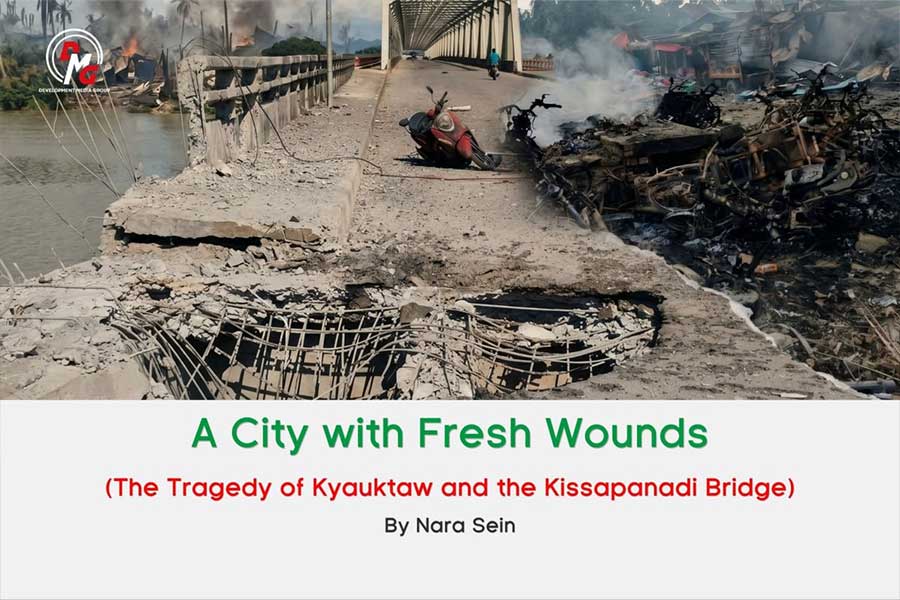
A City with Fresh Wounds (The Tragedy of Kyauktaw and the Kissapanadi Bridge)
By Admin 01 Oct 2026

Arakan Army’s Gains and the Changing Geopolitics of Arakan
By Admin 29 Sep 2026

Beyond Military Victory: What Is Myanmar’s Ultimate Political Objective?
By Admin 26 Sep 2026

UN at a Crossroads: Six Priorities for a Shared Future
By Admin 23 Sep 2026
.jpg)
How Can Myanmar’s Political Crisis Be Brought to an End?
By Admin 13 Sep 2026
POLITICS


BUSINESS
Industry to manufacture finished goods from coconut starting in early 2020
By Aung Kaung Zaw 20 Nov 2019