
- Military operations spread despite decline in clashes, BNI report finds
- Junta aerial attacks force school closures across three Arakan townships
- Family demands swift arrest of statutory rape suspect in Werathani
- Women face shrinking employment opportunities in Myanmar, UNDP reports
- AA seizes five junta outposts as Arakan records most civilian-targeted airstrikes: NLTA
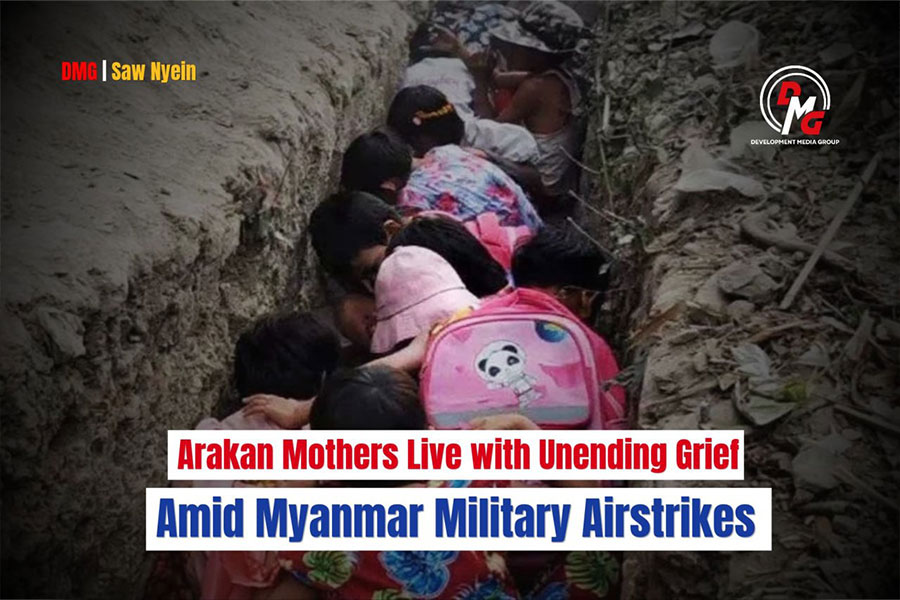
Arakan Mothers Live with Unending Grief Amid Myanmar Military Airstrikes
Balancing a tray of djenkol beans on her head, Daw Aye May walks briskly from house to house, selling her produce to support her family.
14 Oct 2026
By Saw Nyein
Balancing a tray of djenkol beans on her head, Daw Aye May walks briskly from house to house, selling her produce to support her family.
She lives in Upper Laynyintaung Village in Mrauk-U Township, Arakan (Rakhine) State, western Myanmar, where the threat of military airstrikes has become part of everyday life.
Whenever she leaves home to earn a living, she worries about her two young daughters, aged six and three, whom she must leave behind. She says she is always anxious to return home as quickly as possible.
Her fears stem from a devastating loss. In March 2024, her eldest daughter, 13-year-old Ma Khin Thandar, was killed in a Myanmar military airstrike on the village.
Having already lost one child, Daw Aye May lives in constant fear that another attack could take the lives of her two surviving daughters.
Her eldest daughter loved school and was a well-behaved, responsible child. Her death left a void that Daw Aye May says has never been filled.
Despite the painful memories, she continues to live in the village where her daughter died, surviving by selling vegetables and taking whatever work she can find.
Poverty leaves her with few choices. When she goes out to sell vegetables, she sometimes leaves her daughters in the care of neighbors. At other times, she takes them into the forests and hills while gathering food or collecting firewood.
“I end up taking my children with me to gather food and collect firewood, even though they get bitten by mosquitoes and insects. If I don't go, we won't have anything to eat,” she said.
Across Arakan State, residents continue to face the threat of military airstrikes while struggling to secure food, income and basic necessities.
For mothers like Daw Aye May, daily life has become a struggle not only to survive but also to protect their children and safeguard their future.
A Daughter Lost to an Airstrike
On March 21, 2024, Daw Aye May's eldest daughter, Ma Khin Thandar, a Grade 5 student, was killed in an airstrike on Upper Laynyintaung Village.
Five people were killed and nine others injured in the attack. Among those killed were three-year-old Maung Thar Htoo, five-year-old Maung Lin Myat Ko and nine-year-old Ma Ei Khine Mon.
Survivors of airstrikes often face lasting physical injuries and psychological trauma. Mothers who have lost children or witnessed attacks on their families may experience continuing fear and emotional distress.
For women already struggling to support their households, these psychological burdens can make everyday life even more difficult.
Since Myanmar's military seized power in February 2021, airstrikes have become a major threat to civilians across the country.
According to the Institute for Strategy and Policy – Myanmar (ISP-Myanmar), an independent research organization, the military carried out at least 11,916 airstrikes nationwide between February 2021 and May 2025.
Figures compiled by Development Media Group (DMG) show that the military conducted 235 airstrikes causing civilian casualties in Arakan State between December 2025, during the military-organized election period, and September 25, 2026.
The Office of the United Nations High Commissioner for Human Rights (OHCHR) reported that military airstrikes increased by 52 percent in 2025 compared with 2024.
As attacks have intensified, the suffering of families who have lost loved ones has continued, with many survivors receiving little psychological or material support.
Airstrikes have also raised serious concerns about the protection of civilians and the fundamental right to life.
“It will soon be three years, but I still don't dare leave my child alone. I experienced it myself, so I'm still afraid,” said the mother of Ma Phoo Pwint Eain, another young survivor from Upper Laynyintaung Village.
Her daughter, who was four years old at the time, suffered a serious head injury in the same airstrike. The mother says she remains deeply concerned about the long-term effects of the injury and her daughter's future.
Mothers Left Grieving as Justice Remains Elusive
Across Myanmar, mothers continue to lose their children in military airstrikes, while accountability for civilian deaths remains limited.
Attacks directed against civilians and civilian objects are prohibited under international humanitarian law and may constitute war crimes.
Schools and residential neighborhoods across Arakan State have been hit by military airstrikes, placing children and other civilians at serious risk.
Between November 2023, when major fighting resumed in Arakan State, and the end of February 2026, 15 incidents involving at least 10 people killed or injured in each attack were recorded in areas controlled by the Arakan Army (AA), an ethnic armed organization fighting Myanmar's military.
For many families who lost children in these attacks, pursuing justice has remained beyond their reach.
“After the bombs fell, the whole house suddenly lit up. My son said, ‘Mummy, I'm not dead, am I?’ That was all he said. I was injured myself, so I didn't know he had died. I didn't even get to see him. I can't describe how I felt. It was as if my whole life had fallen apart,” said Daw Ma Hla Nwe, who lost her son in an airstrike on Dainggyi Ward in 2025.
Daw Ma Hla Nwe and her daughter also suffered multiple injuries in the attack.
On August 25, 2025, shortly after 11 p.m., a Myanmar military aircraft reportedly dropped two 500-pound bombs on Dainggyi Ward, a residential neighborhood in Mrauk-U, killing 12 people and injuring 21 others.
Five children were among those killed.
Daw Ma Hla Nwe's son, Aung Aung, suffered severe injuries and died while receiving medical treatment.
The entire family was injured in the bombing. After a sudden flash of light, Daw Ma Hla Nwe heard her children telling her, “We're alive, Mummy.”
But her son died before she regained full consciousness.
When she woke and learned that he was gone, she felt as though her entire world had collapsed.
More than a year later, she says she can still hear her son's voice and picture his face. Nothing has eased the pain of his loss.
Survivors Urgently Need Support
Myat Aye Thwe Khine, executive director of Arakkha Women's Voice (AWV), said families who have lost loved ones to airstrikes, as well as those displaced by continuing attacks, urgently need psychological and physical assistance.
“Surviving family members of those killed in airstrikes, families forced to flee other air attacks, and displaced people all need substantial psychological and physical support. But instead of receiving compassion and comfort, we are hearing about people being driven away even when they put up temporary shelters near other people's homes,” she said.
Families who have lost loved ones need mental health and psychosocial support. Yet many struggle even to find safe shelter.
Hundreds of thousands of people remain displaced across Arakan State because of ongoing armed conflict and fears of airstrikes.
According to figures compiled by DMG, military airstrikes in Arakan State killed 667 civilians and injured 1,302 others between April 2024 and September 30, 2026, bringing the total number of civilian casualties to 1,969.
Among those killed or injured were 327 children.
“Myanmar's military is bombing and killing children, blatantly violating Article 3 of the Universal Declaration of Human Rights,” said U Myat Tun, director of the Arakan Human Rights Defenders and Promoters Association.
Article 3 of the Universal Declaration of Human Rights recognizes everyone's right to life, liberty and security of person.
According to the Assistance Association for Political Prisoners (AAPP), a Myanmar human rights monitoring organization, 1,117 children were killed by the military between February 1, 2021, and September 25, 2026.
Children's safety and access to education are essential not only for their immediate well-being but also for rebuilding communities affected by years of conflict.
For mothers like Daw Aye May, the crisis extends beyond the hardships they face today. It also threatens their children's future.
Daw Aye May, who lost her 13-year-old daughter in 2024, continues to live in fear for her two surviving daughters.
“I feel as though there's nowhere at all where I can safely leave my two daughters. I've already lost one child. I can't bear to lose another,” she said.
For Daw Aye May and countless other mothers across Arakan State, grief has become a lasting part of life. As the threat of airstrikes continues, so does their fear of losing another child.

Opinion

Shadows Over Childhood: Confronting the Reality of Missing Children
By Admin 16 Oct 2026
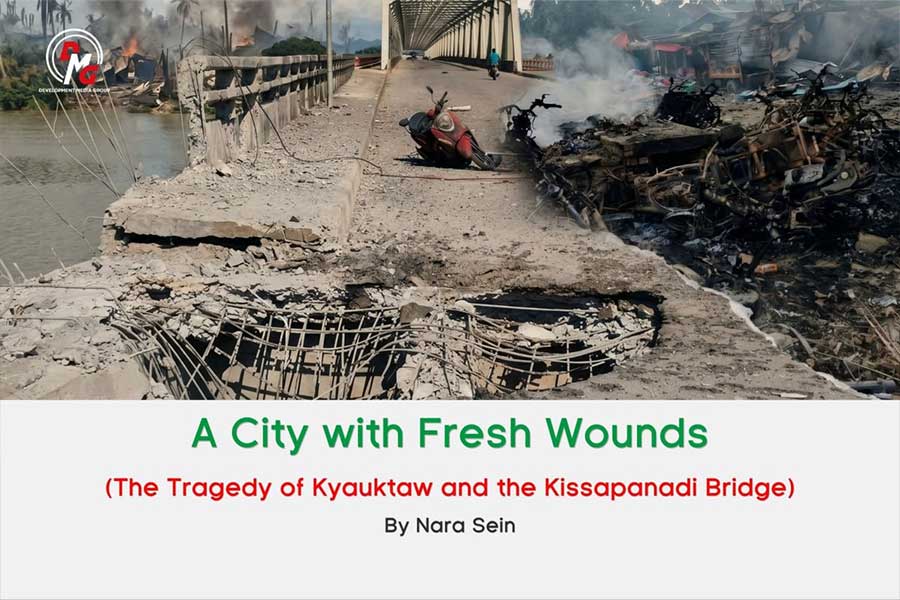
A City with Fresh Wounds (The Tragedy of Kyauktaw and the Kissapanadi Bridge)
By Admin 01 Oct 2026

Arakan Army’s Gains and the Changing Geopolitics of Arakan
By Admin 29 Sep 2026

Beyond Military Victory: What Is Myanmar’s Ultimate Political Objective?
By Admin 26 Sep 2026
UN at a Crossroads: Six Priorities for a Shared Future
By Admin 23 Sep 2026
POLITICS

BUSINESS
Industry to manufacture finished goods from coconut starting in early 2020
By Aung Kaung Zaw 20 Nov 2019