
- 92 groups urge Canada to expand sanctions on Myanmar oil and gas sector
- Junta bombing of Ponnagyun IDP shelter injures three civilians
- UN investigators seek evidence on deadly Kyauktaw airstrike as attacks continue across Arakan
- Myanmar military continues airstrikes across Arakan after deadly Kyauktaw attack
- ISP-Myanmar reports at least 115 mass civilian killing incidents across Myanmar
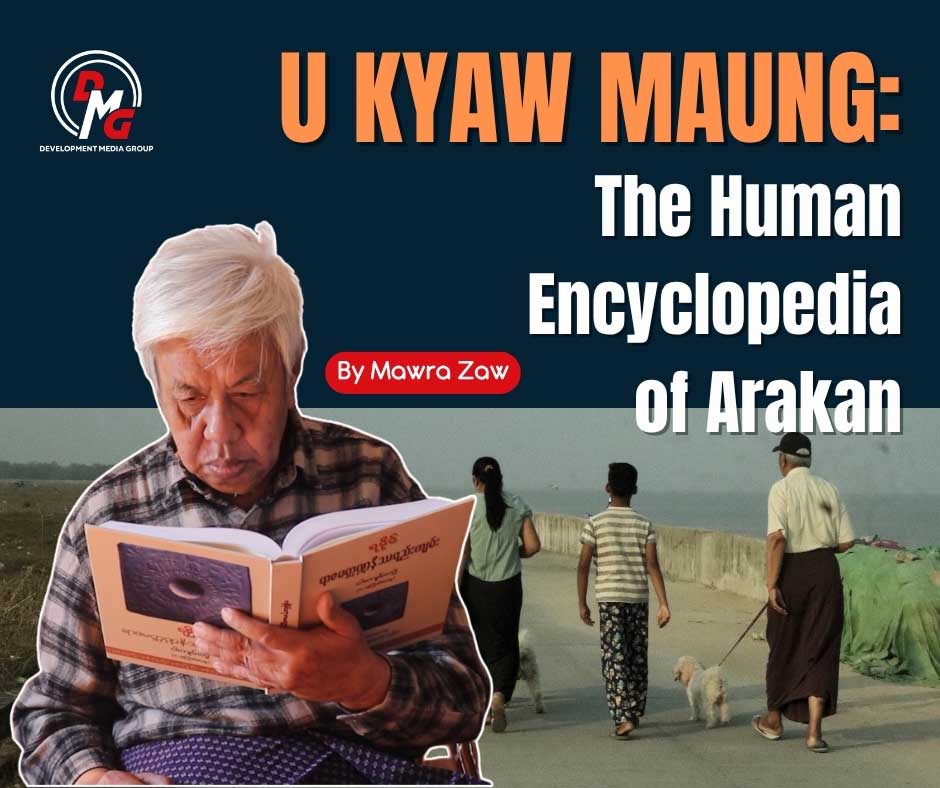
U Kyaw Maung: The Human Encyclopedia of Arakan
Although U Kyaw Maung is no longer with us, his books, ideas, and countless acts of quiet generosity remain. They continue to guide students, researchers, writers, and all those who seek to understand Arakan's past and imagine its future.
04 Jul 2026
By Mawra Zaw
When people admire the beauty of a flower, they seldom think about the roots buried deep beneath the soil that made it bloom. Likewise, when people marvel at the architecture of a building, few ever notice the unseen foundation supporting it from below.
The same is true in society. While people often admire those who stand prominently at the forefront, they rarely notice those who quietly dedicate themselves behind the scenes, supporting others with humility and integrity.
One such person was U Kyaw Maung.
Known and respected throughout Sittwe, U Kyaw Maung was a tall, broad-shouldered elderly teacher with a commanding presence and a head of white hair. He was a familiar face at literary, cultural, historical, and community events. Even in his later years, walking with a cane and wearing a back support belt, he continued attending gatherings devoted to Arakan's history and culture.
In truth, U Kyaw Maung was simply a retired schoolteacher.
Yet he possessed extraordinary knowledge, unwavering integrity, and a profound love for his homeland and people. Rather than seeking recognition, he chose to live quietly, like the unseen roots that nourish a tree or the hidden foundation that supports a building—indispensable, yet rarely noticed.
Born on June 5, 1950, in Lan Thit Ward, Sittwe, Arakan (Rakhine State), western Myanmar, during the monsoon season, he was the third son of U Pho Tha and Daw Tha Mya Oo. Because of his father's government service, the family moved frequently during his childhood, and he received his education in both Buthidaung and Sittwe.
From an early age, he developed an insatiable love of reading. Alongside literature, he cultivated a deep appreciation for Arakanese history, traditions, and culture. He also believed that mastery of English would become an important gateway for Arakanese youth to engage with the wider world, and he devoted himself to studying the language.
After completing high school, the young man from Sittwe chose the modest profession of teaching. Convinced that education was essential to the development of his homeland, he enrolled at Yankin Education College, where he trained as a teacher before returning to serve in Arakan.
His first posting took him to the remote Daletchaung region.
While teaching there, he witnessed authorities collecting large quantities of royal thazin orchid bulbs to be presented as gifts. The practice deeply troubled him, as he recognized both the ecological and cultural significance of the flower.
Rather than encouraging the harvesting of genuine thazin bulbs, he advised local villagers to collect another similar species known locally as thazin-yauk-ma. From that moment onward, he resolved to help preserve Arakan's royal thazin orchid for future generations.
In 2007, he fulfilled that vision by creating a large thazin garden at his own home.
His interests extended beyond orchids. He also collected and bred rare ornamental fish, becoming one of the pioneers of ornamental fishkeeping in Sittwe. His compassion extended to animals as well, especially dogs. He often remarked:
"We Arakanese should never treat dogs as though they belong to no one."
That simple statement reflected the kindness that defined his character.
In 1973, he married Daw Thaung Sein, a fellow middle-school teacher. Together they raised three children.
Although supporting a family on a teacher's salary was never easy, he never complained. Instead, he remained cheerful among his students while spending nearly all of his free time reading.
He collected books relentlessly, researched Arakanese history and culture, and frequently exchanged ideas with his close friend U Aung Hla Thein, a writer and historian.
After earning his Bachelor of Education degree in 1980, he became a high-school teacher. He served in Pauktaw, Mrauk-U, Middle School No. 3 in Sittwe, and eventually Basic Education High School No. 5 in Sittwe until his retirement.
Throughout his teaching career, he devoted himself not only to classroom instruction but also to gathering educational materials and expanding his own knowledge for the benefit of his students.
Most teachers possess expertise in the subjects they teach.
U Kyaw Maung was different.
Beyond English, he possessed remarkable knowledge of history, literature, culture, politics, geography, technology, and countless other fields. Students frequently challenged him with unexpected questions simply to test the limits of his knowledge.
Even when he did not know every detail, he could always recommend the right book or source.
It was for this reason that generations of students affectionately nicknamed him the "Human Encyclopedia" and the "Encyclopedia of Arakan."
As an English teacher, he valued integrity above financial reward.
He often reminded his students:
"Our English pronunciation still carries the smell of ngapi. Listen to native speakers on the BBC and VOA. Read Newsweek and Time magazine."
He believed genuine language ability came from listening to native speakers and reading original English texts rather than translations, which he felt often distorted an author's intended meaning.
His goal was not merely to teach English, but to open the doors of world literature to his students.
Unlike many teachers who relied mainly on stories and anecdotes, U Kyaw Maung encouraged critical thinking about politics, geopolitics, and international affairs.
Even when computers were still rare in Sittwe, he bought computer magazines and taught himself the technology. By around 2000 he was already proficient in using computers, and even before 2008 he had become an active internet user.
Together with his former student and colleague U Thein Tun Aye, he established the "Gate Way" English and Computer Training Centre at Maha Kusala Monastery in Sittwe.
At a time when computer literacy was almost nonexistent in the city, many of his students went on to become professional computer specialists.
His foresight helped prepare an entire generation of young Arakanese for the digital age.
After mastering computers and the internet, he devoted countless hours to expanding his lifelong collection of books, historical records, and archival photographs.
He neither drank alcohol nor smoked, and he rarely spent time in tea shops. Instead, he visited internet cafés at least three times each week in search of rare books, historical documents, and photographs especially those related to Arakan and Sittwe.
Remarkably, despite decades spent reading, researching, and working on computers, he never suffered failing eyesight or required glasses, even until his death at the age of 76.
Following his retirement in 2002, he continued teaching English privately while devoting increasing time to research.
As internet access expanded, he used it to locate rare books, archival photographs, and historical documents from around the world. He also connected with international book-sharing communities and academic networks.
More importantly, he freely shared everything he discovered.
He regularly informed young people about international scholarship opportunities, helping many Arakanese students, who otherwise had little access to global educational information apply for overseas study.
He also made his personal collection of books, historical documents, and cultural materials freely available through social media and directly to students, researchers, and anyone eager to learn.
His generosity extended beyond Myanmar.
Students and researchers from countries including Egypt, Ukraine, and India contacted him for assistance, and he willingly helped them locate books and research materials. Many remained in touch with him for years, expressing their gratitude for his kindness.
Although deeply respected within literary and historical circles, U Kyaw Maung never sought public recognition.
He quietly contributed to numerous cultural initiatives, including the Arakan Literature and Culture Committee of Universities (Yangon) in 1979–80, the publication committee for the Mrauk-U Guidebook issued by the Arakan People's Council in 1988, and the Professor U San Tha Aung Centenary Magazine Committee.
He also supported efforts to nominate Mrauk-U as a UNESCO World Heritage Site and participated in initiatives to preserve its intangible cultural heritage.
Among the scholars he most admired were U San Tha Aung and U Oo Tha Tun, whose dedication to Arakanese history and culture profoundly influenced him.
Although deeply religious, he believed that practicing morality was more important than outward ritual.
"I already observe morality and keep the Five Precepts," he often told his children and students.
Nevertheless, he held profound reverence for Buddhism, particularly the Ri Tan Khar Buddha image of Mrauk-U, which he regarded as one of the finest examples of Arakanese bronze craftsmanship. He commissioned a replica for his own home and encouraged another to be installed at the dhammayon in Lanmadaw Taung Ward.
His devotion reflected both his Buddhist faith and his enduring love for Arakanese artistic heritage.
He loved Sittwe above all else.
He often told family and friends that, when death finally came, he wished to be cremated in his hometown, dressed entirely in white.
He patiently awaited the city's bicentennial celebration.
But history had other plans.
As war engulfed Arakan in 2023 and 2024, thousands fled Sittwe.
U Kyaw Maung was among them.
In April 2024, he reluctantly left behind the city he loved and the treasured thazin garden he had nurtured for years.
He never realized it would be his final farewell.
Although unable to attend Sittwe's 200th anniversary celebrations in person, he continued contributing from afar by providing historical documents and photographs to the organizing committee.
Even in exile, his thoughts remained with his homeland.
He believed Arakan would achieve full liberation by 2028, a conviction rooted in his lifelong study of Arakanese history, traditional prophecies, and the writings of earlier scholars.
His final contribution to the national cause was designing the emblem for Arakan's education system, carefully explaining the symbolism behind every element.
In 2025, however, serious illness overtook him.
Supported by family, students, and friends, he underwent surgery on November 18.
During his recovery, news arrived that the long-lost Yatra Bell, an important symbol of Arakanese history had finally been rediscovered.
The news lifted his spirits.
Despite his illness, he smiled with renewed hope, believing not only in his own recovery but also in the future of his homeland.
Yet death spares no one.
On March 25, 2026, at 9:55 p.m., while meditating upon the Ri Tan Khar Buddha image he so deeply revered, U Kyaw Maung passed away from colon cancer.
He was 76 years old.
His death came ten months after the passing of his beloved wife.
He never returned to Sittwe.
He never witnessed the liberation he had long believed would come.
Nor did he live to see the Vesali Lamp, the educational emblem he had designed for Arakanese children illuminate their future.
War denied him those final wishes.
On March 28, 2026, family members, friends, former students, and admirers gathered at Yayway Cemetery in Yangon to bid him farewell.
As dark smoke rose from the crematorium chimney, his physical journey came to an end.
Yet honoring his final wish, his ashes were carefully preserved so that one day they may be returned to the city he loved most.
U Kyaw Maung may have left this world, but he remains alive in the hearts of those whose lives he touched.
His guidance, humility, generosity, and lifelong dedication continue to inspire new generations.
The books, documents, photographs, and knowledge he painstakingly collected will remain an enduring legacy for Arakanese youth.
He may never have sought to lead from the front.
Instead, he chose to nourish others quietly, like the unseen roots that sustain a tree.
He became the foundation upon which countless others could build.
And in doing so, he truly earned the name by which so many remember him: The Human Encyclopedia of Arakan.
Epilogue
Not long ago, I stepped into the room where U Kyaw Maung had spent the final chapter of his life.
It measured roughly 13 feet by 19 feet. In one corner stood a golden walking cane. Beside it rested an aluminum walking frame that had helped him move during his final months. On one wall hung a portrait of him painted by Maung Maung Saw (Rakhine Nyunt Phu). At the head of the room was an image of the Ri Tan Khar Buddha, to whom he had devoted profound reverence throughout his life.
Near the foot of the room stood a computer, surrounded by shelves and stacks of books, research papers, historical records, and documents he had painstakingly collected over decades. The room was quiet. Yet everything inside it spoke of a life devoted to learning, preserving knowledge, and serving others.
These were the final companions of a man who dedicated his entire life to education, history, and the cultural heritage of Arakan.
Although U Kyaw Maung is no longer with us, his books, ideas, and countless acts of quiet generosity remain. They continue to guide students, researchers, writers, and all those who seek to understand Arakan's past and imagine its future.
Some people leave behind monuments of stone.
U Kyaw Maung left behind something far more enduring, a legacy of knowledge.
Writer's Note
This feature is based primarily on interviews with U Kyaw Maung's family members and several of his former students, including U Thein Tun Aye, Ko Aung Marm Oo, Ko Aung Myo Oo, and Ko Aung Shwe Oo.
No single article can fully capture the breadth of U Kyaw Maung's knowledge, generosity, and lifelong contributions to education, literature, history, and the preservation of Arakan's cultural heritage. If any important aspects of his life have unintentionally been omitted, the writer respectfully asks for the understanding and forgiveness of his family, students, friends, and all those who knew and admired him.

Opinion
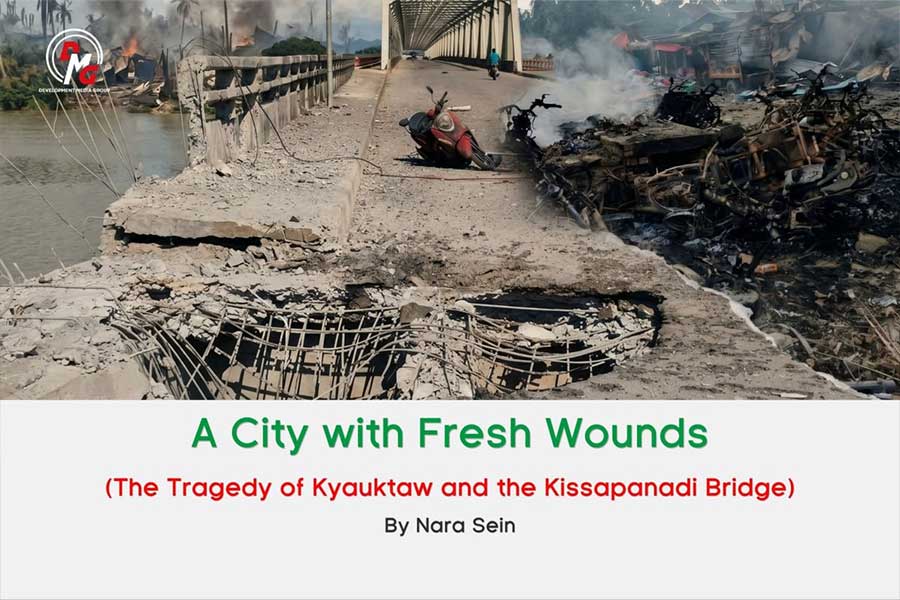
A City with Fresh Wounds (The Tragedy of Kyauktaw and the Kissapanadi Bridge)
By Admin 01 Oct 2026
Arakan Army’s Gains and the Changing Geopolitics of Arakan
By Admin 29 Sep 2026
Beyond Military Victory: What Is Myanmar’s Ultimate Political Objective?
By Admin 26 Sep 2026
UN at a Crossroads: Six Priorities for a Shared Future
By Admin 23 Sep 2026
.jpg)
How Can Myanmar’s Political Crisis Be Brought to an End?
By Admin 13 Sep 2026
POLITICS

BUSINESS
Industry to manufacture finished goods from coconut starting in early 2020
By Aung Kaung Zaw 20 Nov 2019