
- Magway records most airstrikes since new military chief took command: ISP-Myanmar
- Junta warship destroys two fishing boats, seizes another off Werathani
- Junta jet fighters drop 500-pound bombs on former junta battalions in Mrauk-U
- Junta deploys fighter jets to bomb Ponnagyun
- Rathedaung villagers set up night watches amid Sittwe clashes, ARSA threat
"A Zero Tolerance Policy on Sexual Violence Must Be Adopted"
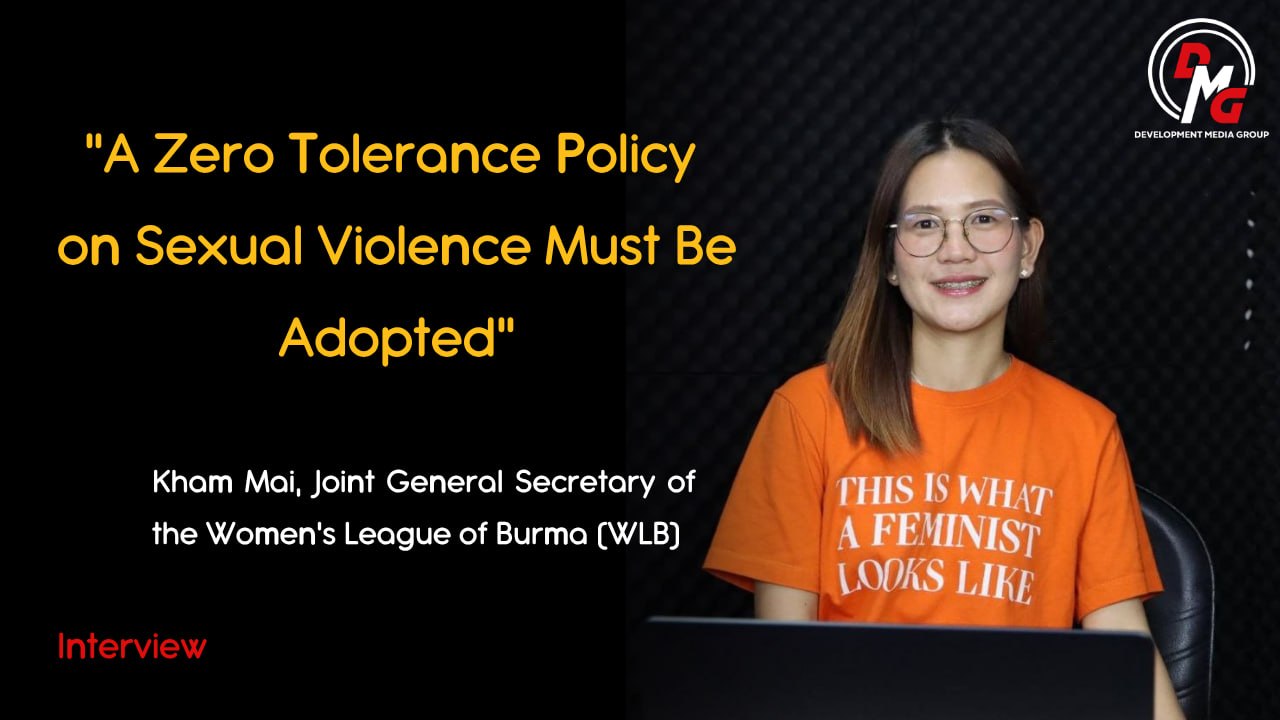
To discuss how sexual violence against women should be addressed, the weaknesses in existing accountability mechanisms, and the urgent protection measures needed for survivors, DMG spoke with Kham Mai, Joint General Secretary of the Women's League of Burma (WLB).
06 Aug 2026
DMG | Interview
Women in conflict-affected Myanmar continue to face sexual violence in many forms. Widespread impunity and limited access to justice have further heightened the security risks facing women and girls.
In Arakan State, reports of rape, sexual violence and the killing of women have become increasingly frequent, raising serious concerns about accountability and the effectiveness of legal action.
To discuss how sexual violence against women should be addressed, the weaknesses in existing accountability mechanisms, and the urgent protection measures needed for survivors, DMG spoke with Kham Mai, Joint General Secretary of the Women's League of Burma (WLB).
DMG: How serious has sexual violence against women become?
Kham Mai: Sexual violence against women across Myanmar has reached an extremely alarming level.
According to the Women's League of Burma's June 2025 briefing paper, Speaking Truth to Power: Ending Military Impunity in Burma/Myanmar, the organization documented 963 cases of conflict-related sexual violence (CRSV) during the four years since the 2021 military coup.
However, these figures represent only the cases that could be documented. Due to insecurity, restrictions on movement and communications, fear, and the lack of safe reporting mechanisms, we believe many more incidents remain undocumented.
These documented cases include gang rape, sexual torture, sexual slavery, human trafficking, forced marriage and other grave human rights violations.
DMG: To what extent are survivors able to obtain justice?
Kham Mai: For many years, WLB's reports have consistently identified impunity as the central obstacle to justice.
This issue was highlighted in WLB's 2018 report, Same Impunity, Same Patterns. Since the 2021 military coup, however, the situation has deteriorated even further.
Survivors often fear for their safety, face threats and intimidation, lack safe reporting mechanisms, and must navigate a collapsed justice system. As a result, obtaining justice has become extremely difficult.
WLB's 2025 report, Seeking Justice and Accountability, found that the vast majority of more than 550 documented cases of conflict-related sexual violence (CRSV), sexual and gender-based violence (SGBV), and gender-based violence (GBV) recorded between 2021 and 2025 have yet to receive justice.
For this reason, WLB is not relying solely on domestic justice mechanisms. We continue to work with the International Criminal Court (ICC), the Independent Investigative Mechanism for Myanmar (IIMM) and relevant United Nations mechanisms to promote accountability.
DMG: What is your assessment of the reported increase in sexual violence in Arakan?
Kham Mai: First of all, in any conflict-affected area, women and girls generally face an increased risk of sexual violence.
In Arakan State, intensified conflict, mass displacement, weakened rule of law, and the breakdown of essential public services and protection mechanisms have all increased the security risks faced by women.
Most importantly, regardless of who commits these crimes, sexual violence constitutes a grave violation of human rights and is completely unacceptable. Every perpetrator must be held accountable.
DMG: Why do you think accountability for violence against women remains weak?
Kham Mai: The primary weakness, in my view, is the persistence of impunity.
Several factors contribute to weak accountability:
- Investigations are often neither timely nor independent.
- Mechanisms for holding perpetrators accountable remain inadequate.
- Survivors often lack adequate protection.
- Victims and witnesses face intimidation, making them afraid to report crimes.
- Weak judicial systems prevent cases from being fully investigated and prosecuted.
Whenever sexual violence occurs regardless of which organization is involved, it is essential to ensure independent and credible investigations, accountability for perpetrators, and a survivor-centred response.
DMG: How do you think the Arakan Army (AA) should address these issues?
Kham Mai: WLB's position is very clear.
Regardless of which armed group commits these crimes, sexual violence is unacceptable.
Therefore, all armed organizations, including the Arakan Army (AA), should:
- Adopt a zero tolerance policy toward sexual violence.
- Conduct independent and impartial investigations whenever allegations arise.
- Ensure that perpetrators are held accountable under the law, regardless of their rank or position.
- Protect survivors' safety, dignity and confidentiality while applying a survivor-centred approach.
- Regularly provide members of armed groups with training on international humanitarian law, human rights and women's rights to help prevent future violations.
WLB applies these principles equally to the Myanmar military, ethnic revolutionary organizations and all other armed groups.
DMG: What kinds of protection should be provided to survivors?
Kham Mai: First and foremost, assistance must be provided through a survivor-centred approach.
The first priority is to ensure survivors' safety. Where necessary, they should be relocated to safe locations and provided with emergency protection.
Second, survivors must have timely access to medical care, psychological counselling and psychosocial support. The consequences of sexual violence are not only physical—they often have profound and long-lasting psychological and social impacts as well.
Third, survivors need economic and livelihood support to rebuild their lives. This includes vocational training, livelihood opportunities and assistance to help them regain financial independence.
At the same time, communities must refrain from blaming or stigmatizing survivors. Instead, they should respect survivors' dignity, believe those who come forward, and support them throughout the recovery process.
WLB and its member organizations continue to implement this survivor-centred approach by providing protection, healthcare, psychosocial support, legal referrals, livelihood assistance, and advocacy for justice through international accountability mechanisms.
DMG: Thank you very much for sharing your views.

Opinion
.jpg)
How Can Myanmar’s Political Crisis Be Brought to an End?
By Admin 13 Sep 2026
By Cutting Trees, We Are Killing Ourselves
By Admin 06 Sep 2026
A Modern August We Must Never Forget
By Admin 31 Aug 2026
Arakan’s Political Shifts and the Debate Over Rights and Governance
By Admin 27 Aug 2026
Securing Rights for Bangladesh's Indigenous Peoples is Indispensable
By Admin 09 Aug 2026
POLITICS
BUSINESS
Industry to manufacture finished goods from coconut starting in early 2020
By Aung Kaung Zaw 20 Nov 2019