

- Kyauktaw market closure disrupts trade and drives up prices across Arakan
- Arakan has Myanmar’s highest multidimensional poverty, 1.66 million affected: UNDP
- Arakan records most armed incidents, second-highest civilian casualty toll in Myanmar: NLTA
- Junta fails to regain territory despite major Arakan offensive: ISP-Myanmar
- Two Myebon fishermen missing after junta troops throw fishermen into sea
Arakan Lottery ticket markups raise calls for stricter oversight
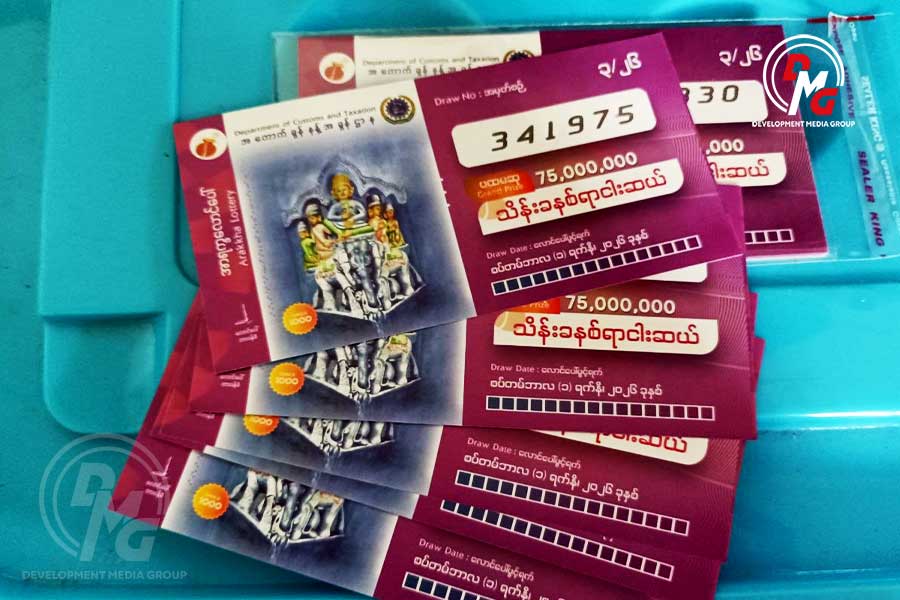
As demand grows for the Arakan Lottery (Laung Paw) issued by the United League of Arakan (ULA) across Arakan State, local residents report that unauthorized resellers are illegally marking up ticket prices.
25 Aug 2026
DMG Newsroom
25 August 2026, Mrauk-U
As demand grows for the Arakan Lottery (Laung Paw) issued by the United League of Arakan (ULA) across Arakan State, local residents report that unauthorized resellers are illegally marking up ticket prices.
Tickets are sold directly by the ULA Taxation Department, while bulk buyers purchase thousands or tens of thousands of tickets at a time and resell them at inflated prices in rural areas.
"We know they are marking up the price. We have to pay up to K15,000 for 10 tickets. But it still costs less than traveling to town ourselves," said a woman in Kyauktaw Township.
The official price of an Arakan Lottery ticket is K1,000. However, tickets are currently being sold for between K1,200 and K1,500 each in rural areas.
As a result, monthly ticket quotas sell out by mid-month, leaving buyers unable to purchase tickets through official taxation offices.
"If we can't go ourselves, we sometimes pay travel expenses for someone else to buy them. We know they cost K1,000 in town, but since we can't travel, we pay higher prices to resellers. Since this is government-issued, it would be better if they enabled villagers to buy tickets at K1,000 each," said a woman in Mrauk-U Township.
Lottery players noted that tickets for the third Arakan Lottery draw, scheduled for September 1, had completely sold out by mid-August.
Currently, the Arakan Lottery is officially sold at fixed prices only through taxation offices, with no authorized dealership system yet established.
Meanwhile, rural residents eager to enter the lottery remain unable to travel to urban areas and continue purchasing marked-up tickets from mobile vendors.
In many rural communities, convenient and direct access to the Arakan Lottery remains limited.
Residents emphasized that the ULA should establish a systematic sales mechanism and formally authorize dealerships.
"Everyone wants to try their luck and support the initiative. When we ask people in town to buy for us, they say long lines are required. Tickets don't reach our villages either. It is unclear how sales are being managed," said Daw Khin Mar from Rathedaung Township.
The ULA officially launched the Arakan Lottery in June and recently increased the prize money, setting the top prize at K75 million.
Fifty percent of Arakan Lottery revenues are allocated for prize payouts, while the remaining 50 percent is earmarked for local development projects.

Top News
Man sentenced to death for rape and murder of nine-year-old girl in Anjanapura
By Admin 10 Oct 2026

Junta troops suffer heavy casualties in failed landings on AA-held Ngapyi Island
By Admin 10 Oct 2026
Kyauktaw market closure disrupts trade and drives up prices across Arakan
By Admin 10 Oct 2026
Arakan has Myanmar’s highest multidimensional poverty, 1.66 million affected: UNDP
By Admin 10 Oct 2026