

- Nay Pyi Taw talks between junta, MNDAA halt over special region demand
- Arakanese civilians face widespread violence, humanitarian aid blockades, UN mechanism warns
- India-Arakan trade route reopens after eight-day closure
- Clashes intensify along Sittwe-Ponnagyun border as Arakan Army captures military outposts
- Heavy fighting erupts in Laymyethna as junta launches offensive against Arakan Army-held territory
Arakan’s Breathing Space (or) Mizoram–Arakan Trade and Business
Today, in India–Arakan border trade, imports from India flow into Arakan, but Arakan products are still not allowed to be exported. Because Arakan’s products, rice, seafood, and salt directly match Mizoram’s needs, observers say the ULA administration should work to export Arakan goods to Mizoram and India.
25 Feb 2026
Written by Aung Than
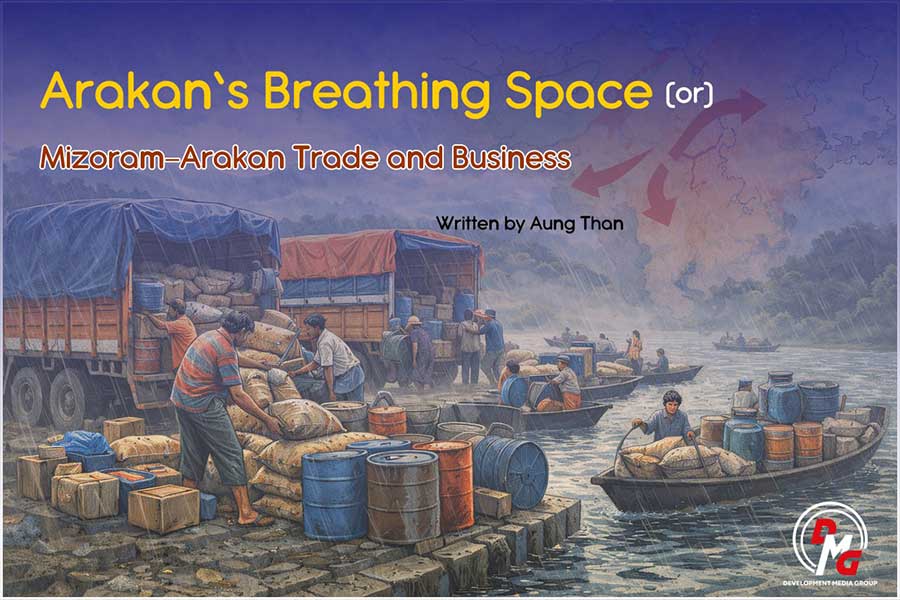
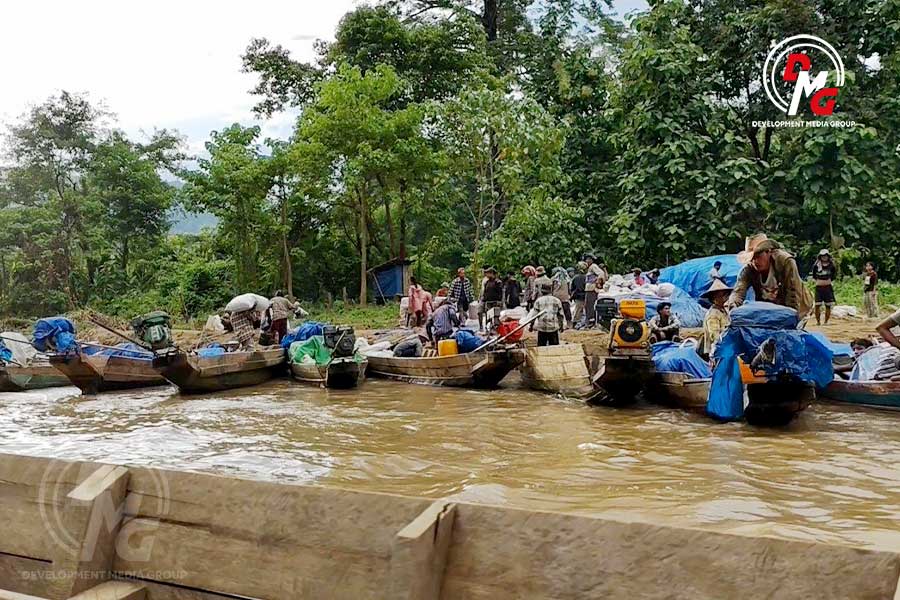
On a rainy October afternoon, the sounds of Arakanese and Mizo languages filled the air along the India–Myanmar highway. More than 50 men and women in colorful raincoats were hurriedly transferring goods from trucks parked by the roadside onto motorboats waiting in a stream below the road, near the Lawngtlai highway.
Among the cargo were packages that could not be exposed to water, covered with rain sheets and tarpaulins, along with waterproof construction materials and hundreds of barrels of fuel.
This place is the jetty of Zochachhuah village on the Indian side of the Myanmar–India border (known in Arakan as Ta Puk Chai village). The village sits at the mouth of Doe Creek, a tributary of the Kaladan River, and functions as a border hub.
In October 2025, DMG spent weeks in Mizoram on an assignment and had an opportunity to closely observe and ask about trade conditions from India’s Mizoram State into Arakan, as well as local social dynamics and travel-related services.
The Start of a New Mizoram–Arakan Trade Route
After the Three Brotherhood Alliance launched Operation 1027 in northern Shan State in November 2023, the Arakan Army (AA) began coordinated offensives in Arakan on November 13, 2023.
Using the fighting as justification, the junta completely blocked trade routes and communication lines into Arakan. In response, the AA quickly intensified its offensive in the Paletwa area of Chin State adjacent to India securing control of all of Paletwa Township by January 2024.
In February, the AA also seized Kyauktaw, Mrauk-U, and Minbya in northern Arakan. As the conflict escalated, the need for essential commodities and medicines critical for Arakan civilians rose sharply.
As a result, in late February 2024, Mizoram legislators and several AA officials reportedly met at a location along the India–Paletwa border to discuss the Kaladan route and broader cross-border engagement.
Following these discussions, AA sources said there was an agreement on humanitarian grounds to open supply routes for urgently needed basic goods and medicines for Arakan.
From early April 2024 onward, a new trade corridor from Lawngtlai in Mizoram through Paletwa began to come to life.
Frictions Along the Route
This new route has not been consistently smooth not because of the terrain, but because it is tied to shifting conditions on the ground related to the Chin and Arakan revolutionary conflicts.
In May, June, and July 2024, there were at least two instances when imports through Lawngtlai District were blocked reportedly as a way to pressure the AA over its military assistance to Chin Brotherhood (CB) forces.
In December 2025, trade was also temporarily suspended for three weeks due to a severe diarrhea outbreak in the border areas, as authorities on both sides sought to contain the spread.
Most recently, after an Indian truck driver died in Shin Let Wa village, Paletwa Township, on February 12, the Lawngtlai and Saiha districts closed border trade routes beginning February 14. The Saiha route reopened on February 17, and the Lawngtlai route reopened on February 20.
Mizoram’s Net Gains From the Corridor
There is no question that access to Mizoram trade has significantly helped Arakan obtain food, medicine, and fuel an essential lifeline for Arakan civilians and the resistance administration.
At the same time, for Mizoram often described as India’s second-poorest state gaining access to trade with Arakan has quickly generated income and local economic benefits.
India has 28 states and 8 union territories, a total of 36 administrative units. According to Economy of India website data for FY 2023–2024, Mizoram’s GDP was 355.76 billion rupees, making it the second-poorest state in India. Only the Andaman and Nicobar Islands, with a GDP of 117 billion rupees, ranked lower.
For a state in this position, the ability to export goods to the Arakan market has produced tangible benefits for local business owners and ordinary workers.
In FY 2024–2025, Mizoram’s GDP reportedly rose to 480.38 billion rupees about a 22% increase compared with FY 2023–2024 according to an announcement by the Mizoram Finance Department.
Traders in Lawngtlai and Saiha, who previously sold goods worth only tens of thousands to just over one hundred thousand rupees per day, say their business surged after trade with Arakan expanded.
Local merchants told DMG that a single shop in Lawngtlai now often earns at least 500,000 rupees per day (around 25 million kyats), and in some cases 2 million rupees or more (around 100 million kyats).
One grocery seller in Lawngtlai explained: “Before, we only ordered supplies from mainland India to meet local needs. Our daily sales were usually tens of thousands of rupees—at most around 100,000. After trade with Arakan began, with orders from Arakan traders, some shops now sell at least 500,000 rupees a day, sometimes up to 2 million.”
Many residents who previously worked as basic drivers or hill farmers said they have benefited directly from increased labor demand along the trade route, raising their daily incomes.
Mizoram’s per-capita monthly income also increased from over 23,834 rupees in 2024 to 30,794 rupees in 2025, according to state GDP figures.
Economy of India data also indicates that Mizoram’s income is composed of 55% services, 27% industry/handicrafts, and 18% agriculture. This suggests that income growth has been driven largely by the expanding service economy, including logistics and transport.
On the ground, truck drivers told DMG their monthly income ranges from 200,000 rupees (about 10 million kyats) to 300,000 rupees (about 15 million kyats). Trucks that were previously idle are now working daily.
Even a basic porter working at the jetty loading and unloading cargocan earn 50,000 to 100,000 rupees per month (around 2.5–5 million kyats), according to workers there.
A 30-year-old labor leader from Ta Puk Chai village in Lawngtlai District said: “Before, our border villages were quiet and poor. Since trade with Arakan started, the border has become lively. Villagers have found new job opportunities and better income. Daily-wage workers earn more from loading and unloading; drivers and food shops are also making more.”
Some locals even compared these earnings to nearly double the basic salary of government staff in India, and comparable to higher-level salaries.
Mizoram residents both rural and urban say profits are rising day by day through transport services, cargo handling, and currency exchange.
In addition, more than 50 patients per day reportedly travel from Arakan to Mizoram for medical treatment, especially to private hospitals and clinics in Aizawl. DMG observed that local Mizo patients and Arakan patients were being treated in roughly equal proportions in some facilities.
In the health sector, new job opportunities have emerged for young people providing interpretation services to Arakan patients. DMG learned that a Mizo interpreter can earn an average of 5,000 rupees or more per day. Interpreters, Mizoram residents who speak Burmese or Arakan, as well as displaced Mizo people from the Kalay area help bridge communication between doctors and patients.
Hotel and guesthouse owners also reported that their income has nearly doubled. One hotel owner in Aizawl said: “Trader and traveler arrivals have increased significantly in Mizoram. The hotel and guesthouse sector, in particular, is earning more. Traders stay daily, and people who come for treatment sometimes rent rooms for weeks.”
In Lawngtlai, where many Arakan traders base themselves hotels often require bookings at least two days in advance, and rooms can be unavailable, forcing people to sleep wherever they can, Arakan traders said.
Although authorities on both sides have not officially published trade value figures, ten Arakan traders interviewed by DMG estimated that daily trade could be worth between 2 and 4 billion kyats. Converted to rupees, this would be roughly 40–80 million rupees per day representing substantial net export earnings for India and Mizoram.
Mizoram’s Geography
Mizoram is located in northeast India along the Myanmar and Bangladesh borders, sharing about 722 km (449 miles) of border with Myanmar and Bangladesh. The entire state is mountainous, and is home to various Chin-related ethnic groups, Mara, Lai, Mizo, Kuki, Zo, and others.
Aizawl is the state capital. Mizoram has 11 districts and 11 major towns, including Aizawl, Lunglei, Champhai, Saiha, Kolasib, Serchhip, Lawngtlai, Saitual, Khawzawl, and Hnahthial.
The two districts bordering Paletwa are Lawngtlai and Saiha both self-administered areas. Lawngtlai is largely inhabited by the Lai community, while Saiha is predominantly Mara.
Trade routes between Mizoram and Arakan can move quickly in the dry season but often slow down in the rainy season. Roads within India are generally good, but routes near the Paletwa border are rough.
Under India’s Kaladan project, an overland road has been built from Zorinpui in Mizoram to Satpi Zabin village in Paletwa Township. However, Paletwa-side roads remain in poor condition, limiting smooth travel. This route has been envisioned as a major Asian trade corridor, connecting Satpi Zabin onward to Paletwa and Kyauktaw.
Mizoram’s Needs and Arakan’s Untapped Exports
Because Mizoram is a mountainous state, it produces less than 10% of the rice it needs; the remaining 90% is imported from India’s Punjab and neighboring states, according to Economy of India data.
Fish, shrimp, and other seafood are reportedly ordered from Odisha and Mumbai and transported into Mizoram via Assam, local business owners said.
Punjab-Mizoram’s main rice supplier is about 3,300 km away by road, meaning deliveries can take nearly a week. By comparison, the road distance between Sittwe and Aizawl is about 1,030 km (640 miles) almost three times shorter than the Punjab–Mizoram route.
Similarly, Mumbai, where seafood is sourced, is about 3,264 km (2,027 miles) from Aizawl, more than three times the Sittwe–Aizawl distance. These long distances drive up transport costs and cause delays, Aizawl residents said.
Arakan traders importing from India argue that while exporting to Arakan benefits Mizoram’s businesspeople and transport sector, efforts should also be made to allow Arakan exports.
A 35-year-old trader, Ko Kyaw Zaw, said: “Mizoram–Arakan trade is a breathing space for Arakan people, but it’s also like we are feeding Mizoram’s businesspeople and drivers. As their side gets richer, our people are getting poorer.”
He added: “The biggest issue is that Arakan’s import value and export value are completely unbalanced. Mizoram is earning large export income, while Arakan’s export value is zero. If the Arakan administration could export Arakan products, rice, beans, seafood then Arakan’s economy would benefit greatly.”
In Aizawl, DMG found that a 50-kg sack of high-quality rice (similar to Myanmar’s Paw San Hmwe) sells for around 2,000 rupees (about 100,000 kyats), while lower-quality rice sells for around 1,500 rupees (about 75,000 kyats). These prices are nearly double rice prices in Arakan. If Arakan could select and export higher-quality rice, it could directly benefit farmers and the Arakan public administration.
Seafood, fish and shrimp is also very expensive and scarce in Mizoram. Due to the 2,000+ mile distance from Mumbai, transport costs are high; ordinary people can only afford seafood occasionally, and cheaper freshwater farmed fish is more commonly eaten.
Arakan traders argue that if Arakan could export seafood to Mizoram at a reasonable price, it could boost Arakan’s fisheries sector and increase foreign currency earnings.
Overall, exporting key Arakan products, rice, beans, and seafood could directly strengthen foreign income and improve livelihoods across Arakan.
Arakan Should Push to Export
While Mizoram’s GDP and economic benefits have grown through trade access to Arakan, poverty in Arakan has continued to increase year by year. Arakan business circles say this highlights a direct imbalance in the economic relationship.
They also argue that being unable to sell Arakan’s domestic products to mainland regions or international markets and being forced to sell only within Arakan at low prices creates negative consequences for basic economic development.
As described above, if India and Mizoram are earning an estimated 12–24 billion rupees per month in export value from this corridor, while Arakan’s export income remains zero, then the relationship becomes a one-sided trade economy, Arakan businesspeople say.
In Arakan, agriculture, fisheries, and salt production have been continuously moving into loss since 2023, while input costs and fuel prices keep rising year by year, key drivers of economic decline.
A trader from the Mrauk-U area said: “Even if we can’t produce modern exports due to the war, India still needs basic food. If we can export those, imports and exports would become balanced and we could earn foreign income.”
Today, in India–Arakan border trade, imports from India flow into Arakan, but Arakan products are still not allowed to be exported.
Because Arakan’s products, rice, seafood, and salt directly match Mizoram’s needs, observers say the ULA administration should work to export Arakan goods to Mizoram and India.
A trader from Kyauktaw explained: “Each trip to Mizoram can involve at least 50 million kyats, and some traders bring in goods worth hundreds of millions or even billions. It depends on capital. For me, because I deal in construction materials, the value of this shipment is over 200 million kyats.”
He added that if Mizoram goods, medicines, and fuel can be imported to Arakan, then exporting Arakan products to Mizoram could create a win-win situation for both sides.
Beyond a purely “humanitarian corridor,” they argue that if India/Mizoram and the Arakan public administration could negotiate and sign a bilateral trade agreement (BTA) based on two-way imports and exports, it could become an entry point for Arakan’s economic recovery.
If the Arakan public administration can coordinate with Indian authorities to establish a reciprocal trade system, it would open new markets for farmers, fishers, and traders in Arakan supporting local development and livelihoods.

Top News
Nay Pyi Taw talks between junta, MNDAA halt over special region demand
By Admin 25 Sep 2026
India-Arakan trade route reopens after eight-day closure
By Admin 25 Sep 2026