
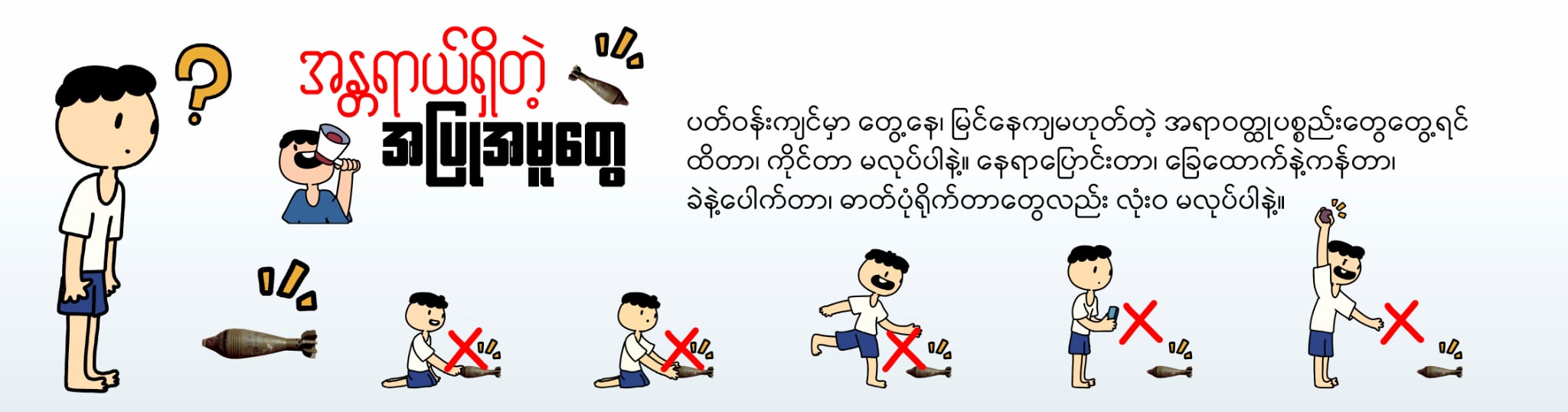

- ULA warns Arakan residents of airstrike risks during Thadingyut festival
- Months-long internet blackout drives up costs for residents of Thandwe and Gwa
- At least five injured in junta Y-12 airstrikes on Werathani villages
- Junta orders Sittwe residents to dismantle home bomb shelters
- Arakan records most armed incidents as 78 civilians killed across Myanmar: NLTA
How Can the Arakan Army Approach the Yunus Government?
As an initial step, it may be wise to use credible intermediaries-trusted political party representatives and civil society figures not directly affiliated with ULA (United League of Arakan)/AA-to open talks and create a channel to the Bangladesh government.
30 Dec 2025
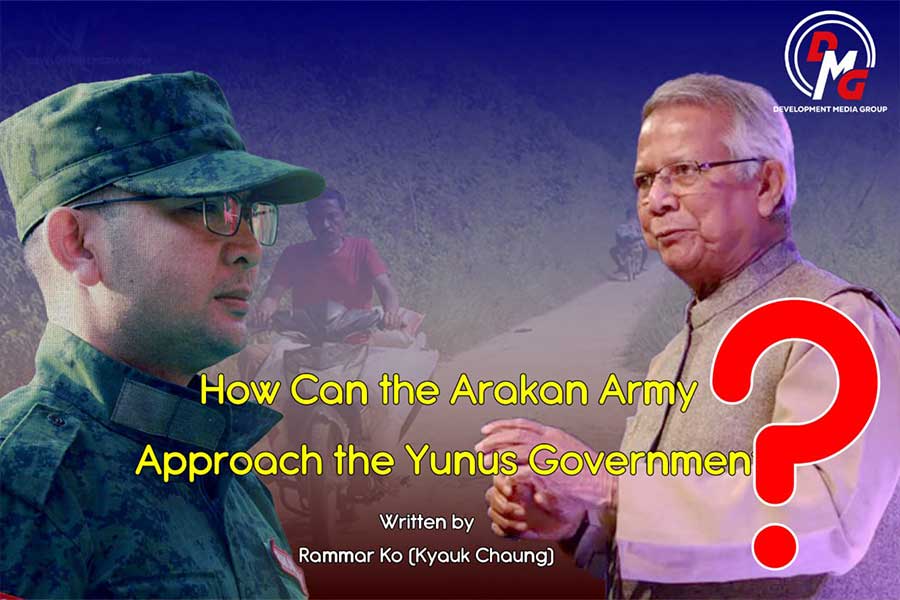
Written by Rammar Ko (Kyauk Chaung)
The Arakan Army (AA), which has captured and firmly taken control of the Bangladesh-Arakan border area, the Paletwa region, and 14 townships across Arakan, can be said to be in a tense relationship-at least for the time being-with the Bangladesh government led by Muhammad Yunus.
In reality, however, whether the goal is to find solutions to the refugee issue along the Arakan-Bangladesh border, or to address the current hardships facing Arakan's population through political, diplomatic, and humanitarian means, the AA and the Bangladesh government should build constructive relations and positive cooperation. Yet this "should-be" scenario faces many practical obstacles and serious challenges.
What Is the Yunus Government, and Where Is It Heading?
Muhammad Yunus is a Bangladeshi economist and senior academic who pioneered "microcredit." In 1983, he founded Grameen Bank and provided small loans to the poor without requiring collateral.
This system enabled people without financial resources to start small businesses and improve their livelihoods. For this, Yunus was hailed as someone who "lifts people out of misery," and he received the Nobel Peace Prize in 2006.
In politics, Yunus announced in 2011 that he would enter Bangladeshi politics by launching "Nagorik Shakti" (Citizen Power), but later declared that he would not continue in political activity.
Even today, available information suggests that he continues to work on social development, equality of opportunity, and humanitarian initiatives.
After Sheikh Hasina fell and Yunus became the head of an interim government, he-consistent with his Nobel Peace Prize profile-appears to have been seeking ways to address the Arakan border issue and the Muslim/Rohingya refugee issue. It is assumed that, as a first priority, he sought to use a UN- and US-led Arakan-Bangladesh humanitarian corridor to build relations with the AA and try to resolve the refugee question.
However, China is said to have used its influence to shape Bangladesh's military leadership and nationalist parties, pushing them to strongly oppose Yunus's efforts. In connection with this, Bangladesh's military chief reportedly even pressured for Yunus to be removed from office, forcing his plan to retreat.
After the AA seized and controlled the entire Buthidaung-Maungdaw border area, Bangladesh's government initially had tense relations with Myanmar's Naypyidaw military authorities, even recalling its ambassador. Later, the Chinese Communist Party engaged Bangladesh, and Bangladesh's military chief pressured the Yunus government to halt the Bangladesh-Arakan humanitarian corridor.
In the next stage, the Yunus government began to keep the AA at arm's length and-amid Myanmar's complex military and political conflicts-adopted an approach that squeezes the AA into a difficult position in order to force a solution to the refugee issue.
Pressures from Bangladesh on the AA
In Bangladesh, ethnic- and religion-based parties and organizations are increasingly pursuing the idea of turning the Buthidaung-Maungdaw area into a UN-backed "Save Zone," not only for refugees but also as part of addressing Bangladesh's own demographic pressures. This strategy is framed as advancing Bangladesh's national interests.
To implement this strategy, Bangladesh is portrayed as applying military, diplomatic, and political pressure on the AA.
Military pressure
Along the Arakan-Bangladesh border, armed groups such as ARSA (Arakan Rohingya Salvation Army), RSO (Rohingya Solidarity Organisation), and RDF (Rohingya Development Foundation) have reportedly become active in a synchronized way. On the diplomatic side, overseas Rohingya-issue advocacy groups such as BROUK (UK) and ARNC (Arakan Rohingya National Council), together with the Bangladesh government, appear to be mobilizing UN human rights mechanisms in parallel, timing their actions together.
The objective is to portray the AA as unable to maintain peace in Buthidaung-Maungdaw or manage the "Muslim/Rohingya issue," thereby pressuring the UN to designate a Save Zone. At Cox's Bazar refugee camps, synchronized calls reportedly emerged demanding R2P. At the UN's 80th anniversary assembly, the Yunus government also called for the international community to pressure the AA.
Yunus's government called on the international community not only to increase new funding for humanitarian assistance, but also to urgently pressure "a non-state actor" inside Arakan for political change and "positive transformation." The "non-state actor" referenced is the AA.
The Diplomat cited an Indian government official as saying that Dhaka's plan involves coordinating with Myanmar's authorities and systematically arming and training Muslim armed groups to fight the AA. If the AA is forced into a two-front conflict, it could be pushed into a corner. By doing so, Bangladesh hopes to reach a point where the AA has no choice but to agree to a "safe zone" arrangement in Maungdaw. The Indian official said Bangladesh's leadership has repeatedly discussed this with Myanmar's military authorities.
Reports from Fortify Rights and the International Crisis Group are cited as supporting this claim. Moreover, the fact that Bangladesh and Myanmar's military authorities have recently maintained a workable diplomatic relationship is presented as further reinforcing that account.
This is framed as Bangladesh applying military and diplomatic pressure as part of a broader strategy.
Political pressure
Politically, Bangladesh has recently moved to block the import of medicine, consumer goods, and food supplies into Arakan.
Given Arakan's current situation, it relies heavily on Bangladesh and India for the import of medicines and goods. Therefore, Bangladesh's Border Guard (BGB) restricting cross-border trade is portrayed as a form of pressure.
Another method described is a BGB official accusing the AA of being a drug-trafficking organization. Such accusations can seriously damage the AA's image. An Arakanese person living in Malaysia said Malaysian police questioned them after hearing drug-related allegations and claims linking their organization to the AA, and they had to explain at length.
These synchronized accusations by Myanmar's military authorities and Bangladesh's BGB are thus portrayed as follow-on pressure tactics that weaken the AA's political and revolutionary image.
Based on the information above, these are presented as concrete signs that Bangladesh is applying various pressures on the AA, coordinating with Myanmar's military authorities, and attempting to exploit the border refugee issue for advantage.
Just as Myanmar's military authorities have cut off and blockaded Arakan's population into hardship, the actions by Bangladesh's BGB are also described as a form of political pressure. China's communist government is also said to have demonstrated similar pressure tactics against revolutionary forces along northern Shan State's border-suggesting this kind of external leverage is not unprecedented.
How Should the Yunus Government Be Approached?
In an interview with The Irrawaddy on "the state of relations with Bangladesh," AA Commander-in-Chief Major General Twan Mrat Naing said they once believed relations could be good because there were shared interests in cooperating on refugee matters, and that through this cooperation they could build a practical working relationship. However, he said Bangladesh shifted toward a coercive, pressure-based approach to implement those policies.
What Bangladesh should do instead, he argued, is work with the AA to build real "empowerment"-because if refugees are accepted, conditions must be created for refugees' livelihoods and survival. He added that the AA is trying to get Bangladesh to reconsider and return to a constructive approach rather than pressure.
It is also suggested that Yunus's government and the AA initially tried to work constructively on border and refugee issues-particularly during the period when senior UN figures, some senior US military officials, and other responsible parties visited Bangladesh in relation to establishing a humanitarian corridor.
After that, the Chinese Communist Party engaged Bangladesh. Although China is described as having never provided humanitarian assistance to Myanmar refugees fleeing conflict, it donated humanitarian funds for Muslim refugees and met with the Jamaat-e-Islami Party on April 17. Following that, voices from Jamaat-e-Islami reportedly emerged calling for northern Arakan's Buthidaung-Maungdaw area to be designated as a Rohingya state.
The CCP also met with Bangladesh's military chief, and soon afterward pressure on Yunus's government increased. In August, Bangladesh's army chief, Waker-uz-Zaman, again met the CCP. Bangladesh's military leadership reportedly blocked Yunus's Bangladesh-Arakan humanitarian corridor plan, citing sovereignty and regional security concerns, and applied intense pressure to stop it.
Since then, Bangladesh is portrayed as increasingly adopting a strategy of pressuring and maneuvering the AA.
Even so, the AA is urged to avoid escalating tensions and instead remain patient, prioritizing a workable relationship with the Dhaka government through all possible means.
What the AA Should Try to Do
At present, even if relations with Bangladesh's Border Guard (BGB) are tense, the AA should adopt a constructive approach to the Yunus government and develop a diplomatic grand strategy-patiently and persistently exploring multiple ways to build improved relations.
Tense relations with Bangladesh are extremely dangerous for Arakan.
A direct communication channel-direct contact and direct dialogue-with responsible officials in Yunus's government must be established. How exactly to achieve this is for responsible actors to consider.
As an initial step, it may be wise to use credible intermediaries-trusted political party representatives and civil society figures not directly affiliated with ULA (United League of Arakan)/AA-to open talks and create a channel to the Bangladesh government.
For example, public representatives such as Daw Htoot May and U Pe Than could serve as intermediaries. If possible, including trusted leaders from Muslim civil society organizations could also help identify a workable pathway for dialogue with the Dhaka government.
Statements and messaging about the Yunus government should use diplomatic language-open-door communication that is not overly harsh-while using media strategically to demonstrate a constructive approach.
Diplomatic words can even stop wars. Therefore, it is crucial that AA leaders possess strong diplomatic skills.
It is unclear whether the AA has a special envoy team dedicated to relations with Dhaka. Yunus is a Nobel laureate. If the AA can clearly present practical policies and constructive positions for resolving the refugee issue-and publicize these internationally-it may weaken the Yunus government's one-sided pressure strategy.
Regarding mutual accusations with the BGB, the AA should not respond only with words; it must present evidence and ensure it becomes known internationally. Breaking through to the global media arena is also essential.
Global Arakan Network has released video and photographic evidence showing militant groups conducting military training near BGB outpost areas. With similar data, it will be necessary to reach major global news organizations-inviting foreign journalists, and also inviting independent domestic media-to show realities on the ground.
Even if the AA holds public legitimacy inside Arakan, in Bangladesh's view it is still seen as an armed insurgent force that has won battles. In attempting to engage a sovereign state like Bangladesh, the AA should take the first step diplomatically by going to meet and hold talks with Bangladesh. Bangladesh is unlikely to come to the AA-but the AA can go to Bangladesh. This is because Bangladesh considers itself a sovereign state and views the AA primarily as an armed group.
Another point: the AA should compile sentiment surveys and evidence from Muslim communities living peacefully under AA administration, and from Muslims serving within AA-administered departments, to help create a dialogue pathway with the Yunus government.
Winning genuine support from local Muslim communities is a major strategic asset for the AA, and it should demonstrate real-not superficial-care and attention.
Overseas Rohingya-issue advocacy communities not only receive global attention but also have advantages in the international media arena. To counter that, the AA should invite international media into Arakan. It should also compile and present research-based evidence of links between some BGB personnel and armed groups such as ARSA and RSO, and ensure this reaches global media.
Only then can the world hear the AA's voice-its policies and positions-as well as the voice, wishes, and views of the people of Rakhine.
By presenting facts and evidence diplomatically to the Yunus government, it may also be possible to apply counter-pressure: that border issues require constructive cooperation between Dhaka and the AA.
Conclusion
Allegations and narratives advanced by overseas Rohingya advocacy groups such as BROUK (UK) and ARNC, as well as accusations tied to incidents such as the "Htan Shaung Khan village case"-including claims by rights-monitoring organizations like Fortify Rights that Muslims (using the term "Rohingya") in AA-controlled areas were severely abused and killed-have harmed the AA's political and revolutionary image.
There were campaigns calling for the ICJ to issue warrants targeting AA leaders. Muslims in Cox's Bazar refugee camps also protested against AA leaders.
As a result, international suspicion of the AA increased, and pressure grew even within UN human rights mechanisms for investigations.
Although the AA was able to respond to the Htan Shaung Khan issue to some extent using testimonies from villagers and prisoners of war linked to the SAC, overseas Rohingya advocacy groups continue to maintain those allegations.
Tom Andrews noted in his October UN report that the AA Commander-in-Chief invited the UN Special Rapporteur to come and investigate the Htan Shaung Khan village allegations.
If pathways are opened so UN agencies and international journalists can enter and travel within AA-controlled territory, the AA could gain many benefits.
For this to happen, the AA must demonstrate-in practical reality-genuine commitment (not token gestures) toward Muslim communities that are trying to coexist peacefully under AA administration.
It is also necessary to take credible action against Arakan troops who have committed human rights violations.
By striving to implement these steps, and by leveraging pressure and momentum from the UN and international media to approach Bangladesh's Yunus government, the AA may be able to build constructive cooperation on the refugee issue-and thereby increase the chances of a positive turning point for Arakan's future. This is the assessment presented here.

Opinion
Can the UN Restore Trust in a Fractured World?
By Admin 23 Oct 2026
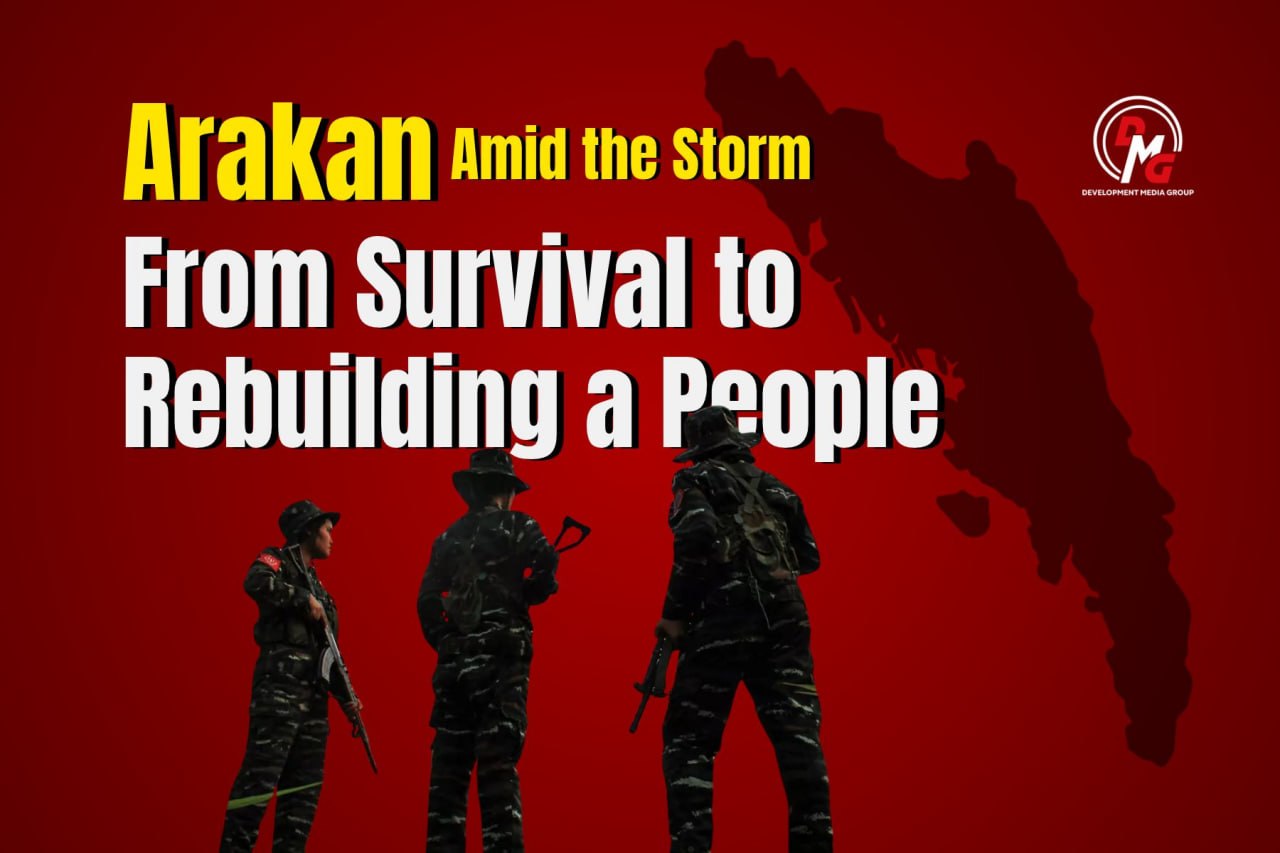
Arakan Amid the Storm: From Survival to Rebuilding a People
By Admin 22 Oct 2026
Surviving Amid the Bombs: Arakan's Quiet Resistance
By Admin 19 Oct 2026

Shadows Over Childhood: Confronting the Reality of Missing Children
By Admin 16 Oct 2026
A City with Fresh Wounds (The Tragedy of Kyauktaw and the Kissapanadi Bridge)
By Admin 01 Oct 2026
Arakan Army’s Gains and the Changing Geopolitics of Arakan
By Admin 29 Sep 2026
POLITICS

BUSINESS
Industry to manufacture finished goods from coconut starting in early 2020
By Aung Kaung Zaw 20 Nov 2019