
NUG–SRA meeting seen as potential turning point in Spring Revolution
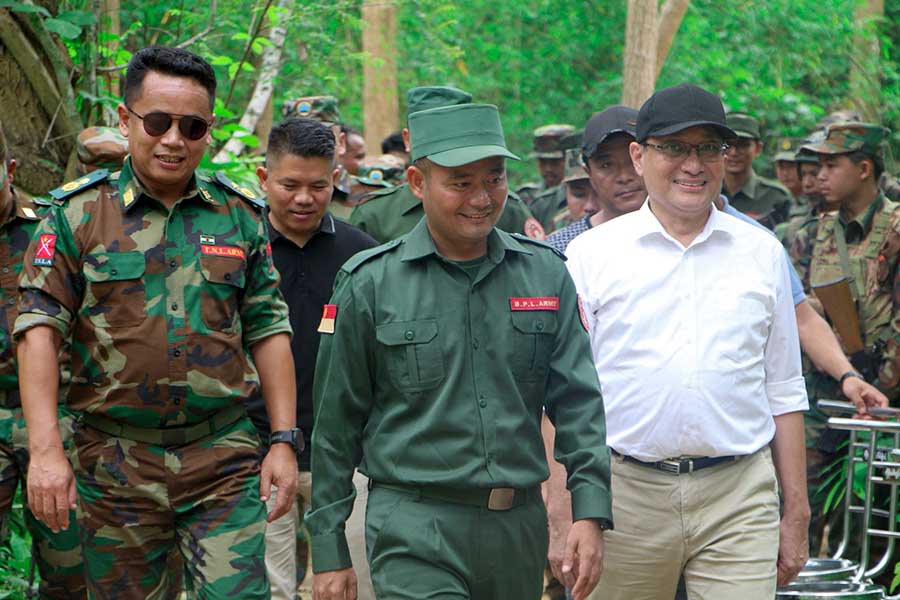
Officials from the National Unity Government (NUG) and the Spring Revolution Alliance (SRA) met on February 27 to discuss ongoing revolutionary efforts in Myanmar.
28 Feb 2026
DMG Newsroom
28 February 2026, Kyauktaw
Officials from the National Unity Government (NUG) and the Spring Revolution Alliance (SRA) met on February 27 to discuss ongoing revolutionary efforts in Myanmar.
The meeting was attended by NUG ministers Dr. Zaw Wai Soe and U Yee Mon, along with members of the SRA leadership committee and representatives of local People’s Defence Forces (PDFs). Discussions focused on military policy and potential cooperation.
“The first part of the discussion focused on mutual recognition between our organizations, and the second was about how we can work together,” SRA spokesperson Ko Min Htet told DMG. “We achieved positive results and reached an agreement in principle on how to proceed with our collaboration.”
Political observers view the meeting as a positive development that could lead to shifts in the country’s military landscape in the near future.
SRA member groups are engaged in fighting the military regime across Myanmar, while the NUG and its allied forces are active in Sagaing, Magway, Bago, Tanintharyi and Mandalay Regions, as well as Kachin State.
Supporters say coordination among frontline resistance forces could strengthen military and intelligence cooperation, as well as political leadership, shaping the next phase of the revolutionary movement.
“The statement released after the NUG and SRA meeting did not clearly detail the specific message they wanted to convey. However, it is understood that they have set a process for further meetings between the MOD [Ministry of Defence] and the SRA,” political analyst U Tun Kyi told DMG. “As Bamar People’s Liberation Army leader Maung Saung Kha previously mentioned, there is a need to resolve conflicts arising among revolutionary forces.”
U Tun Kyi added that the NUG should prioritize fighting the military regime rather than engaging in conflicts with other revolutionary groups, including the BNRA.
“Regarding the incident involving the BNRA led by Bo Nagar, it is known that the NUG deployed thousands of troops to fight them, yet we have not seen such strength deployed against the common enemy, the military regime,” he said. “If the NUG intends to win the war against the regime, it needs to build a unified military coalition. This can only be achieved through political reconciliation.”
The Spring Revolution Alliance was formed on December 15, 2025, bringing together 19 revolutionary groups that emerged following the 2021 military coup.
The alliance includes Bamar anti-regime forces such as the BPLA and SAF, as well as Chin and Karenni resistance groups, making it a significant regional coalition.
Political analysts suggest that the SRA’s activities this year could lead to more coordinated and intensified fighting nationwide, posing increased challenges for the military regime.
A representative from Burma News International (BNI), which monitors military and political developments in Myanmar, also commented on the current situation.
“Looking at the battles in the early part of 2026, we have seen fighting intensify in Myanmar’s heartland, including Sagaing, Magway and Mandalay,” the representative said. “2025 was a year in which revolutionary forces focused on organizing and coordination. As we enter the sixth year since the military coup, these forces are working to maintain military gains and territorial control.”
The representative added that in 2026, attention should be paid to potential coalition offensives in areas bordering Arakan State, including Bago and Ayeyarwady Regions, alongside operations aimed at dealing direct blows to the regime.
The current political landscape is also shaped by the military regime’s efforts to gain international recognition through planned elections and preparations to convene a parliament and form a government.
The NUG and other resistance forces have rejected the junta-organized election as illegal and illegitimate, while fighting continues to intensify in central Myanmar and ethnic states.

Top News
Clashes intensify at three locations near Sittwe ROC
By Admin 19 Oct 2026
Junta extends martial law in 55 townships, including AA-held areas
By Admin 19 Oct 2026
Financial hardship limits access to healthcare in Arakan
By Admin 19 Oct 2026
Rice shortages worsen in Taungup as prices soar
By Admin 19 Oct 2026
Junta airstrike kills at least seven, injures many in Paletwa Twsp
By Admin 19 Oct 2026