

Tree Planters Amid the Gunfire
“Tree planting isn’t just a one-time activity. When the rains stop, people go back with water and tend the saplings so they survive. It’s a continuous effort,”
10 Dec 2025
Written by Three Brothers
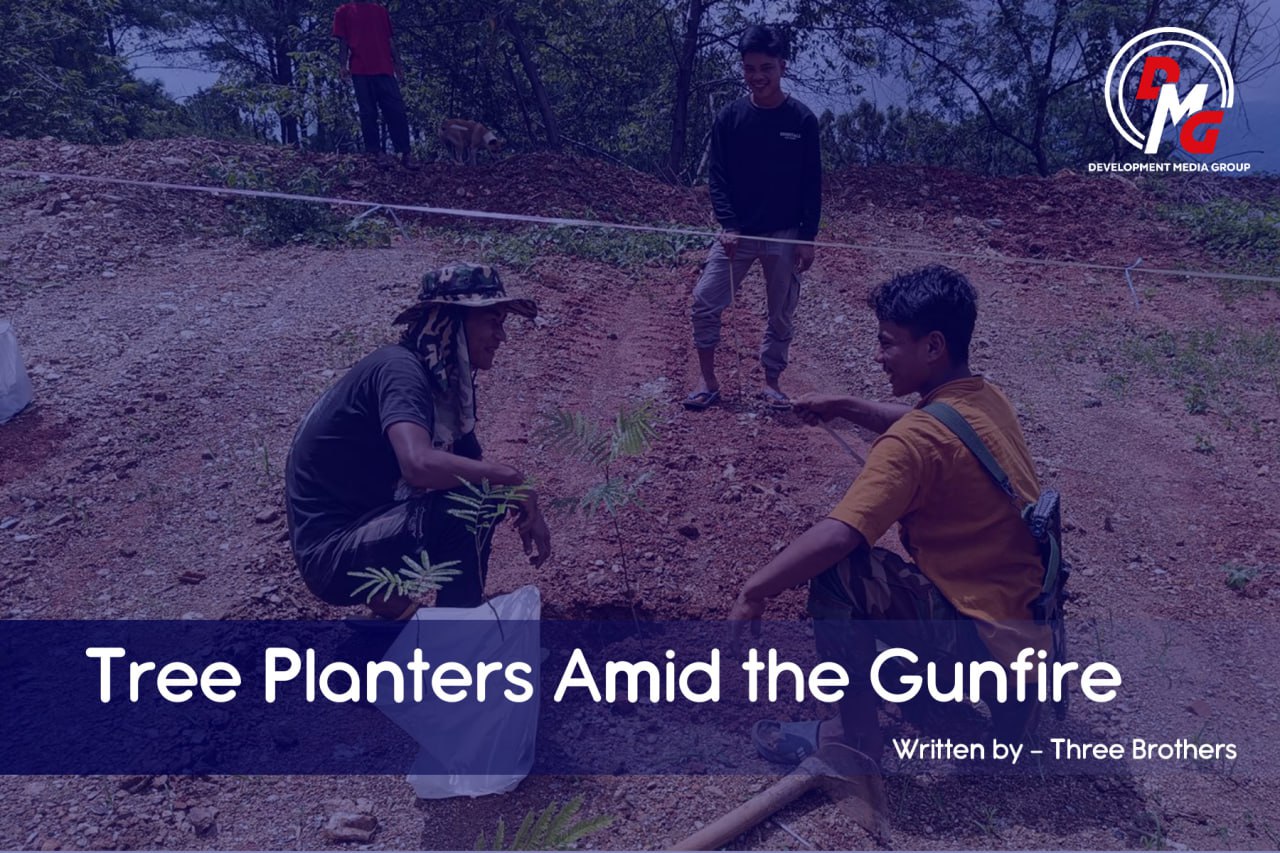
Because it is the rainy season, the air is damp and heavy. Sunlight struggles to pierce the thick layers of cloud. Under this muted light, a young man in his early twenties, a rifle slung across his chest, is planting a small sapling—no taller than two handspans—beside a mountain road.
Not far from him, around twenty other men are doing the same. Some are digging holes and planting saplings. Others are tying the young trees carefully to bamboo stakes so they can stand upright and survive the wind and rain.
This is southern Chin State’s Mindat Township, where local residents and members of a community defense force are working together—tree by tree—to replant their forests, even as the sound of conflict continues in the background.
Chin State: Myanmar’s Second Most Deforested Region
Chin State is Myanmar’s second most deforested state, according to Global Forest Watch. Between 2002 and 2024, more than 100,000 acres of forest in Chin were lost.
Across Myanmar, Global Forest Watch notes that most deforestation is driven by:
• converting forests into farmland
• expanding shifting hillside cultivation
• mining
• “development projects”
• commercial timber extraction
• forest fires and natural disasters
Chin State has nine townships and a population of more than 460,000 people. It is also one of the most forested states in the country—around 70 percent of its land area is covered by forest.
However, most Chin households depend on shifting hillside cultivation for their livelihoods. Each year, tens of thousands of acres of forest are cleared for this purpose.
Before the coup, many local families had begun to move away from shifting cultivation and toward crops like taro and yam, which brought in better income and required less forest clearing. As a result, hillside farming decreased in some areas and the forests remained greener and healthier.
But since the military seized power, forest clearing in Chin has increased significantly, says Mai Khin Win Yi, coordinator of the K’Cho – Chin Woman Organization, an environmental group.
“After the revolution began, we went back to prioritizing shifting hillside cultivation,” she says.
“If you look at the period from 2021 to now in 2025, and you look around in all directions—north, south, east, west—you see hillside plots everywhere. I believe this has led to serious forest degradation and a decline in forest quality.”
Chin State is one of Myanmar’s least developed regions, with poor road connectivity and very limited job opportunities. A Chin local explains that for many villagers, there are almost no options beyond hillside farming.
“There’s no farmland here, it’s all mountains. So people clear the hillsides for crops. When they clear the hillsides, the forest disappears. A single family may clear an acre, and because there are many families, large forest areas are lost,” he says.
“If we don’t do hillside farming, there’s simply nothing else to do here.”
A forest department staff member notes that the destruction of Chin’s forests is not only due to shifting cultivation.
“Forest management and protection are weak. There are forest fires. Because of the fighting, people’s livelihoods have worsened, so they cut whatever trees they can for survival. Houses are burned down during the conflict, so people cut trees again to rebuild shelter. There are too few forest officers on the ground. All of this contributes to deforestation,” he explains.
Mai Khin Win Yi adds that illegal logging and natural disasters also play a role: “Chin doesn’t have large-scale legal timber extraction, but the small amounts we do have are being logged in all areas bordering Magway Region. These are not official operations—they are done through collusion between some officials and timber traders,” she says.
Since the coup, armed conflict has also forced many conservation activities to stop. Government agencies that used to oversee protected forests have largely disappeared from the landscape.
When Forest Loss Threatens Livelihoods
Deforestation is not just about losing trees. It accelerates climate change, intensifies global warming, reduces biodiversity, degrades soil, and threatens daily human survival.
In Chin State, now one of Myanmar’s most deforested areas, locals say they are already facing:
• erratic weather
• landslides
• floods
• unseasonal heavy rain
• water shortages
A farmer from Falam explains: “Because the climate is changing, we see more landslides, and when it rains, the roads are blocked. In the hot season, there’s a water crisis. Streams dry up. Villages face all kinds of hardship.”
He says unseasonal rain is also damaging crops: “Rain comes when it shouldn’t. Yesterday it rained, today it’s hot. The rain doesn’t follow the usual pattern. Pests spread in the hillside fields and damage the crops. The yields are poor.”
Across the wider region of Southeast and South Asia, including the Chin Hills, communities are now experiencing climate extremes: heavy rainfall, drought, cold snaps and heatwaves. These are manifestations of climate change, driven by both:
• high carbon emissions from fossil fuels
• and the loss of forests that absorb carbon
Forests are also vital to Indigenous peoples and rural communities, providing:
• food and wild plants
• medicinal herbs
• building materials
• and other essential resources
When forests are lost, their livelihoods, cultures and ways of life are put at risk.
Restarting Forest Protection
In 2023, many Chin communities began to clearly see how much the forests around them had degraded. Shocked by the visible loss, they started trying—on their own—to restore and protect the trees.
Salai Yaoman, spokesperson for the Chin public administration committee, explains: “After 2005, when taro cultivation became more commercial, hillside clearing decreased and people focused more on taro and yam. The forests slowly began to recover. But then the coup happened, and hillside plots expanded again. Seeing the forests disappear, people decided to protect whatever they could.”
A Chin villager from Mindat Township says that in his area, communities are now organizing by village to plant trees: “In our village, we agreed that each household must plant at least five trees per year. We discussed this with the youth and set it as a commitment. It’s not a harsh pressure—five trees per family is not a big burden.”
He says that since late 2023, locals have been planting native, long-lived tree species such as cherry, hill jackfruit, Swedaw (a local species), guava, coffee and papaya.
Meanwhile, resistance forces now controlling parts of Chin State are also cooperating with local communities on forest protection, according to Salai Yaoman.
“We’ve introduced rules, especially around springs and water sources. Within 50 feet on both sides of streams, trees must not be cut. We also discourage cutting in green forest areas and wild forest zones. Each village and each sector protects the forest in its own way,” he says.
He adds that it is not just about planting once and walking away. In some areas, where newly planted trees might suffer from lack of rain, people are organizing watering schedules to keep them alive.
“Tree planting isn’t just a one-time activity. When the rains stop, people go back with water and tend the saplings so they survive. It’s a continuous effort,” says Mai Khin Win Yi from the K’Cho – Chin Woman Organization.
Resistance groups are also working with locals to protect remaining natural forests, especially in areas around old-growth stands and upstream water catchments.
Forest Conservation and Its Challenges
Despite these local initiatives, long-term forest protection in Chin faces serious obstacles.
A former (CDM) forest department staff member recalls that under the previous elected NLD government, there were both short- and long-term forest management plans: “Back then, we established new plantations every year, created private plantations for community use, supported community forests, distributed saplings, and carried out public awareness campaigns on the benefits of forests and how to prevent forest fires,” he says.
After the coup, he explains, most of these efforts collapsed.
Locals argue that if natural ecosystems are to be protected, alternative livelihood options must be created so that people are not forced to depend solely on hillside cultivation.
“For environmental protection to work, more NGOs need to come in,” says one Chin resident.
“If NGOs can create more jobs and livelihood opportunities, then it’s possible. Otherwise, the forests will keep disappearing. If we can link forest conservation work with income-generating activities for locals, it will be more sustainable.”
Salai Yaoman agrees that while people are now doing what they can, it is difficult to sustain conservation without outside support:
“To protect the environment in the long term, we need organizations that can support those who want to conserve nature. We need technical assistance and long-term projects,” he says.
Mai Khin Win Yi emphasizes that conservation plans must take local livelihoods into account: “There will always be people who depend on this land and these forests for their survival. For them, conservation plans can create obstacles if not designed carefully. Projects that ignore their livelihood needs may become a burden,” she warns.
Despite these concerns, she insists Chin’s remaining forests must still be protected: “We cannot simply abandon long-term forest protection. Whatever we face, however hard it is, we must continue to protect these forests.”
Why These Trees Matter
As Chin villagers and local defense forces plant trees, they are doing more than just greening the hills. Forests can:
• reduce the severity of landslides and flash floods
• lower temperatures during extreme heat
• stabilize soil with their roots
• reduce erosion and surface runoff during heavy rain
Forests are also home to countless plants, animals and insects. Protecting them means safeguarding priceless biodiversity and maintaining the delicate balance of natural ecosystems.
Put simply, conserving forests means protecting the lungs of our planet, its natural water filters, and the homes of countless living beings, including humans.

Top News
.jpg)
Junta aircraft drop over 20 bombs in Kyauktaw
By Admin 20 Oct 2026

18 journalists remain detained in Myanmar, Athan reports
By Admin 20 Oct 2026
Junta airstrike destroys homes in Kyeintali Town
By Admin 20 Oct 2026
Wild elephants destroy farmland in northern Maungdaw
By Admin 20 Oct 2026

Clashes intensify at three locations near Sittwe ROC
By Admin 19 Oct 2026