

- Malaria cases surge across Ann Twsp as residents struggle to access healthcare
- Arakan’s elderly face deepening crisis amid war: CAS study
- ULA detains Arakanese merchants over Khaikhy dispute, moves to resolve issue
- Arakan Army captures four junta outposts on Sittwe-Ponnagyun front
- Magway records most airstrikes since new military chief took command: ISP-Myanmar
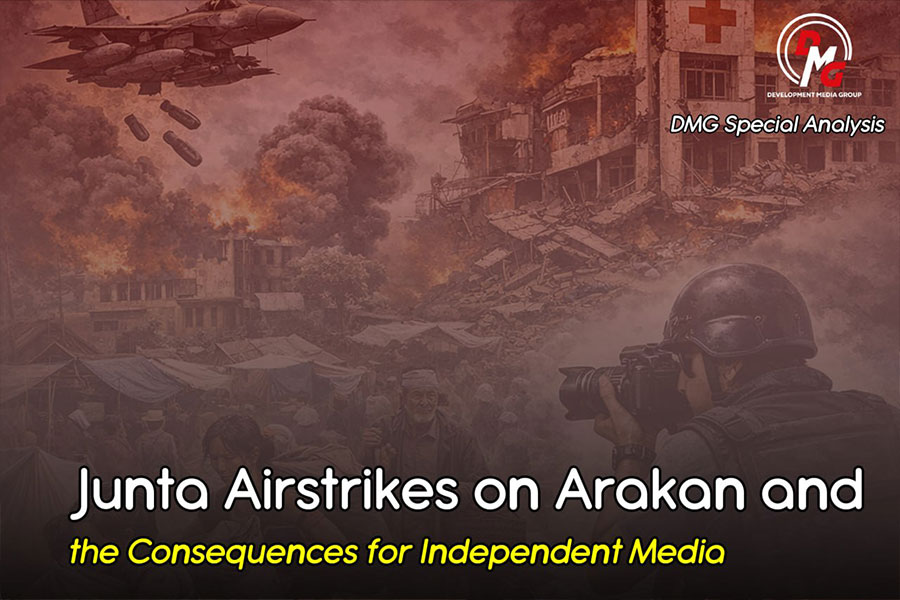
Junta Airstrikes on Arakan and the Consequences for Independent Media
In 2025, junta airstrikes fundamentally reshaped the conflict landscape in Arakan (Rakhine State). More than a battlefield tactic, aerial attacks became a central instrument of political control used to compensate for shrinking ground authority, disrupt civilian life, and silence independent information flows.
30 Jan 2026
DMG Special Analysis
In 2025, junta airstrikes fundamentally reshaped the conflict landscape in Arakan (Rakhine State). More than a battlefield tactic, aerial attacks became a central instrument of political control used to compensate for shrinking ground authority, disrupt civilian life, and silence independent information flows.
For Arakan’s people, the air war translated into death, fear, and displacement. For Development Media Group (DMG), it created an existential challenge: how to continue reporting when schools, hospitals, and entire communities are no longer safe from the sky.
Two incidents in particular the airstrike on Thayet Tapin Private School in Kyauktaw Township and the attack on Mrauk-U General Hospital on International Human Rights Day, 10 December 2025 illustrate how air power in 2025 targeted the foundations of civilian life and, in doing so, directly undermined independent journalism.
Airstrikes as a Tool of Control in Arakan
By 2025, the Myanmar junta increasingly relied on airstrikes as a substitute for effective territorial control in Arakan. As ground positions weakened and governance fragmented, air power became the most efficient way to impose authority without maintaining presence. The pattern was consistent: strikes followed territorial setbacks, targeted populated areas, and occurred far from active front lines.
This was not merely military escalation. It was a strategy designed to instill fear, deter civilian cooperation with alternative governance systems, and keep society in a permanent state of emergency.
Case Study 1: Thayet Tapin Private School — When Education Became a Target
The airstrike on Thayet Tapin Private School in Kyauktaw Township marked one of the most shocking moments of 2025. A civilian educational compound filled with students was struck from the air. Children were killed and injured. Classrooms were reduced to rubble.
Beyond the immediate human loss, the political and social consequences were profound:
- Parents across Arakan withdrew children from schools, fearing that no learning space was safe.
- Informal education networks collapsed as gatherings became increasingly risky.
- An already fragile education system was pushed closer to breakdown.
International Response and Its Limits
The attack drew condemnation from international human rights organisations and UN agencies, including UNICEF and United Nations human rights mechanisms, which reiterated that schools are protected civilian objects under international humanitarian law and must never be targeted.
Statements expressed alarm at the killing of children and called for accountability. However, these responses remained normative rather than deterrent. No immediate protective measures followed, and airstrikes continued elsewhere in Arakan.
For DMG, this gap between international condemnation and on-the-ground reality reinforced a painful lesson: documentation does not automatically translate into protection.
Impact on DMG’s Reporting
Journalists attempting to document the aftermath faced:
- Immediate security risks from follow-up airstrikes.
- Communication blackouts that delayed the transmission of photos, videos, and eyewitness accounts.
- Ethical dilemmas around protecting sources in grieving and fearful communities.
The Thayet Tapin strike demonstrated how airstrikes do not merely kill civilians, they erase civilian institutions. When schools are no longer protected spaces, the future itself becomes a casualty.
Case Study 2: Mrauk-U General Hospital — Human Rights Day Under Bombs
If the attack on Thayet Tapin shattered education, the airstrike on Mrauk-U General Hospital struck at the heart of humanitarian protection and did so on a day meant to affirm universal human dignity.
On 10 December 2025, International Human Rights Day, an airstrike affected Mrauk-U General Hospital, one of the most important referral medical facilities in northern Arakan, serving civilians from multiple townships and large displaced populations. The timing gave the attack powerful symbolic weight: while the world marked global commitments to human rights, civilians in Arakan watched a medical sanctuary come under fire.
International Reaction
International humanitarian and medical-protection advocates including World Health Organization partners and global rights organisations such as Human Rights Watch publicly reiterated that hospitals are protected under international law and that attacks on medical facilities may constitute war crimes.
Diplomatic missions and UN officials expressed concern and called for restraint. Yet, as with the Thayet Tapin incident, these responses did not halt subsequent air operations, underscoring the limits of international pressure absent enforcement.
Consequences on the Ground
The effects were immediate and severe:
- Patients avoided the hospital even in life-threatening emergencies out of fear of further attacks.
- Health workers faced moral and physical danger simply by continuing to work.
- Emergency referrals were delayed or abandoned, increasing the risk of preventable deaths.
For DMG, reporting on the hospital strike underscored a grim reality: when hospitals are targeted or rendered unsafe, humanitarian reporting itself becomes life-threatening. Journalists could not safely approach medical facilities, interview staff, or verify damage without risking air surveillance and attack.
This incident illustrated how airstrikes undermine not only healthcare, but also the ability of independent media to document violations of international humanitarian and human rights law in real time.
The Information War: Airstrikes and Silence
Both the Thayet Tapin and Mrauk-U incidents occurred amid severe internet and phone shutdowns. This combination of air power and information blackout proved devastating:
- Civilian casualty figures remained undercounted.
- Evidence arrived late or incomplete.
- Rumors spread faster than verified information.
For DMG, this meant slower publication, heavier verification burdens, and increased reliance on fragmented local networks. Editorial decisions increasingly prioritized safety and accuracy over speed, even as the international news cycle moved on.
In Arakan, airstrikes did not need to destroy newsrooms. By making movement dangerous and communication unreliable, they effectively compressed the space for journalism.
Humanitarian, Social, and Economic Fallout
The broader impacts of airstrikes in 2025 extended far beyond individual incidents:
- Humanitarian: displacement surged, access to aid shrank, and fear replaced predictability.
- Social: trauma became normalized; children associated daily life with air-raid anxiety.
- Economic: markets emptied early, transport routes became unreliable, and livelihoods collapsed under constant risk.
These pressures fed directly into DMG’s institutional survival. Rising operational costs, staff displacement, and delayed donor communication placed additional strain on an already fragile independent media ecosystem.
Why Airstrikes Are Also Attacks on Media
The Thayet Tapin and Mrauk-U cases reveal a broader truth: airstrikes function as indirect censorship. They do not silence journalists through law or arrest alone, but by making reporting logistically dangerous, psychologically exhausting, and institutionally unsustainable.
In Arakan, air power has become a way to narrow the information space without visibly banning the press.
Conclusion: Journalism Under the Bombs
Junta airstrikes in Arakan during 2025 reshaped not only the battlefield, but civilian existence and the information environment itself. By striking schools and hospitals including on International Human Rights Day, they attacked the social foundations of Arakan and exposed the gap between international norms and civilian protection on the ground.
For DMG, continuing to report under these conditions became both a professional duty and an act of resilience. The challenge was no longer just to document airstrikes, but to survive them as an institution while bearing witness to their human cost.
As long as the sky remains a weapon, Arakan’s civilians and the journalists who tell their stories will remain under siege. Protecting independent media in Arakan is inseparable from protecting schools, hospitals, and civilian life itself.

Opinion
.jpg)
How Can Myanmar’s Political Crisis Be Brought to an End?
By Admin 13 Sep 2026

By Cutting Trees, We Are Killing Ourselves
By Admin 06 Sep 2026
A Modern August We Must Never Forget
By Admin 31 Aug 2026
Arakan’s Political Shifts and the Debate Over Rights and Governance
By Admin 27 Aug 2026
Securing Rights for Bangladesh's Indigenous Peoples is Indispensable
By Admin 09 Aug 2026
POLITICS

BUSINESS
Industry to manufacture finished goods from coconut starting in early 2020
By Aung Kaung Zaw 20 Nov 2019