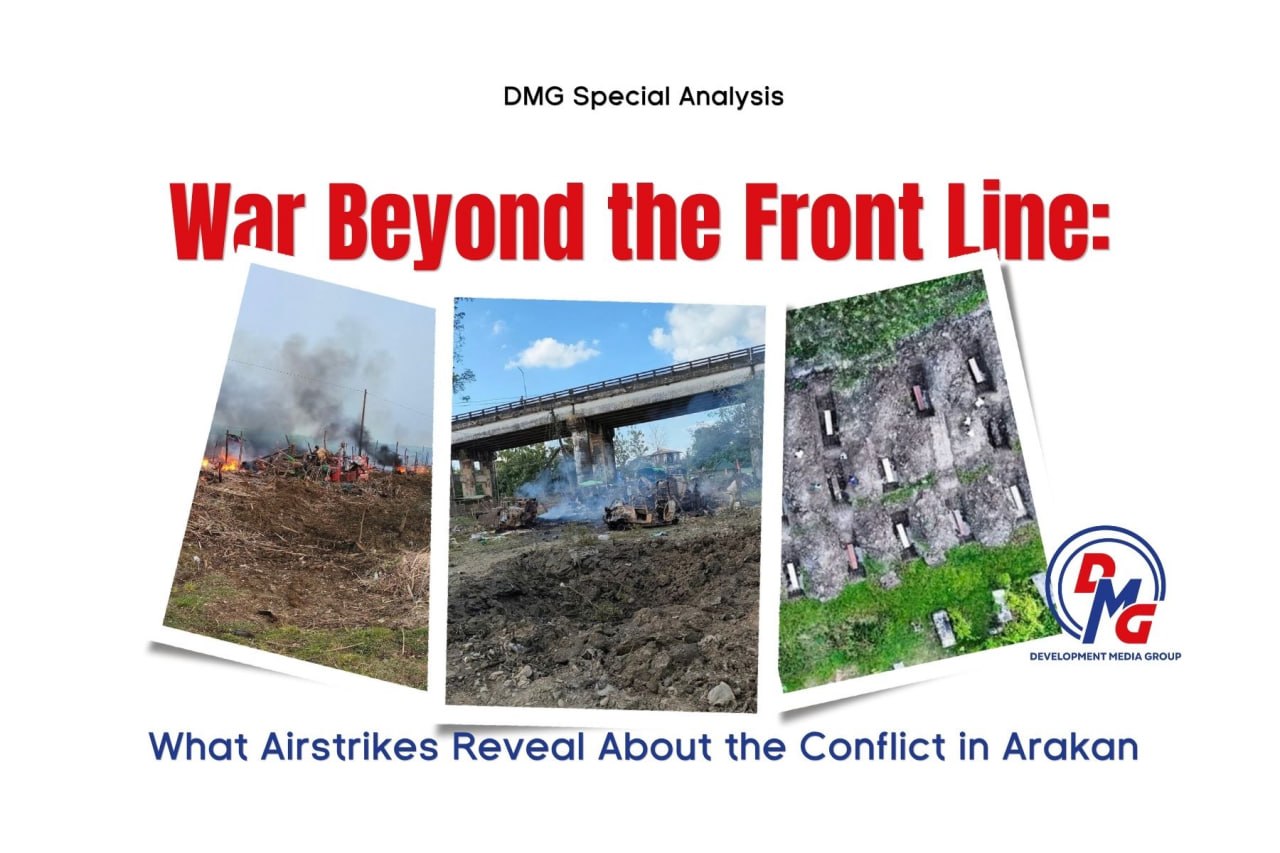

- Arakan records highest civilian toll from junta airstrikes in three months: NLTA
- Heavy junta casualties reported in month-long Indaw battles; tactical commander captured
- Athan report highlights restrictions on freedom of expression in resistance-held areas
- Arakan records Myanmar’s highest combined civilian death and injury toll: NLTA
- Junta honours 38 conscripts amid intense fighting in Sittwe
Under the Shadow of Airstrikes, Arakan's Children Struggle to Stay in School
Beyond the immediate danger to children's lives, prolonged disruptions to education threaten the knowledge, skills, and opportunities that Arakan's younger generation will need to rebuild their communities after years of conflict.
27 Oct 2026
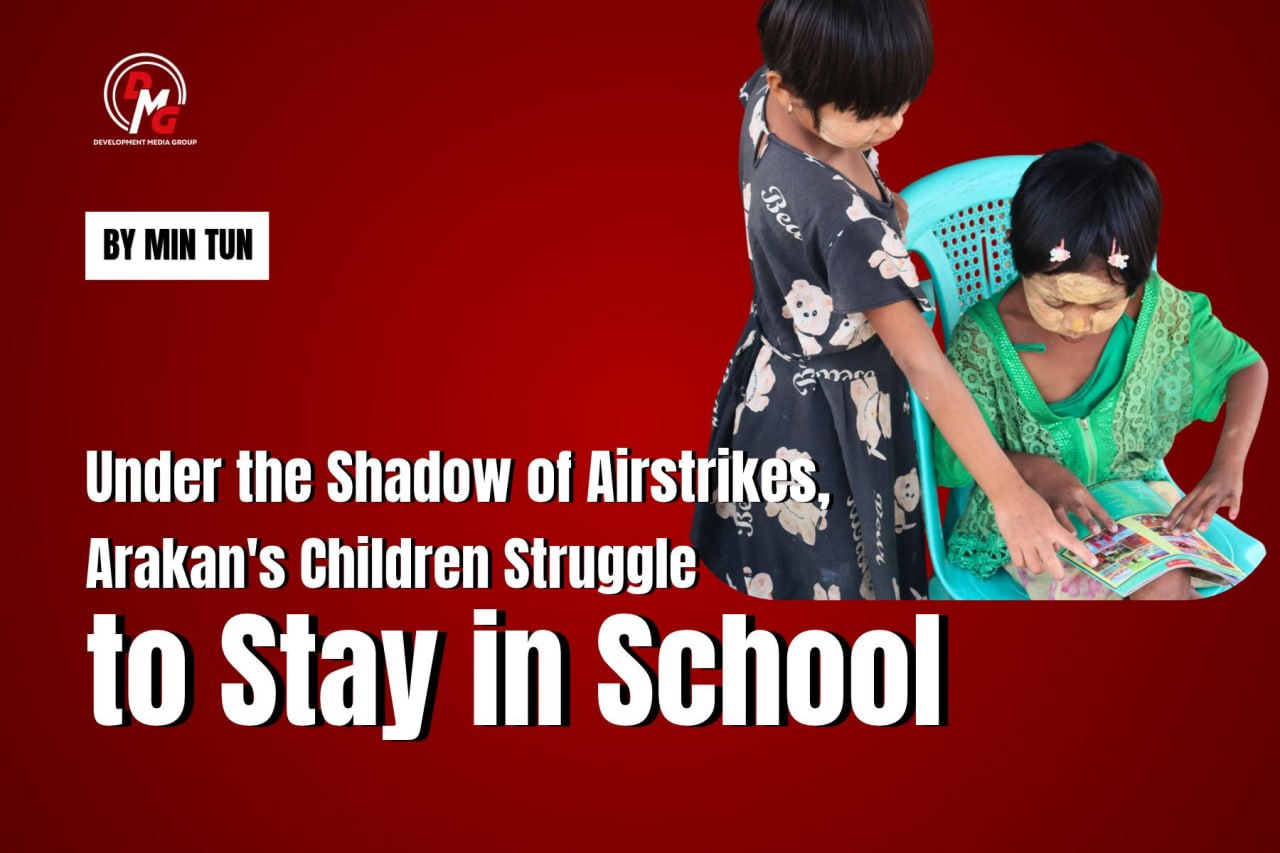
By Min Tun
The sudden roar of a fighter jet overhead sends schoolchildren dropping to the ground. Some scramble for cover in panic, desperate to find somewhere safe.
Scenes like these have become a frightening reality for children in Kyauktaw, a town in Myanmar's conflict-affected Arakan (Rakhine) State, western Myanmar.
When bombs explode nearby, the blasts shake the ground and surrounding houses. Children attending makeshift classes beneath residential buildings, rather than in conventional classrooms, burst into tears.
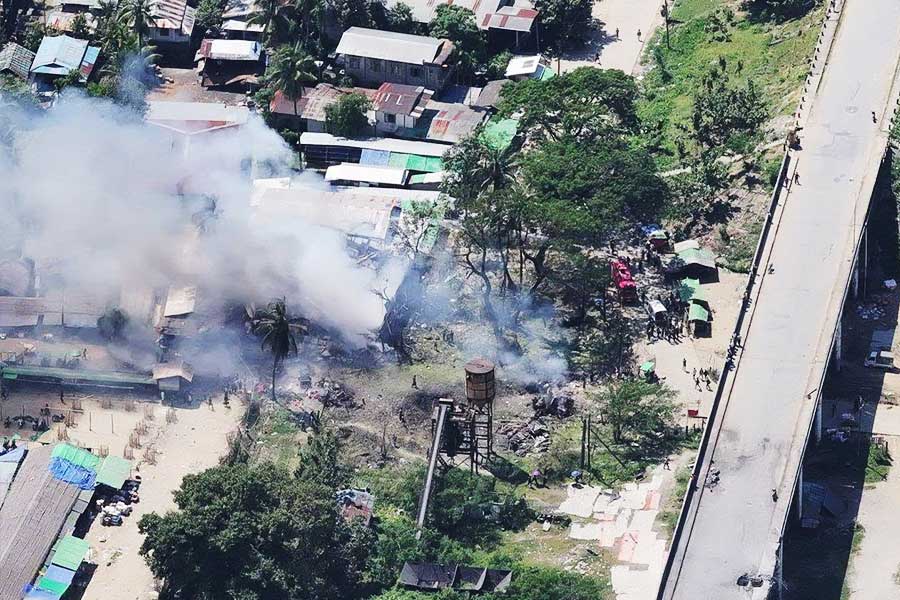
On September 28, 2026, shortly after midday, a Myanmar military airstrike struck the area around India Market and the Kissapanadi Bridge in Kyauktaw. According to the United Nations, the attack reportedly killed at least 50 people, including women and children, and injured at least 58 others.
The attack was among the deadliest reported in Arakan State since Myanmar's military seized power in February 2021.
As aerial bombardments intensify, keeping schools open, protecting students and teachers, and maintaining regular education have become increasingly difficult.
Beyond the immediate danger to children's lives, prolonged disruptions to education threaten the knowledge, skills, and opportunities that Arakan's younger generation will need to rebuild their communities after years of conflict.
Airstrikes and Their Impact on Education
Since Myanmar's military seized power in February 2021, armed conflict has expanded across much of the country. In Arakan State, fighting between the military and the Arakan Army (AA), an ethnic armed organisation seeking greater autonomy, has intensified since November 2023.
Myanmar's military has repeatedly conducted airstrikes in territories controlled by the AA and other resistance groups. Schools, monasteries, markets, and residential areas have been among the civilian locations affected.
These attacks have disrupted schooling and deprived many children of consistent access to education, a fundamental right protected under international human rights law.
Students and teachers have been killed or injured during attacks affecting educational facilities. Repeated airstrikes have also damaged school buildings, made travel routes dangerous, and created widespread fear among parents and teachers.
Even where schools remain open, families face difficult decisions about whether sending their children to class is worth the risk.
"When we hear bombs exploding or see aircraft flying overhead, it's extremely difficult to decide whether to send my daughter to school or keep her at home," said Daw Aye Sein Nu, a mother in her 40s.
"Most of the time, I choose not to send her. Her life is more important."
As airstrikes continue, schools have increasingly been forced to suspend classes, leaving children without regular learning opportunities and raising concerns about long-term educational losses.
Schools Close as Aerial Threats Intensify
Fighting between Myanmar's military and the AA continues to affect communities around Sittwe, Ponnagyun, and Wira Thani (Pauktaw), with residents reporting airstrikes and artillery shelling in civilian-populated areas.
According to local accounts, military aircraft have sometimes operated in groups of more than three fighter jets alongside reconnaissance planes, with bombardments reportedly lasting more than an hour.
Data compiled by Development Media Group (DMG) show that military airstrikes killed 667 civilians and injured 1,302 others across Arakan State between April 2024 and September 30, 2026.
The figures represent 1,969 civilians killed or injured during that period, according to DMG's records. Communications disruptions, security restrictions, and difficulties accessing affected communities mean the figures may not capture every casualty.
The consequences extend beyond immediate deaths and injuries.
Schools in parts of Ponnagyun, Werathani (Pauktaw), and Kyauktaw townships have suspended operations because of continuing security threats, interrupting children's education.
Residents in Ponnagyun Township say frequent airstrikes and artillery fire have made it increasingly difficult for children to attend school safely.
"Schools in villages near the town have closed because we hear bombing and artillery fire almost every day," a local resident said.
In more than 10 villages across Ponnagyun Township, parents have reportedly stopped sending their children to school out of concern for their safety, effectively bringing formal education to a halt.
Since fighting intensified in late 2023, communities in Arakan have attempted to maintain education by relocating classrooms to temporary learning sites.
In late 2024, the United League of Arakan (ULA), the AA's political organisation, established the Arakan National Education Department to organise schooling in territories under its administration.
However, the recent escalation in airstrikes has forced some of these educational facilities to close.
In Kyauktaw, schools have remained closed for nearly a month following the September 28 bombing, as parents fear further attacks.
"Parents are afraid to send their children to school, and teachers are not yet comfortable resuming classes," said a parent in Kyauktaw.
"Even when we take our children to school, we have to rush back to collect them whenever aircraft appear."
Physical Injuries and Psychological Trauma
The impact of airstrikes on children extends far beyond the immediate danger of death.
Survivors may suffer permanent disabilities, lose family members, experience psychological trauma, and face prolonged interruptions to their education.
On February 24, 2026, an airstrike on Yoe Ngu Village in Ponnagyun Township reportedly killed at least four children and seriously injured at least three others.
Among the survivors was four-year-old Ma Khaing Sandar Lin, who lost both legs.
Her grandmother, Daw Hla Sein Nyunt, described the emotional pain of watching the child struggle with her injuries.
"We try to comfort her. When I see her moving around on her knees, I can hardly bear to look because I feel so sorry for her," she said.
"She watches other children walking and looks at them with longing."
Another devastating incident occurred on September 12, 2025, when a Myanmar military fighter jet reportedly dropped two 500-pound bombs on the Pannya Pankhin and Amyin Thit private high schools in Thayet Ta Pin Village, Kyauktaw Township.
According to the IIMM, the attack reportedly killed at least 22 people, mostly students, and injured at least 20 others.
Among the survivors was Maung Tun Tun Naing, a Grade 11 student from Min Thar Taung Village who sustained a serious leg injury.
More than a year later, he remains unable to walk normally or return to school.
"I can't attend school, and I still can't walk properly," he said.
"When I see my friends going out, I feel discouraged. I want to go with them, but I can't. My leg still hasn't recovered."
Teachers say the psychological consequences are also becoming increasingly apparent.
Children who have experienced airstrikes or witnessed family members being killed or injured often struggle with fear, anxiety, and difficulty concentrating.
For some, the sound of an aircraft is enough to trigger memories of previous attacks.
According to Myanmar's opposition National Unity Government (NUG), military airstrikes affected 240 schools, 96 hospitals and clinics, and 435 religious buildings between 2023 and May 12, 2025.
The NUG identified Sagaing, Magway, Chin, Arakan, Karen, and Kayah (Karenni) among the areas most affected by attacks on educational facilities.
Meanwhile, military leader Min Aung Hlaing acknowledged during a meeting on February 9, 2026, that instability had forced basic education schools to close and deprived children of educational opportunities.
He blamed what he described as terrorist activities for the disruption.
"Instability caused by terrorists has forced basic education schools to close, resulting in significant losses of opportunities for school-age children," he said.
The military authorities routinely describe armed resistance groups as terrorists, while resistance organisations accuse the military of attacking civilian communities and infrastructure.
The United Nations and other international and regional organisations have repeatedly raised concerns about attacks affecting civilians, schools, and other protected facilities.
Nevertheless, airstrikes continue to threaten children across Myanmar.
Wai Hin Aung, a writer involved in humanitarian assistance work, called for stronger international action.
"These are serious human rights violations," he said.
"Under international standards, human rights principles, and basic respect for human life, I believe the international community should have taken effective action against a military responsible for such extreme brutality."
The Long-Term Cost of Interrupted Education
Education is fundamental to children's intellectual and psychological development, social relationships, and future employment opportunities.
For families already struggling with displacement, poverty, and the loss of relatives, the destruction caused by airstrikes can make continued schooling almost impossible.
In March 2025, an airstrike on Aung Phyu Pyin Village in Ponnagyun Township killed both parents and an elder brother of Ma Moe Moe Chay.
She was left struggling to support surviving family members, including younger brothers whose education became increasingly difficult to finance.
Medical expenses and the rising cost of basic necessities have placed additional pressure on the household.
"I can only afford to send my son, one younger brother, and one niece to school," she said.
"Of my two younger brothers, I can no longer afford to educate one of them."
For children in such circumstances, losing access to education can have consequences extending well beyond the current conflict.
Prolonged interruptions can lead to declining academic performance, widening learning gaps, and difficulties returning to formal schooling.
An education worker in her 60s warned that the consequences could be particularly severe for younger children who are still developing essential literacy, numeracy, and other foundational skills.
"Losing access to education can create difficulties throughout a child's entire educational journey," she said.
"Most importantly, the learning gap could become much wider."
Without sustained educational support, these disruptions risk creating lasting inequalities between children who can continue learning and those whose schooling has been interrupted by violence and displacement.
An Uncertain Future for Arakan's Younger Generation
The United League of Arakan and its armed wing, the Arakan Army, control most of Arakan State's 17 townships, with Sittwe, Kyaukphyu, and Manaung remaining outside their control, according to the territorial situation described in DMG's reporting.
In areas under ULA administration, its Arakan National Education Department has been working to expand educational activities and prevent further disruptions to children's schooling.
However, continued aerial bombardments remain a major obstacle.
Ensuring access to education will require more than reopening classrooms.
Children and teachers need safe learning environments, while survivors of airstrikes require psychological and social support.
Alternative learning arrangements are also essential for children who cannot attend school regularly because of displacement, insecurity, or physical disabilities.
For many families, however, the immediate concern remains survival.
Daw Ma Nwe Mar San, a relative of 16-year-old Ma Khin Khin Kyaw, who was killed in the September 2025 bombing of a private school in Thayet Ta Pin Village, expressed hope that no other family would experience a similar tragedy.
"I don't want anyone else to experience something like this again," she said.
"I pray that people capable of bringing down the military junta will emerge as soon as possible."
Her words reflect the grief and frustration of families who have lost children to the conflict.
As airstrikes continue across Myanmar, including Arakan State, many children face the prospect of growing up without the security, stability, and consistent education that others take for granted.
For them, the consequences of war will not end when the bombing stops.
The loss of years of education, the psychological scars of violence, and the destruction of family livelihoods may shape their futures long after the conflict itself has ended.

Top News
Arakan records highest civilian toll from junta airstrikes in three months: NLTA
By Admin 01 Nov 2026
Junta offensive toward Ponnagyun meets fierce resistance on Sittwe front
By Admin 31 Oct 2026
Arakan records Myanmar’s highest combined civilian death and injury toll: NLTA
By Admin 31 Oct 2026