
- Arakan Army captures junta outposts as fighting intensifies near Sittwe
- Pro-junta ALP chair says NCA can shape Arakan’s future
- Extreme heat drives rise in clinic visits across Arakan
- Junta airstrikes on Ponnagyun IDP camps kill 15 civilians, injure 30: AAPP
- Myanmar junta airstrikes kill 163 civilians in September, Arakan hardest hit: MDSI
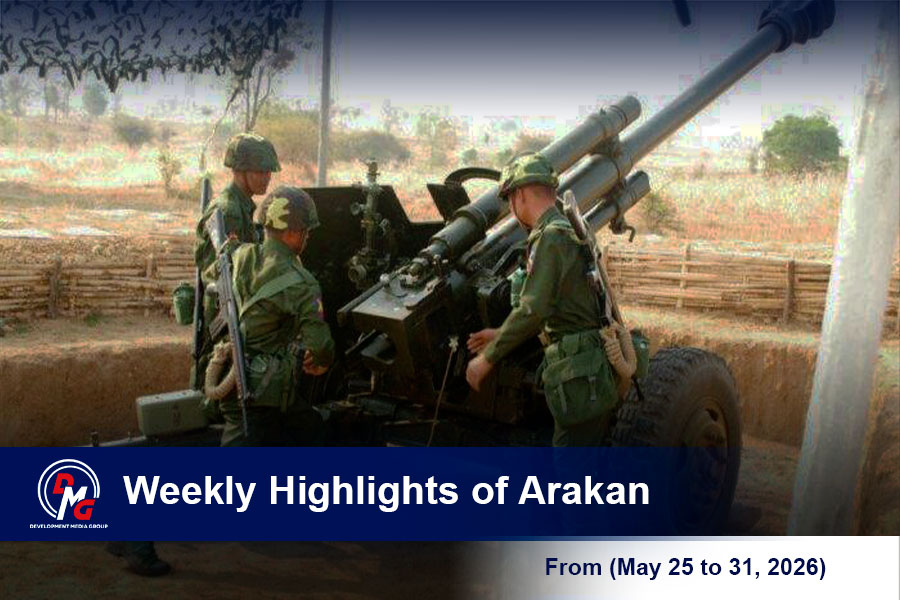
Weekly Highlights from Arakan (May 25 to 31, 2026)
In an era when daily news from Arakan is often fragmented and fast-changing, DMG's Weekly Highlights of Arakan brings clarity, depth, and context to the stories that matter most.
01 Jun 2026
In an era when daily news from Arakan is often fragmented and fast-changing, DMG's Weekly Highlights of Arakan brings clarity, depth, and context to the stories that matter most.
Each week, we round up key political, military, social, and humanitarian developments across Arakan State - connecting the dots between events and offering analysis to help audiences see the bigger picture.
This series is designed for readers and viewers seeking a concise yet comprehensive understanding of how ongoing conflict, governance shifts, and community issues continue to shape lives across Arakan.
Regime launches 90-minute aerial bombardment on Ann
Myanmar’s military regime carried out a continuous 90-minute airstrike on the town of Ann in Arakan State from 4 p.m. to 5:30 p.m. on May 26.
The regime used four Y-12 transport aircraft, a jet fighter and drones in the attack.
Details regarding casualties and damage caused by the airstrike could not be independently confirmed at the time of reporting.
Since early 2026, the regime has shifted from using single aircraft in airstrikes to launching coordinated attacks involving four or more planes.
The tactical shift indicates a move toward large-scale aerial bombardment aimed at causing widespread destruction.
The Arakan Army (AA) captured Ann Township, home to the regime’s Western Command headquarters, on December 20.
During the battle for control of Ann, the Arakan Army captured Western Command Deputy Commander Brigadier-General Thaung Tun, Chief of Staff Brigadier-General Kyaw Kyaw Than and hundreds of junta soldiers.
On March 8, 2026, the regime carried out heavy bombardments on an Arakan Army prisoner of war detention camp in the Darletchaung area of Ann Township, killing 116 POWs and detainees and wounding at least 32 others.
Regime launches airstrikes on Pauktaw as clashes intensify near Sittwe
Clashes have reportedly broken out between regime forces and the Arakan Army (AA) near Sittwe in Arakan State, with both sides exchanging heavy artillery fire, according to local sources.
Residents said the regime carried out jet fighter airstrikes in Pauktaw Township on the afternoon of May 28.
Sources familiar with the local situation said the regime has reinforced its military and naval presence in Sittwe and is currently exchanging heavy artillery fire with the Arakan Army along the borders of Rathedaung and Ponnagyun townships.
Fearing a possible Arakan Army attack on Sittwe, the regime has erected fences around the town and confined thousands of residents from nearby villages inside monasteries in Sittwe as internally displaced persons.
Currently, junta warships offshore and military battalions in Sittwe are carrying out jet fighter airstrikes, heavy artillery shelling and drone attacks targeting Rathedaung, Ponnagyun and Pauktaw townships, which are under Arakan Army control.
Military observers said fighting could intensify in Sittwe following remarks by the Arakan Army chief indicating plans to capture all remaining regime-controlled towns before 2027. Heavy fighting is already ongoing in Kyaukphyu Township.
IDP man killed in Myanmar Navy shelling in Kyaukphyu
An internally displaced person (IDP) man was killed after a heavy artillery shell fired from a Myanmar Navy warship exploded in Paukpyin Village, Kyaukphyu Township, Arakan State, on the morning of May 29.
The victim was identified as 24-year-old Ko Moe Htet Paing from Kanpyin Ward in Sanae Town, who had been sheltering in Paukpyin Village as an IDP.
According to local residents, Ko Moe Htet Paing was inside a house in the village when he was struck by shrapnel from the shell fired by the junta warship and died at the scene.
Several houses were also damaged by the explosion.
Residents said the military regime has frequently carried out airstrikes and heavy artillery attacks targeting civilian-populated villages in Kyaukphyu Township, causing a growing number of civilian casualties.
Blood donor associations in Arakan State struggle to survive amid fuel crisis and declining membership
Blood donor associations in areas controlled by the Arakan Army are facing various difficulties and struggling to maintain regular operations due to air threats from Myanmar’s military regime and soaring fuel prices, according to group representatives.
Airstrikes by the regime and disruptions to internet and phone services have caused delays in coordination and made it difficult to reach members in time.
Economic hardships faced by local residents are also affecting the regular operations of blood donor groups across Arakan State.
Meanwhile, shortages of emergency vehicles and high fuel prices are further disrupting the routine activities of blood donor organizations.
Blood donor groups are currently visiting villages to raise awareness and recruit volunteers.
However, many individuals are leaving for foreign countries due to family financial difficulties and economic hardships, leading to a decline in personnel across social aid organizations in Arakan State.
A shortage of healthcare workers, along with inadequate medicines and diagnostic equipment in Arakan Army-controlled areas, is worsening hardships during health crises, including blood shortages.
Social aid groups say urgent support is needed to strengthen blood donor associations in Arakan State, which remain vital for saving civilian lives.
Arakanese call for relaxation of medical certificate requirements
People in Arakan State are calling on the United League of Arakan (ULA) to relax medical travel certificate requirements, as patients face significant difficulties obtaining approval to travel to India for treatment.
Residents from townships controlled by the Arakan Army (AA) were previously allowed to travel freely to India for medical treatment until the end of 2025. However, since early 2026, inspections at Arakan Army security checkpoints have become stricter, making travel more difficult for patients.
People requiring surgery and specialized treatment are traveling to Mizoram State in India, but many say they are struggling to obtain recommendation letters while also facing concerns related to conscription enforcement.
Patients say that a doctor’s recommendation alone is insufficient, and they must spend additional time and money obtaining further endorsements from township medical officers and senior physicians, along with several layers of recommendation letters.
Although the Department of Public Health under the ULA is providing healthcare services in Arakan Army-held areas, some residents continue traveling to India due to shortages of healthcare workers, medicines and medical equipment.
Due to measures related to the National Defence and Emergency Provisions for public conscription (NDEP), authorities in townships controlled by the Arakan Army have temporarily suspended issuing travel recommendation letters to young and middle-aged traders. People traveling for medical reasons are currently permitted to travel only after obtaining multiple recommendation letters.
Some patients suffering from severe illnesses that cannot be treated within the Arakan Army-held territory are forced to travel to the India border area for treatment.
Hospitals and clinics in areas controlled by the Arakan Army reportedly lack specialists such as obstetricians, gynecologists, orthopedists, neurologists and ophthalmologists. Patients with serious illnesses are often treated only by general practitioners.
Residents say hospitals are overcrowded with hundreds of patients each day, forcing even emergency patients to wait more than a week for appointments.
Although the ULA is attempting to provide healthcare services for local residents through its healthcare system in Arakan State, public access to comprehensive medical treatment remains limited due to shortages of medicines, doctors and equipment.
Private entrepreneurs yet to join Bangladesh-Arakan border trade
Although border trade between Bangladesh and Arakan State resumed in April, trade activities remain limited and have yet to attract participation from private entrepreneurs, according to border traders.
Bilateral trade between Teknaf in Bangladesh and Kanyin Chaung Jetty in Maungdaw Township, Arakan State, resumed on May 1.
However, border traders said trade operations remain limited to a merchants' association formed by the United League of Arakan (ULA), with little interest so far from private business owners.
According to traders, the timber currently being exported consists of shipments that had been scheduled for export before 2023. Small-scale private trade is reportedly taking place only in Taungpyo Letwe Town and Bandoola Village.
Sources close to the merchants’ association said the Bangladesh government is treating the arrangement as Myanmar-Bangladesh trade and has not officially recognized trade relations with the ULA.
According to figures released by the Myanmar military regime, annual trade between Bangladesh and Arakan State reached nearly US$260 million during the 2022-2023 fiscal year before fighting erupted in Arakan State.
Border trade between Bangladesh and Arakan State was halted after armed conflict intensified in Arakan State and only resumed in May 2026.
Meanwhile, the Saw route in Magway Region, which had been a major trade route into Arakan State, has been disrupted due to ongoing fighting, leaving the route through India’s Mizoram State as the main remaining trade corridor for Arakan State.
Businesspeople are also urging authorities to place greater emphasis on Bangladesh-Arakan trade, citing concerns that transportation delays and difficult travel conditions could worsen during the upcoming rainy season along the India route.

Opinion
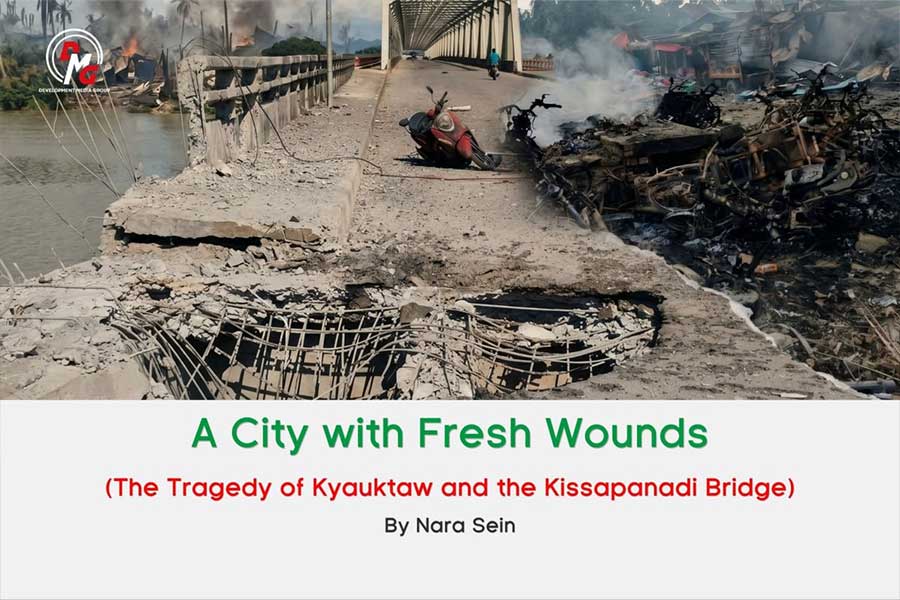
A City with Fresh Wounds (The Tragedy of Kyauktaw and the Kissapanadi Bridge)
By Admin 01 Oct 2026

Arakan Army’s Gains and the Changing Geopolitics of Arakan
By Admin 29 Sep 2026

Beyond Military Victory: What Is Myanmar’s Ultimate Political Objective?
By Admin 26 Sep 2026

UN at a Crossroads: Six Priorities for a Shared Future
By Admin 23 Sep 2026
.jpg)
How Can Myanmar’s Political Crisis Be Brought to an End?
By Admin 13 Sep 2026
POLITICS

BUSINESS
Industry to manufacture finished goods from coconut starting in early 2020
By Aung Kaung Zaw 20 Nov 2019