
- Y-12 aircraft, drones circle over Sittwe as clashes intensify
- Panic grips Sittwe after deadly reported Y-12 airstrike
- At least six killed, 37 injured in reported Y-12 bombing of downtown Sittwe
- Junta column heading toward Kyindwe suffers heavy casualties in resistance ambushes
- Junta replaces Arakan State security minister amid escalating battles near Sittwe
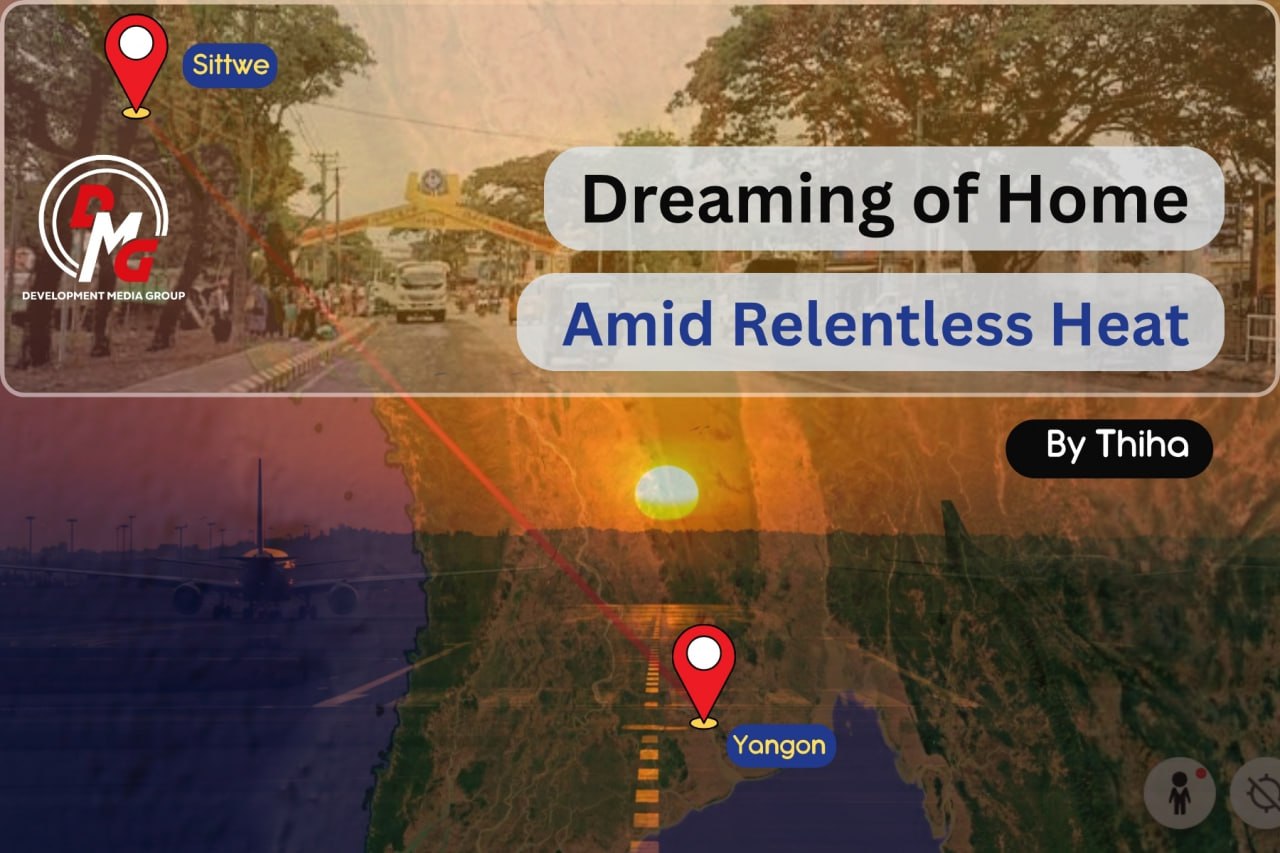
Dreaming of Home Amid Relentless Heat
"I used to love fried bottle gourd fritters. Back when I lived in Sittwe, I ate them at least once a week," Daw Mari said as she gently dropped another slice of battered bottle gourd into a wok of sizzling oil.
29 Jun 2026
By Thiha
"I used to love fried bottle gourd fritters. Back when I lived in Sittwe, I ate them at least once a week," Daw Mari said as she gently dropped another slice of battered bottle gourd into a wok of sizzling oil.
Wisps of gray streaked through her neatly tied hair, while loose strands clung to her sweat-soaked forehead.
Before her, a charcoal stove blazed relentlessly beneath a pan of bubbling oil, where slices of bottle gourd and bananas crackled as they turned golden brown. Nearby, a young woman in her twenties and a three-year-old child helped serve customers stopping by the modest roadside stall.
Now in her forties, Daw Mari is originally from Rathedaung Township in Arakan State. At the age of nineteen, she married a man from Sittwe and settled in Min Gan Ward, where the couple built their life together. She earned a living as a small trader and raised three children.
As the years passed, her eldest son and middle daughter married and established families of their own. They all continued living together within the same family compound, while Daw Mari remained with her youngest son.
"I built a house right next to ours for my eldest son," she recalled with a wistful smile. "My daughter and her husband lived nearby too, along with my youngest boy. Back then, I never even noticed how hard I worked. Maybe it was because the whole family was together."
That peaceful life changed in 2020 when her husband passed away.
Like many families in Arakan, they struggled to find stable employment. Hoping to secure a better future, Daw Mari sold half of the family compound to send her eldest son to Malaysia for work. With the remaining money, she built a new two-story home.
Barely a month after construction was completed, Cyclone Mocha struck Arakan.
Their new house was badly damaged and had to be repaired.
Looking back now, she says she never imagined that the cyclone would be only the first of many storms her family would face.
When War Closed the Roads
On November 13, 2023, shortly after Cyclone Mocha, the Arakan Army (AA) launched its military offensive across Arakan.
Almost immediately, Myanmar's military imposed strict restrictions on land and water transportation to and from Sittwe.
For traders like Daw Mari, the blockade was devastating.
"I used to order goods from Mandalay and sell them in Sittwe," she explained. "When the roads were closed, everything became extremely difficult. In the end, although transportation costs were very high, I had no choice but to fly the goods in."
As supply routes were cut, prices of food and essential household goods surged throughout the city. Everyday expenses rose sharply, placing enormous pressure on ordinary families.
Then came another terrifying reality.
Artillery shells fired from Military Battalion No. 354, located near the entrance to Sittwe, began echoing across the city.
"The first explosion I heard was unbelievably loud," she recalled. "I'd never heard anything like it before. I was terrified."
As the shelling became more frequent, fear became part of daily life.
"Later, in the evenings, if you looked into the sky, you could actually see the artillery shells flying overhead. Every time one was fired, the whole house shook. Eventually, I became too frightened even to look outside. I kept thinking that one day one might fall on us."
The Day Fear Became Reality
While struggling to live with constant anxiety, the day Daw Mari feared most finally arrived.
At around 8:30 a.m. on February 29, 2024, an artillery shell fired from the Myanmar Navy base in Pyitawtha Ward exploded inside Sittwe's central market.
The blast killed around fifteen civilians, including children, and seriously injured more than twenty others.
As fear spread across the city, reports also emerged that ward authorities would begin selecting young people aged eighteen and above for compulsory military service.
Many young residents of Sittwe began searching desperately for ways to escape despite tight travel restrictions. Some reportedly paid large sums of money to board naval vessels, travelling by sea toward Pauktaw before making their way into areas controlled by the Arakan Army.
Fearing that her youngest son might also be conscripted, Daw Mari hurriedly arranged for him to leave with his aunts for Rathedaung Township, which was under AA control.
"Even the ward administrator secretly sent his own son away," she said.
"I was so worried about my youngest boy that I sold his motorcycle to pay for the journey. I'd bought it for 1.6 million kyats, but because I urgently needed the money, I had to let it go for only 900,000."
The plan was simple: send her youngest son and her elder sister's family to safety first, while the rest of the family would follow later.
But as more and more residents attempted to flee Sittwe, the military tightened restrictions even further.
Escape routes became increasingly dangerous.
According to residents, troops fired artillery and small arms at civilians trying to leave the city. As a result, the number of people killed or injured while attempting to reach safer areas steadily increased.
Meanwhile, security forces intensified nighttime raids across Sittwe. Young men were arrested during household registration inspections, while military vehicles patrolled the streets after dark. Residents said civilians encountered outside at night were sometimes shot.
"Whenever I heard military vehicles passing, I couldn't sleep," Daw Mari recalled. "I'd sit upright all night, listening in fear."
The Massacre That Changed Everything
Despite the growing danger, Daw Mari still hoped she would soon be reunited with her youngest son.
Then another tragedy unfolded.
On May 29, 2024, junta troops and members of the Arakan Liberation Party (ALP) entered Byine Phyu Village in Sittwe's Sat Yoe Kya Ward. According to local reports, hundreds of residents were arrested, tortured, and killed. News of the massacre quickly spread inside Myanmar and abroad.
"People who escaped from that area later came to work here and told us what they'd seen," Daw Mari said quietly.
"They said the ponds in Byine Phyu were filled with bodies. They also said they could hear people screaming while being tortured throughout the night."
After hearing those accounts, she reached a painful conclusion.
Remaining in Sittwe was no longer possible.
Although she had visited Yangon only once before and had almost no relatives there, she decided her family had no choice but to leave.
With the help of friends who had already relocated to Yangon, Daw Mari managed to arrange airline tickets for her family.
Even that, however, became another hardship.
Before the war, a one-way ticket from Sittwe to Yangon had cost just over 100,000 kyats. By early June 2024, the fare had risen to more than 500,000 kyats per person.
Still, safety mattered more than money.
Using funds sent by her eldest son in Malaysia and selling some of the gold jewelry she had carefully saved over the years, Daw Mari bought tickets not only for herself but also for her daughter, son-in-law, and grandchild.
On June 8, 2024, they finally left Sittwe.
Behind them, they left not only their home but the life they had spent decades building.
Starting Over in Yangon
Upon arriving in Yangon, Daw Mari rented a small room near a workers' hostel in Shwepyithar Township, where several acquaintances from Sittwe were already living.
Even securing a place to stay proved difficult.
When she tried to register her family's temporary residence, the local ward administrator refused to issue the necessary household registration simply because they had come from Arakan State.
"The ward administrator told us he couldn't register us because we were from Rakhine," she recalled.
"So I went directly to the ward office myself and explained everything. Only after paying money did they finally agree to process our registration."
For Daw Mari, it was another painful reminder that displacement did not end after leaving home.
The struggle simply took a different form.
Surviving One Day at a Time
Once accommodation had been secured, the family's next challenge was survival.
Her son-in-law had worked as a goldsmith in Sittwe, so they searched for employment for him in Yangon. Meanwhile, to cover daily expenses, Daw Mari continued selling the remaining pieces of gold jewelry she had brought with her often for far less than they were worth.
Before long, those savings were gone.
With no steady income and few alternatives, the family found themselves running out of options.
According to the United Nations Office for the Coordination of Humanitarian Affairs (UNOCHA), as of April 27, 2026, more than 3.74 million people had been displaced across Myanmar. More than 600,000 of them were internally displaced within Arakan State alone.
Like countless other displaced families, many people with few resources sought shelter in forests, mountains, or nearby villages. Those with some financial means often relocated to Yangon in search of safety and work.
Although there are no official figures for how many people fled from Sittwe to Yangon, local residents estimate that more than half of the city's population has left since the conflict escalated.
Living in Yangon gradually taught Daw Mari a difficult lesson.
No matter how stable life had once been, surviving in Myanmar's largest city was impossible without a reliable source of income.
Determined not to rely entirely on her children, she decided to invest what little money remained in a small business that required modest capital.
She began selling fried snacks.
Standing Before the Fire
After buying basic cooking equipment and ingredients, Daw Mari opened a modest roadside stall near the hostel where she lived.
Business was slow at first.
"When I first started, hardly anyone knew me," she said.
"Even by seven o'clock in the evening, nearly half of the fritters would still be left unsold."
Instead of selling throughout the day, she focused on the busiest hours from noon until seven in the evening when workers returned home and people looked for an inexpensive afternoon snack.
Every day, she stands inside a small stall covered with a blue tarpaulin, tending a charcoal stove beneath a pan of boiling oil.
The heat rising from the fire merges with Yangon's scorching tropical weather, turning the tiny space into what feels like an oven.
Yet she rarely complains.
She simply continues frying bottle gourd fritters and banana fritters, serving customers one after another while trying to earn enough to support her family.
"I keep telling myself that this difficult time is only temporary," she said.
Whenever she speaks with friends from Sittwe, she comforts herself with the hope that before long they will all be able to return home.
Every night, after praying before her small household shrine, she asks only for the safety of her youngest son, who remains in an AA-controlled area of Arakan.
Whenever news breaks of junta airstrikes on liberated areas, her anxiety returns.
"Our family is already so small," she said softly.
"Now we're scattered in different places. That alone is heartbreaking."
"Whenever I hear that the military has bombed somewhere in Arakan again, I immediately think about my youngest son and my elder sister. Every time I see those reports, I pray."
Separated by war, distance, and uncertainty, she carries those worries with her every day.
For Daw Mari, the burden of not knowing is often heavier than the work itself.
Nearly two years after fleeing to Yangon, the relentless heat surrounding Daw Mari has begun to take its toll.
Day after day, she stands over a charcoal stove, frying snacks beneath the scorching sun. Yet she says the heat from the fire is easier to endure than the pain she carries inside.
Years of physical exhaustion, financial hardship, and constant worry about her scattered family have gradually undermined her health.
She now suffers frequent dizziness, heart palpitations, and chest discomfort.
"I've been unwell for quite some time," she said.
"I have to visit the clinic often. The doctor says I have symptoms of heart disease. But I still have to keep working to support my family. I take my medicine, then I go back to work."
For Daw Mari, however, the oppressive heat of Yangon is nothing compared to the emotional burden of worrying about the son she left behind in Arakan.
Every report of junta airstrikes on areas under Arakan Army (AA) control fills her with fear.
"Our family is already so small," she said quietly.
"Now we're living in different places. That alone is heartbreaking. And whenever I hear that the military has bombed somewhere in Arakan again, I immediately think about my youngest son and my elder sister. Every time those reports come out, I pray."
She knows there is little she can do except wait.
The uncertainty has become part of her daily life.
Yet hope has never left her.
Holding On to the Dream of Home
Like hundreds of thousands of other displaced people from Arakan, Daw Mari did not choose to leave her home.
War forced her to abandon the house she had built, the neighborhood where she had spent most of her adult life, and the close-knit family she once believed would always remain together.
Now, each day follows the same rhythm.
She prepares ingredients before noon.
She lights the charcoal stove.
She fries bottle gourd fritters and banana fritters beneath the relentless heat.
She serves customers until evening.
Then she returns to the small rented room where memories of home remain far more vivid than the unfamiliar streets around her.
She still believes the separation is only temporary.
Whenever she speaks with friends from Sittwe, she reassures both them and herself that one day they will all return.
Not to the uncertainty they left behind, but to a peaceful home where parents, children, and grandchildren can once again live together.
That hope has become the strength that carries her through each day.
More Than Survival
For many displaced families, survival is measured one day at a time.
For Daw Mari, survival alone is not enough.
She longs to see her youngest son again.
She dreams of sharing meals with her children under the same roof, just as they once did before war tore the family apart.
That dream of returning home has become her greatest source of resilience.
Every afternoon, customers gather around her modest roadside stall.
The oil continues to sizzle.
The charcoal fire continues to burn.
Sweat trickles down her face as she quietly prepares another batch of fritters.
Behind every serving she sells lies a story of displacement, separation, sacrifice, and perseverance.
Like hundreds of thousands of other people uprooted by Myanmar's conflict, Daw Mari is rebuilding her life far from home while carrying memories that refuse to fade.
The heat surrounding her may be relentless.
But it is the hope of returning home that keeps her going.
Until that day comes, she will continue standing beside her charcoal stove, enduring each hardship with quiet determination holding tightly to one dream above all others: To return home.

Opinion

Can the UN Restore Trust in a Fractured World?
By Admin 23 Oct 2026
Arakan Amid the Storm: From Survival to Rebuilding a People
By Admin 22 Oct 2026
Surviving Amid the Bombs: Arakan's Quiet Resistance
By Admin 19 Oct 2026

Shadows Over Childhood: Confronting the Reality of Missing Children
By Admin 16 Oct 2026
A City with Fresh Wounds (The Tragedy of Kyauktaw and the Kissapanadi Bridge)
By Admin 01 Oct 2026

Arakan Army’s Gains and the Changing Geopolitics of Arakan
By Admin 29 Sep 2026
POLITICS

BUSINESS
Industry to manufacture finished goods from coconut starting in early 2020
By Aung Kaung Zaw 20 Nov 2019