
- Returning to Mother’s Home
- Hundreds of IDP shelters damaged as heavy rain, strong winds hit Arakan State
- Regime-appointed Arakan CM claims development plans underway amid widespread hardship
- Over 30 Sittwe residents detained in three days during guest list checks
- Three Kyaukphyu women missing for over 20 days after trip toward Yangon
Returning to Mother’s Home
Between the Mayu mountain range and the Saing Tin hills lies a plain. In the upper reaches of the Mayu River, beside Pan Zin Creek, stood a small town where my mother’s home once was.
30 Apr 2026
Written by Maung May Yu (Buthidaung)
Between the Mayu mountain range and the Saing Tin hills lies a plain. In the upper reaches of the Mayu River, beside Pan Zin Creek, stood a small town where my mother’s home once was.
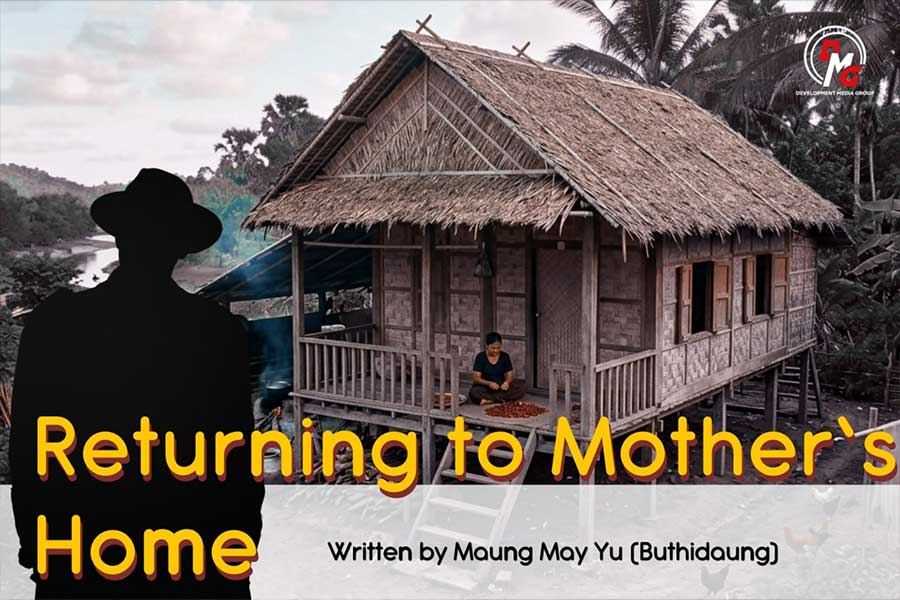
The house was modest built with wooden posts, bamboo walls, and a tin roof yet it was sturdy and dignified. The staircase, carefully constructed with brick and concrete, made it appear neat and welcoming to visitors.
A Home Full of Memories
Behind the house, vegetables were always grown. In front stood two mango trees, a danyin tree, and a small berry tree that my mother loved. A shrub of medicinal plants swayed gently in the breeze, its flowers often used as a remedy for children’s coughs and colds.
In that home, my siblings and I lived together with our mother in warmth and unity. Though she was growing older and no longer had formal work, she never depended entirely on her children. Instead, she devoted herself to preparing balanced meals for the whole family every day. She knew each of our preferences and cooked with patience and care.
If I were to praise her, I would say her chickpea curry was the best in the world. On days when she cooked dried wild pork with sour leaf soup, there was never enough rice to go around. Even a simple mango soup tasted extraordinary because of her touch.
Mother’s Love for Her Home
My mother loved her home deeply. As her children grew older, she expanded and repaired the house year after year. Gradually, it became a large family home.
She feared that her children would leave once they started families of their own, so she kept extending the house, hoping to keep everyone close. She believed her home was the safest place for all of us.
But her hopes were shattered before she even reached the age of 60.
February 3, 2024, was the last day she ever saw her home.
The Day We Left
Before that day, the town had become eerily quiet and frightening. At night, junta troops patrolled the streets, staging mock battles. On one night, heavy and small arms fire from a monastery hill shook the entire town. On another day, a mortar shell landed near a house in the southern ward.
After these, our family led by my mother decided to leave. At the same time, the Arakan Army had warned civilians to evacuate as a major offensive was imminent.
On February 3, 2024, we left our home.
I still remember what my mother did that day. She cleaned the house thoroughly, carefully packed essential belongings, repaired the compound fence, and cleaned the household shrine, offering fresh flowers and water. Finally, she locked the doors and stepped out quietly.
Her eyes were red. Tears welled up in them.
War and Displacement
At that time, battles across Arakan were intensifying. The Arakan Army had already captured several towns and was preparing to seize the remaining ones.
The fighting around the Saing Tin Bridge was particularly intense. Artillery fire, drones, and airstrikes filled the sky. We often had to run to bunkers in the middle of meals. Shells exploded near the village where we had taken shelter.
A Family Torn Apart
As the conflict worsened, our situation became increasingly unsafe. With most of Arakan under Arakan Army control, government employees lost their jobs and salaries. Livelihoods collapsed.
Eventually, we had to separate.
My mother stayed behind in the village with her grandchildren, unwilling to go far from home. My older brother moved to an area near the Bangladesh border, while our family relocated to Kyauktaw, near the India trade route.
When my mother heard our decision, she could not sleep. Late into the night, she sat smoking quietly, lost in thought. Yet she did not stop us, she understood that survival had become more important than staying together.
The war shattered a family that had lived together for more than 30 years.
News from Afar
On May 18, 2024, the Arakan Army captured nearly 20 junta battalions in Buthidaung Township. But the town itself had already been reduced to ashes.
Before the final battle, junta troops and ARSA (Arakan Rohingya Salvation Army) militants burned down every Arakanese/Rakhine home systematically and without mercy.
My mother’s house was among them.
The Desire to Return
By late 2025, much of Arakan had stabilized under new administration. Agriculture and trade resumed, and people began rebuilding their lives.
Festivals returned. Laughter returned.
As the Thingyan water festival approached, the sound of songs filled the air once again. And within me, an uncontrollable longing grew to return to my mother’s home.
The End of the Journey
From afar, the town no longer looked alive only dark and lifeless. Inside, every house lay in ruins.
Where my mother’s home once stood, only the staircase remained.
But in one corner of the compound, there was a small hut made from scraps of old wood and roofing sheets.
My mother had built it.
She feared that if there were no home, her children would never return. So she created something, anything that could still be called home.
Knowing this, my heart ached.
I felt deep sorrow for her.
I wanted to fulfill her wish.
But…

Opinion
We Must Remove What Is No Longer Needed
By Admin 24 Apr 2026
Grandmother’s Little Kerosene Lamp
By Admin 08 Apr 2026

Bangladesh’s New Foreign Policy Gamble and the Arakan Puzzle
By Admin 06 Apr 2026
The Iron Shackle Left Behind: When Myanmar’s War Turned on Its Own Soldiers
By Admin 23 Mar 2026
The Rhythms of War
By Admin 16 Mar 2026

POLITICS

BUSINESS
Industry to manufacture finished goods from coconut starting in early 2020
By Aung Kaung Zaw 20 Nov 2019