
- Junta airstrikes on Ponnagyun IDP camps kill 15 civilians, injure 30: AAPP
- Myanmar junta airstrikes kill 163 civilians in September, Arakan hardest hit: MDSI
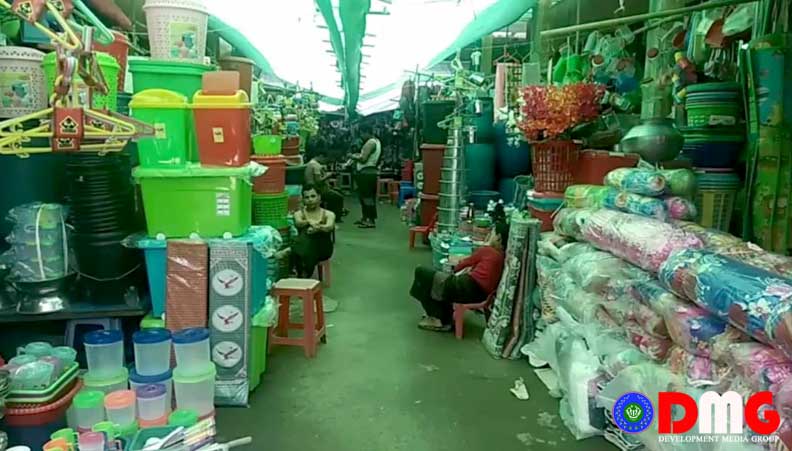
- Commodity prices rise in Ramree after Kyauktaw market bombing
- Junta intensifies offensive against resistance-held territory in strategic Sagaing town
- Fighting escalates in Sittwe as Arakan Army captures junta outposts
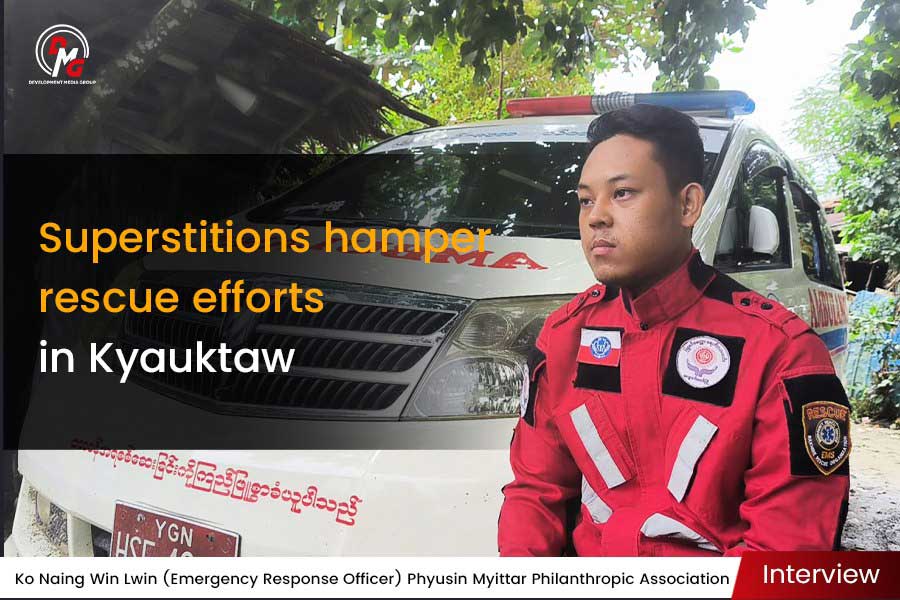
DMG interview: Superstitions hamper rescue efforts in Kyauktaw
DMG spoke with Ko Naing Win Lwin, an emergency response officer at the Phyusin Myittar Philanthropic Association, about the rescue operations, logistical hurdles and institutional challenges encountered during the bombing in Kyauktaw.
13 Oct 2026
As relentless junta airstrikes continue to batter Arakan State, civilian casualties are mounting, leaving local populations facing acute threats to their safety and survival.
Amid these crises, local humanitarian and rescue organizations are working tirelessly around the clock to respond to emergencies in real time and save civilian lives.
The Phyusin Myittar Philanthropic Association in Kyauktaw has continued its work to save lives despite immense hardships. The association says the recent mass casualty aerial bombardment in Kyauktaw presented unprecedented challenges.
DMG spoke with Ko Naing Win Lwin, an emergency response officer at the Phyusin Myittar Philanthropic Association, about the rescue operations, logistical hurdles and institutional challenges encountered during the bombing in Kyauktaw.
DMG: Could you describe the situation you encountered during the September 28 aerial bombing in Kyauktaw?
Ko Naing Win Lwin: Right after the bombs fell, we gathered information about the situation and deployed two ambulances. When our vehicles arrived at the Indian Market, the number of casualties was beyond counting. Wounded people were everywhere, along with the dead. Some victims had their limbs severed and scattered across the scene. The devastation was so overwhelming that we were momentarily paralyzed, unable to figure out who or what to attend to first.
People of all backgrounds and ages were mixed together, including children and elderly people. Because it was a market, it was heavily frequented by daily wage earners and manual laborers.
Shoppers also came from all around, so virtually every township was represented. Children and elderly residents were among the victims. When we arrived, some victims were still lying motionless amid the debris. We could not pull them out immediately, but we pulled them out despite their injuries. Some people even breathed their last while we were trying to bring them to safety.
DMG: What kind of difficulties did you encounter during the rescue operations?
Ko Naing Win Lwin: To be entirely frank, very few people were willing to help pull out the wounded during this incident. A small group of local authorities, firefighters and members of our team, numbering just over a dozen people altogether, were there. Yet there were 30, 40 or 50 victims, and no one else stepped forward to help pull them out. We could not call on bystanders to assist us either. That was the situation we faced.
DMG: How did this rescue operation differ from previous humanitarian responses you have handled?
Ko Naing Win Lwin: In the past, when the military launched airstrikes, it would typically send a single aircraft, drop a bomb or two and leave without returning. But its tactics have now shifted toward coordinated attacks involving multiple waves of aircraft. The regime sends several fighter jets in succession. Even when you think they have finished bombing and departed, they circle back and drop more ordnance.
What makes this situation so difficult is the sheer number of casualties. When bombs strike crowded civilian areas such as bustling markets, ambulances are the primary necessity. Given the size of Kyauktaw Township, our association has only two ambulances. The incident at Indian Market presented an exceptionally severe crisis.
We did not have enough vehicles. We saw cargo trishaws and other transport trucks parked nearby, but when we asked their drivers to carry the wounded, they refused. They said things like, “I have to haul cargo.” Some people flatly refused to transport the injured, even asking, “Who is going to pray for the deceased if they die in my vehicle?” We encountered that kind of callousness. When junta airstrikes hit, the critical needs are emergency medical transport and, once patients reach healthcare facilities, blood supplies.
DMG: You mentioned that people were reluctant to transport emergency patients to help save their lives. What would you like to say about this?
Ko Naing Win Lwin: To put it bluntly, deeply rooted superstitions persist. People still cling to the belief that if someone dies inside their vehicle, the victim’s wandering spirit will remain trapped, bringing ruin to their transport business. Even if a single drop of blood stains the vehicle, they become obsessed with the thought that it is no longer clean. We witnessed that mindset firsthand. That day, as we stopped passing Hijet trucks and pleaded, “Brother, please load this patient and help us,” the drivers refused.
They retorted, “If this patient dies, will you recite prayers for them? What can you guarantee?” Sometimes, you cannot entirely blame them because everyone clings to their own beliefs and superstitions. I do not mean to dismiss their beliefs entirely. Having personal convictions is one thing, but when human life is under immediate threat, should those superstitions not be set aside? I want to earnestly appeal to everyone to put aside traditional superstitions and step forward to help save lives.
DMG: What difficulties did you face when transferring emergency patients to hospitals or clinics?
Ko Naing Win Lwin: Whenever we deal with bleeding injuries caused by airstrikes or other attacks, blood is desperately needed. But obtaining blood is extremely difficult because we no longer have telecommunications networks like we used to. In the past, when phone lines were operational, communication was simple. We could immediately announce which blood type was needed. Today, with no telecommunications networks, finding blood is an immense struggle. Donors are no longer concentrated in one place; they are scattered everywhere. They may or may not be at home, and reaching them is a matter of chance. Blood management has become a major bottleneck.
Right now, blood brokers are proliferating. Before we can even find a voluntary donor, we are forced to pay K50,000 just to secure a single unit of blood because of these exploiters. Their actions have made genuine blood donors increasingly scarce. In the past, people donated blood purely out of altruism and goodwill. Now, seeing these profiteers sell donated blood, genuine donors have become reluctant to donate, deepening the blood shortage.
DMG: What are your thoughts on the Kyauktaw bombing?
Ko Naing Win Lwin: The previous incidents we experienced were not quite this catastrophic. That does not mean past events were not terrible, but they were not on this scale. This time, the military intentionally and directly targeted a bustling market where civilians were trading and traveling. It was a deliberate mass casualty attack carried out by the military. I strongly feel that the international community must see and recognize these atrocities. Yet at the same time, there is also the grim realization that the international community remains powerless to do anything right now.
DMG: Could you share the current challenges and difficulties facing the Phyusin Myittar Philanthropic Association?
Ko Naing Win Lwin: For our association, our most critical struggles are funding shortages and a lack of emergency vehicles. Our association provides social welfare and healthcare services throughout Kyauktaw Township. Ever since we resumed operations following the 2024 battle for control of Kyauktaw, we have faced severe, ongoing funding deficits. We managed to operate from 2024 through 2026 largely thanks to a donation of K10 million from writer Wai Hun Aung.
However, because of the changing nature of these aerial bombardments, our association is now forced to make preparations in advance. I have only two emergency vehicles. Are two vehicles enough? Absolutely not. During that day’s disaster, we had to travel back and forth to healthcare facilities not once or twice, but three or four times. Fuel costs alone were staggering. Our funds were not just tight; they were virtually nonexistent. Despite those conditions, we pushed ourselves to the absolute limit.
Our association’s greatest bottlenecks remain funding and vehicles. We have two vehicles, but are they in good condition? Far from it. Both are structurally degraded and falling apart. One vehicle runs well, but its tires are worn out. Right now, tire prices are exorbitant. A single tire costs more than K700,000, K600,000 or K500,000. The difficulties are multifaceted.
Furthermore, we face logistical obstacles along the routes used to transport emergency patients. Many displaced people and manual laborers cannot afford emergency transport. They simply cannot afford to travel in ambulances, and hiring private vehicles is even more expensive, leaving them in an impossible situation. We try to address these problems and provide whatever assistance we can. People might look at us and assume, “They must have plenty of funds since they’re handling everything.” But our funds are meager; we are simply improvising and making ends meet with whatever little we have.
DMG: Is there anything else you would like to add?
Ko Naing Win Lwin: We arrive at the scene within just five to seven minutes after the fighter jets finish firing and depart. I do not blame the people gathered nearby; everyone is gripped by absolute terror. You could say their souls have flown out of their bodies from fright. In those moments, they were too panicked to help pull the victims out. Looking ahead, if, God forbid, we face large-scale aerial attacks again, I want to advise and encourage everyone nearby to actively participate, cooperate and help prevent the loss of human lives.
I also want to say that, moving forward, we hope people at home and abroad will work with our philanthropic association so we can continue assisting the public and protect the lives and property of our people more effectively than ever before.
DMG: Thank you very much for your time and insights.

Opinion
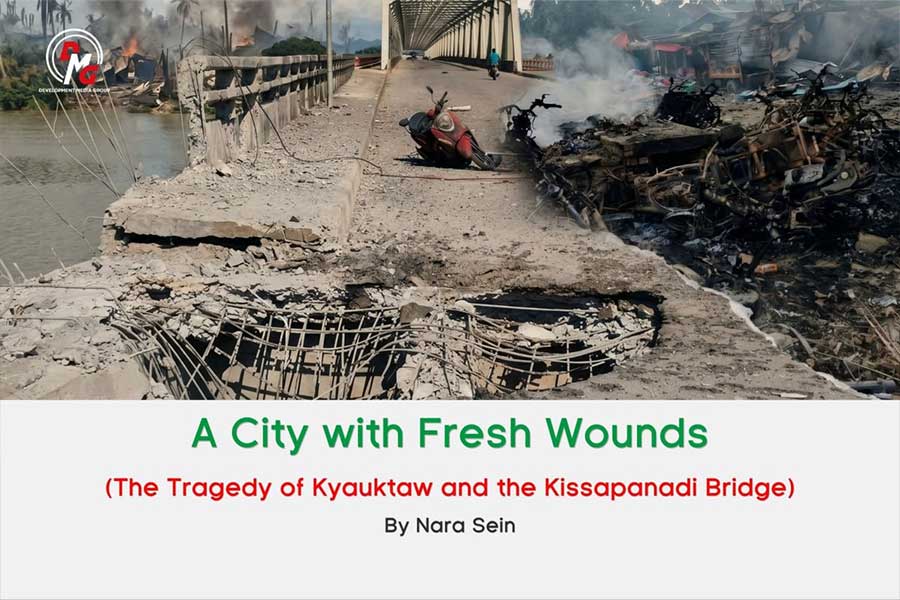
A City with Fresh Wounds (The Tragedy of Kyauktaw and the Kissapanadi Bridge)
By Admin 01 Oct 2026
Arakan Army’s Gains and the Changing Geopolitics of Arakan
By Admin 29 Sep 2026
Beyond Military Victory: What Is Myanmar’s Ultimate Political Objective?
By Admin 26 Sep 2026
UN at a Crossroads: Six Priorities for a Shared Future
By Admin 23 Sep 2026
.jpg)
How Can Myanmar’s Political Crisis Be Brought to an End?
By Admin 13 Sep 2026
POLITICS

BUSINESS
Industry to manufacture finished goods from coconut starting in early 2020
By Aung Kaung Zaw 20 Nov 2019