
- High airfares leave low-income families stranded in blockaded Sittwe
- MSF rrges civilian protection after Sittwe shelling kills two, injures 17
- ULA warns Arakan residents of airstrike risks during Thadingyut festival
- Months-long internet blackout drives up costs for residents of Thandwe and Gwa
- At least five injured in junta Y-12 airstrikes on Werathani villages
Resistance-held towns lost amid weakening unity among revolutionary forces: analysts
Political analysts say the regime’s ability to retake several towns across Myanmar that were previously seized by resistance forces during Operation 1027 is linked to Chinese intervention and weakening unity among revolutionary groups.
12 May 2026
DMG Newsroom
12 May 2026, Mandalay
Political analysts say the regime’s ability to retake several towns across Myanmar that were previously seized by resistance forces during Operation 1027 is linked to Chinese intervention and weakening unity among revolutionary groups.
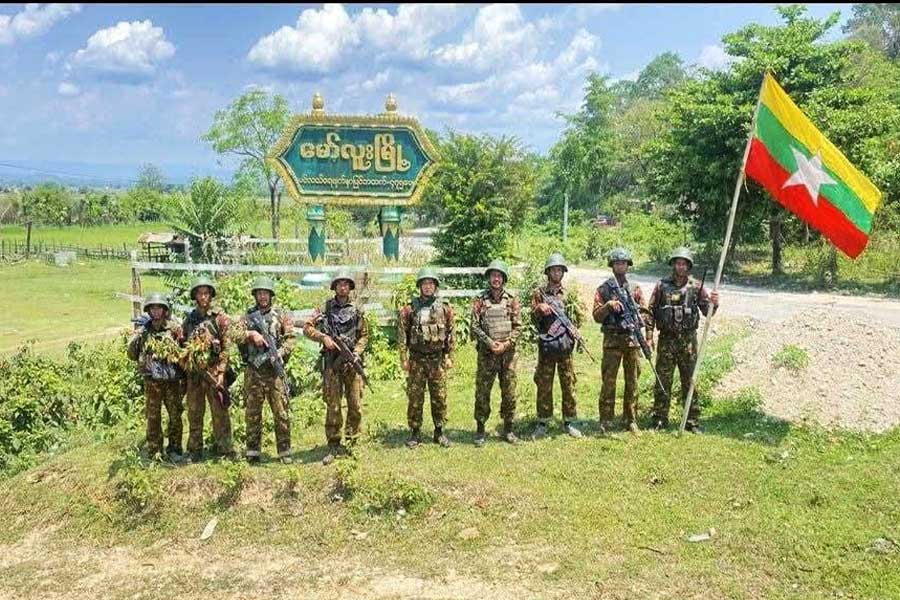
Beginning in mid-2025, following pressure and mediation from the Chinese government, the Myanmar National Democratic Alliance Army (MNDAA) and the Ta’ang National Liberation Army (TNLA) were forced to hand back control of some townships in northern Shan State and Mandalay Region to the regime.
In addition, due to large-scale military offensives by the regime, several towns in northern Shan, Kayin and Chin states, as well as Mandalay and Sagaing regions, have recently fallen back under regime control.
Political observers noted that the loss of resistance-held territory is also connected to weakening alliances among revolutionary groups and shortages of military supplies.
“The decline in relations among allied forces and the failure to build effective coordination have created major logistical challenges for the revolution. More importantly, access to arms and ammunition became much more difficult after the United Wa State Army announced it would no longer supply weapons. These factors contributed significantly to the military setbacks,” political analyst Dr. Sai Kyi Zin Soe told DMG.
The United Wa State Army, one of the most powerful armed groups along the Chinese border, announced in August 2025 that it would stop supplying weapons to allied groups, including the Shan State Progress Party, the MNDAA, and the TNLA.
Dr. Sai Kyi Zin Soe added that Chinese involvement in territorial negotiations, along with decisions by Brotherhood Alliance members to prioritize territorial control over alliance cooperation, further weakened ties among revolutionary forces.
The regime has since regained control of several towns captured during Operation 1027, including Lashio, Mogok, and Momeik, following Chinese mediation efforts.
Regime offensives have also retaken Singu, Madaya, and Thabeikkyin in Mandalay Region, as well as Htigyaing, Indaw, and Mawlu in Sagaing Region. Some towns in Chin and Kayin states have also fallen back under regime control.
Before its planned election process, the regime strengthened ties with both China and Russia. Analysts say the acquisition of drones and aerial warfare technology from China has enabled the military to intensify offensives against resistance forces.
“The regime was able to establish strong ties with Russia and China before the election. It secured advanced drones and support related to aerial operations. Since receiving this support, the military has expanded its use of airstrikes and increased pressure on resistance-controlled areas,” Dr. Sai Kyi Zin Soe said.
During 2026, the regime recaptured several towns in Mandalay and Sagaing regions and Chin State, while continuing to launch military offensives in multiple areas.
After seizing Falam in northern Chin State, the regime reportedly stationed troops in Kangyi Village in Saw Township, Magway Region, located about 12 miles from Mindat in southern Chin State, posing a military threat to both Chin State and Magway Region.
Military observers also pointed to the significant disparity in weapons and ammunition between the regime and revolutionary forces.
“There is a huge gap in arms and ammunition between the regime and revolutionary forces. While the military can rely on heavy ammunition and air support, revolutionary groups are forced to use their ammunition carefully. In such conditions, the side with greater firepower usually gains the advantage,” said Captain Zin Yaw, a participant in the Civil Disobedience Movement.
Alongside its military gains, the regime is also continuing efforts to secure international recognition and legitimacy.
Resistance forces captured more than 100 towns across Myanmar during Operation 1027. However, since mid-2025, revolutionary groups have not captured additional towns nationwide, while the number of towns retaken by the regime has continued to increase.
Daily clashes between regime forces and revolutionary groups are currently ongoing in Arakan, Chin, Kachin, Kayin, and Mon states, as well as Sagaing and Tanintharyi regions.

Top News
High airfares leave low-income families stranded in blockaded Sittwe
By Admin 25 Oct 2026
MSF rrges civilian protection after Sittwe shelling kills two, injures 17
By Admin 25 Oct 2026
ULA warns Arakan residents of airstrike risks during Thadingyut festival
By Admin 24 Oct 2026
Months-long internet blackout drives up costs for residents of Thandwe and Gwa
By Admin 24 Oct 2026
At least five injured in junta Y-12 airstrikes on Werathani villages
By Admin 24 Oct 2026