
Five years on Myanmar faces uncertain military and political outlook after coup
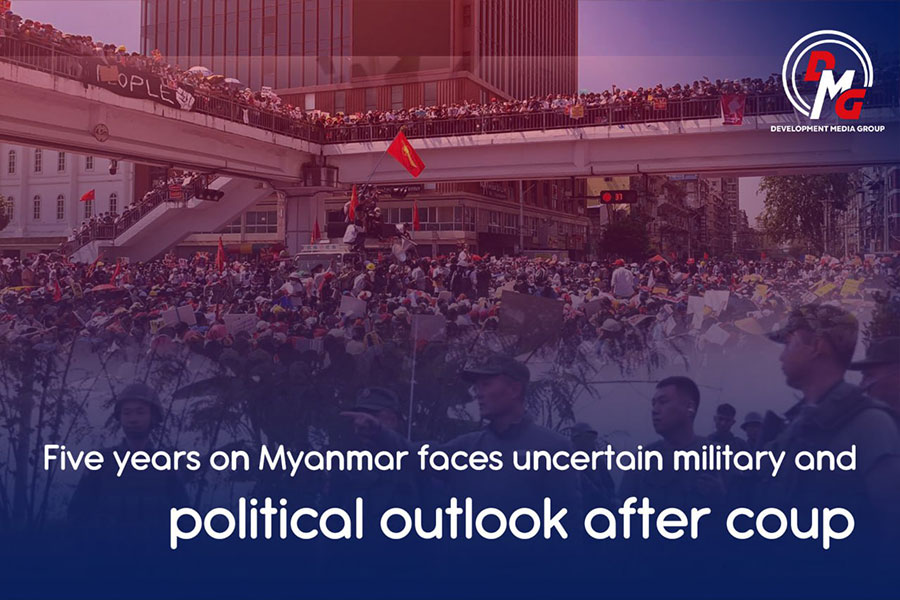
February 1 marks five years since the military coup in Myanmar. The armed forces seized power by overthrowing the National League for Democracy, which won the 2020 general election, citing alleged widespread electoral fraud.
01 Feb 2026
DMG Newsroom
1 February 2026, Kyauktaw
February 1 marks five years since the military coup in Myanmar. The armed forces seized power by overthrowing the National League for Democracy, which won the 2020 general election, citing alleged widespread electoral fraud.
Mass public protests against the coup were met with violent crackdowns by the regime, resulting in large numbers of civilian casualties. In response, various resistance groups emerged under what became known as the Spring Revolution, launching armed opposition to military rule.
To dismantle military control, young revolutionaries sought training and support from ethnic armed organizations. Groups including the Kachin Independence Army, Arakan Army, Ta’ang National Liberation Army, Karen National Union and Chin National Front provided military training and assistance to newly formed resistance forces.
The Students Armed Force told DMG that the Arakan Army has provided extensive support since the group was formed, including training and battlefield experience.
“Since the founding of the Students Armed Force, the Arakan Army has provided strong support, including military training. We gained valuable combat experience in the early period and continue to cooperate as allies,” spokesperson Ko Min Htet Han told DMG in an interview in December 2025.
In addition to independent groups, many resistance forces now operate under the Ministry of Defence of the National Unity Government, which emerged from the ousted National League for Democracy. Daily clashes continue in central Myanmar, including Sagaing, Magway, Bago and Mandalay regions, as resistance operations intensify.
On October 27, 2023, the Brotherhood Alliance, made up of the MNDAA, TNLA and AA, launched Operation 1027, stating its aim was to dismantle military rule and crack down on cyber scam networks along the China Myanmar border.
The operation resulted in the military losing an unprecedented number of bases in a short time.
Military analyst U Than Soe Naing said in September 2024 that the operation influenced around 60 percent of the country, adding that the momentum could extend to Mandalay and PyinOoLwin.
However, intervention by China allowed the regime to regain ground. After the MNDAA seized the Northeastern Regional Military Command headquarters in Lashio, Chinese Foreign Minister Wang Yi visited Naypyidaw on August 14, 2024. Subsequent pressure from Beijing forced the MNDAA and TNLA to withdraw from several captured areas.
Using the national conscription law, the regime launched counteroffensives and recaptured Lashio from the MNDAA, as well as Nawnghkio, Kyaukme and Hsipaw from the TNLA. The military also re-entered Momeik and Mogok through ceasefire agreements.
On January 30, 2026, the regime extended martial law for another 90 days in 63 townships under resistance control. Military analysts warned that air and artillery attacks are likely to intensify as commanders seek to secure these areas.
“Over the past five years, resistance forces have gained considerable experience. The regime is trying to use an election as an exit strategy. If the resistance can block this, they will gain the advantage,” writer Wai Hun Aung said.
At present, 19 resistance groups have formed the Spring Revolution Alliance to coordinate operations in central Myanmar.
“We plan to carry out joint operations outside Chin State, particularly in areas bordering Chin State that have not yet been liberated,” Chin Brotherhood spokesperson Salai Yaw Mang told Myanmar Now.
Observers predict continued violence across the country, with civilian casualties expected to rise due to the regime’s use of heavy weapons and air attacks.
According to the Assistance Association for Political Prisoners, at least 7,738 civilians have been killed by the regime and its affiliates in the five years since the coup.
As a political exit, the regime plans to hold elections in 2026, a process expected to result in a government led by the military-backed Union Solidarity and Development Party.
Political analyst Maung Tamar said 2026 will be a decisive year, warning that if the regime secures ceasefires with major ethnic armed organizations such as the Kachin Independence Army, Karen National Union and Arakan Army, resistance forces could face mounting pressure.
Analysts say revolutionary leaders must maintain a broad and strategic outlook in both military and political spheres as global political dynamics continue to shift.

Top News
People with disabilities in Arakan face deepening humanitarian crisis, CAS warns
By Admin 21 Oct 2026
CPU/CPA says junta airstrikes deliberately target civilians in Paletwa
By Admin 21 Oct 2026
Junta nighttime airstrikes kill four civilians in Werathani
By Admin 21 Oct 2026
Two junta defectors urge conscripts to surrender to AA to save their lives
By Admin 21 Oct 2026
NGO, INGO staff relocate to Yangon as fighting nears Sittwe
By Admin 21 Oct 2026