
- Kyauktaw market closure disrupts trade and drives up prices across Arakan
- Arakan has Myanmar’s highest multidimensional poverty, 1.66 million affected: UNDP
- Arakan records most armed incidents, second-highest civilian casualty toll in Myanmar: NLTA
- Junta fails to regain territory despite major Arakan offensive: ISP-Myanmar
- Two Myebon fishermen missing after junta troops throw fishermen into sea
HRW accuses Arakan Army of mass killing of Muslims in Buthidaung village
Human Rights Watch (HRW) released a report on May 19 accusing members of the Arakan Army (AA) of killing 170 local Muslims in Hoyyar Siri, also known as Htan Shauk Khan Village, in Buthidaung Township, Arakan State.
20 May 2026
DMG Newsroom
20 May 2026, Buthidaung
Human Rights Watch (HRW) released a report on May 19 accusing members of the Arakan Army (AA) of killing 170 local Muslims in Hoyyar Siri, also known as Htan Shauk Khan Village, in Buthidaung Township, Arakan State.
According to HRW, the incident occurred during the battle for control of Buthidaung on May 2, 2024, when local Muslims were fleeing to safer areas amid the fighting.
The allegation was included in a report titled “Skeletons and Skulls Scattered Everywhere.”
HRW stated that it interviewed dozens of eyewitnesses and survivors who escaped the incident, cross-checked their accounts with satellite imagery, and analyzed photographs and videos related to the case.
Based on testimonies from 41 eyewitnesses, HRW alleged that villagers carrying white flags while fleeing the fighting were fired upon.
The report stated that at least 170 Muslims, including children, were killed in the shooting, while the total number of injured and missing persons could reach into the hundreds.
According to HRW, a list of more than 170 villagers, including around 90 children who remain dead or missing, has been compiled. The report also included analyses of photographs and videos showing human remains at three locations inside the village.
Meenakshi Ganguly, Deputy Director of HRW’s Asia Division, said survivors of the incident are currently living under the control of the Arakan Army, and that no compensation or accountability measures have been provided.
HRW also said its findings contradict responses sent by the Arakan Army, which claimed that only military personnel and members of Muslim armed groups were targeted during the fighting.
The rights group classified the incident as a serious violation of international humanitarian law and called for an independent international investigation.
The Arakan Army has repeatedly denied the allegations. In August 2025, it allowed several media outlets to visit Htan Shauk Khan Village and interview residents.
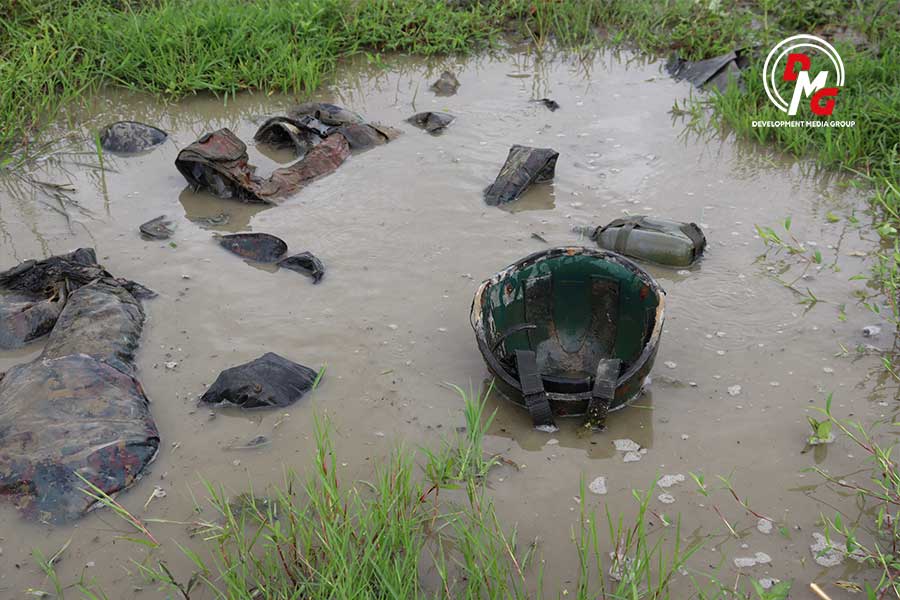
Speaking to DMG in August 2025, villager U Zoli Tee said that when residents returned to the village after the fighting, they found bodies believed to be junta soldiers.
“When we returned home after the battle, a neighbour asked me to check their house. That was where we found the skeletons. None of the skeletons belonged to Muslim men or women. They were all junta soldiers. We also found one or two corpses of Muslim armed combatants,” he said.
Villagers also stated that residents of Htan Shauk Khan had fled the area after regime forces entered the village on May 2, 2024.
Col Kaung Myat, Deputy Commander of No. 15 Military Operations Command, who is currently captured by the Arakan Army as a prisoner of war, told DMG in August 2025 that more than 100 regime soldiers and Muslim militiamen who had received military training were killed during the battle near Htan Shauk Khan Village.
“The fighting was intense. There was a lot of shooting from both sides. On our side, more than 100 officers, soldiers, and militarily trained Muslims were hit and killed. Many dependent family members were also injured,” he said.
He added that after the Arakan Army captured the Buthidaung-based No. 15 Military Operations Command on May 2, 2024, fighting continued around Light Infantry Battalion 551, forcing around 1,000 military personnel and family members to retreat to Htan Shauk Khan Village.
Despite those accounts, HRW released its report on May 19 accusing the Arakan Army of committing serious human rights violations.
“This Htan Shauk Khan case will always remain an allegation against the Arakan Army. Journalists visited the area last year and reported freely, and both villagers and military officers stated that the bodies belonged to military personnel. However, human rights organizations appear to be using this incident to tarnish the military success and reputation of the Arakan Army,” an observer on Arakan affairs said.
Muslim leaders from Maungdaw District also released a clarification on August 23, 2025, stating that the skeletons found in Htan Shauk Khan Village were the remains of military personnel killed during battle, and that allegations accusing the Arakan Army of killing villagers were fabricated.
During the battles for control of Maungdaw and Buthidaung near the Bangladesh border, regime forces and Muslim armed groups, including the Arakan Rohingya Salvation Army (ARSA), the Rohingya Solidarity Organization (RSO), and the Arakan Rohingya Army (ARA), fought alongside the military against the Arakan Army, while tensions linked to race and religion also intensified.
As a result, allegations and rights-related accusations concerning the Arakan Army frequently continue to emerge in the Buthidaung and Maungdaw areas.

Top News
Kyauktaw market closure disrupts trade and drives up prices across Arakan
By Admin 10 Oct 2026
Arakan has Myanmar’s highest multidimensional poverty, 1.66 million affected: UNDP
By Admin 10 Oct 2026
Junta fails to regain territory despite major Arakan offensive: ISP-Myanmar
By Admin 10 Oct 2026
Clashes intensify near Taung Maw Oo naval station as Arakan Army launches offensive
By Admin 09 Oct 2026