
- Y-12 aircraft, drones circle over Sittwe as clashes intensify
- Panic grips Sittwe after deadly reported Y-12 airstrike
- At least six killed, 37 injured in reported Y-12 bombing of downtown Sittwe
- Junta column heading toward Kyindwe suffers heavy casualties in resistance ambushes
- Junta replaces Arakan State security minister amid escalating battles near Sittwe
Weaknesses in strategy, ammunition shortages blamed for loss of northern Chin State
In recent months, the Myanmar military regime has recaptured some resistance-held towns in northern Chin State and is also launching offensives on towns in southern Chin State.
23 May 2026
DMG Newsroom
23 May 2026, Tonzang, Chin State
In recent months, the Myanmar military regime has recaptured some resistance-held towns in northern Chin State and is also launching offensives on towns in southern Chin State.
Political and military analysts assess that the regime forces were able to regain control of towns in Chin State due to weaknesses in military preparations, strategic failures, and shortages of weapons and ammunition among Chin revolutionary forces.
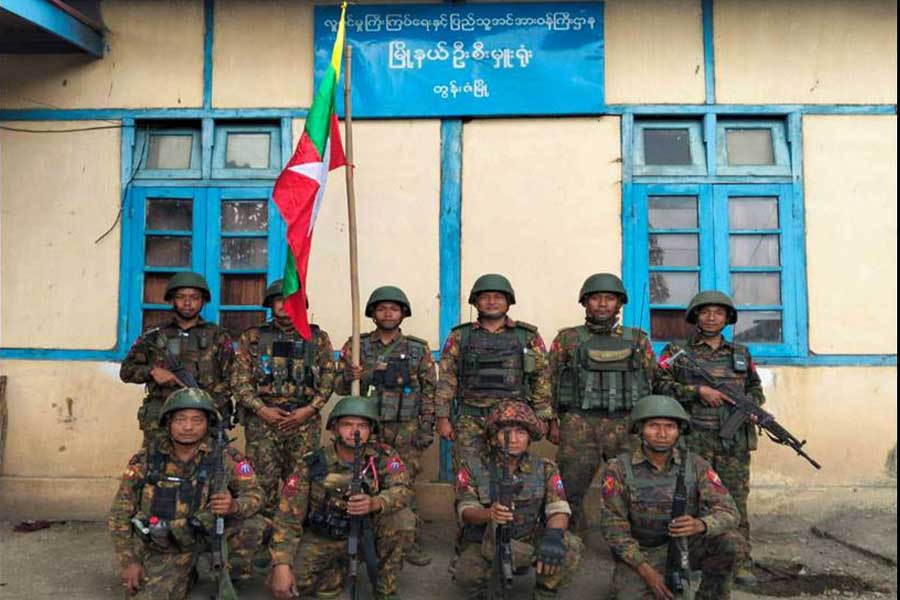
On April 25, regime forces recaptured Falam Town in northern Chin State, which had been controlled by the Chin Brotherhood (CB). On May 19, regime troops also retook Tonzang Town, which had been controlled by the Chinland Council, and later announced that they had secured the entirety of northern Chin State.
Chin political analysts view the loss of those northern Chin towns to the regime as the result of weak advance planning and strategic military errors among Chin revolutionary forces.
Chin political analyst Ko Salai Hwei Lian said: “The main reason for losing the entire northern Chin State is not a problem between the Chin Brotherhood and the Chinland Council. It is also not a problem between the Chin Brotherhood and the Chin National Army. There were organizational weaknesses on the part of the Chin Brotherhood. There were also organizational weaknesses on the part of the Chinland Council and the Chin National Army. If the Chin National Army and the Chinland Council had organized effectively, they were in a position to defend against the regime offensive.”
He added: “In Chin State, the junta columns that marched into the north were not even a quarter of the junta columns that marched into the south. Chiefly, they became weak in terms of organization. Because there was no proper organization, the chain of command (COC) did not function well. Therefore, it appears as though northern Chin State had to be surrendered.”
After gaining control of northern Chin State, the regime has continued applying military pressure and launching offensives on Kanpetlet and Mindat townships in southern Chin State.
Currently, fierce clashes are taking place near the 6-mile area outside Kanpetlet Town, and the regime is reportedly reinforcing its operations with ground offensives in addition to airstrikes.
Previously, six townships in Chin State had been captured by Chin revolutionary forces, including the Chin National Front/Chin National Army, Chinland Council (CC), Chin Brotherhood (CB), and the Arakan Army. However, at present, the Chin Brotherhood and the Arakan Army are only able to continue controlling four townships in southern Chin State.
Military strategic preparations were weak among Chin forces during the battle to defend Falam Town, while the Chin Defence Force was also weak in expanding troop strength and preparing in advance during the Tonzang battle.
“We have to say that we were weak in our military strategy. To defend a town, the defensive line must basically be positioned at the furthest point from that town. However, Falam’s defensive line was right near the entrance of the town. Because the defensive line was placed there, as the battle dragged on, the regime forces gradually entered the town. It was easy for the defensive line to break,” Ko Salai Hwei Lian said.
“Regarding the loss of Tonzang Town, Tonzang had been captured for quite a long time. However, CDF-Tonzang, which was based in Tonzang Town, did not do anything to expand troop strength or make preparations. It remained the same as before, and there was no preparation,” he added.
Chin revolutionary forces said that although the Chin Brotherhood (CB) and the Chinland Council (CC) jointly resisted during the battle for Falam, only the Chinland Council (CC) fought alone during the battle for Tonzang.
Captain Zin Yaw, a participant in the Civil Disobedience Movement, also analyzed that the towns in Chin State fell under regime control due to the involvement of Chin forces cooperating with the military, as well as the inability of revolutionary forces to match the regime’s firepower.
“I view it as an inability to match firepower. Not having unity and being unable to match firepower are not the same. In Falam, the revolutionary forces were still able to control it well in the early stages. As time went on, the regime forces used manpower and firepower. At that point, the firepower on the side of the revolutionary forces declined, and only then was Falam captured,” he said.
“When the regime forces launched an offensive on Tonzang, it was a situation where they secured it easily with the help of the Zomi Revolutionary Army - Eastern Command (ZRA-EC). They did not even have to fight intensely. Chiefly, rather than a lack of unity on the side of the revolutionary forces, the military’s firepower and their ability to win over groups like the Zomi Revolutionary Army - Eastern Command (ZRA-EC) led to the loss of the entire northern Chin State,” he added.
Since mid-2025, the regime has been continuously recapturing townships previously seized by revolutionary forces in northern Shan State, Mandalay, Sagaing and Tanintharyi Regions, Kayin and Chin States.
Although revolutionary forces had seized control of 104 towns across 10 states and regions throughout Myanmar after the coup and during Operation 1027, the regime has reportedly regained control of 19 of those towns.
A report released on May 19 by the BNI-Myanmar Peace Monitor stated that revolutionary forces had controlled up to 104 towns during the post-coup period, including 24 towns in northern Shan State, 24 towns in Arakan State, 16 towns in Chin State, 14 towns in Kachin State, 8 towns in Sagaing Region, 5 towns in Kayah State, 4 towns in Mandalay Region, 2 towns in southern Shan State, 2 towns in eastern Bago Region, and 1 town in Tanintharyi Region.

Top News
Y-12 aircraft, drones circle over Sittwe as clashes intensify
By Admin 23 Oct 2026
Panic grips Sittwe after deadly reported Y-12 airstrike
By Admin 23 Oct 2026
At least six killed, 37 injured in reported Y-12 bombing of downtown Sittwe
By Admin 23 Oct 2026
Fighting continues on Ngapyi Island as junta troops remain trapped
By Admin 22 Oct 2026

Junta allows Aung San Suu Kyi to speak with son for first time in over five years
By Admin 22 Oct 2026