

- APHR opposes Min Aung Hlaing’s Malaysia visit, urges halt to Myanmar returns
- Myanmar military airstrikes kill eight in Ponnagyun as attacks escalate across Arakan
- One killed, four injured as junta bombs Pannilar IDP camp, Aungphyupyin Village in Ponnagyun
- RICE report says Mon state faces deepening socioeconomic, security crisis
- IPCM offers emergency support to Myanmar journalists facing threats, exile
Arakanese fishermen struggle as water resources decline
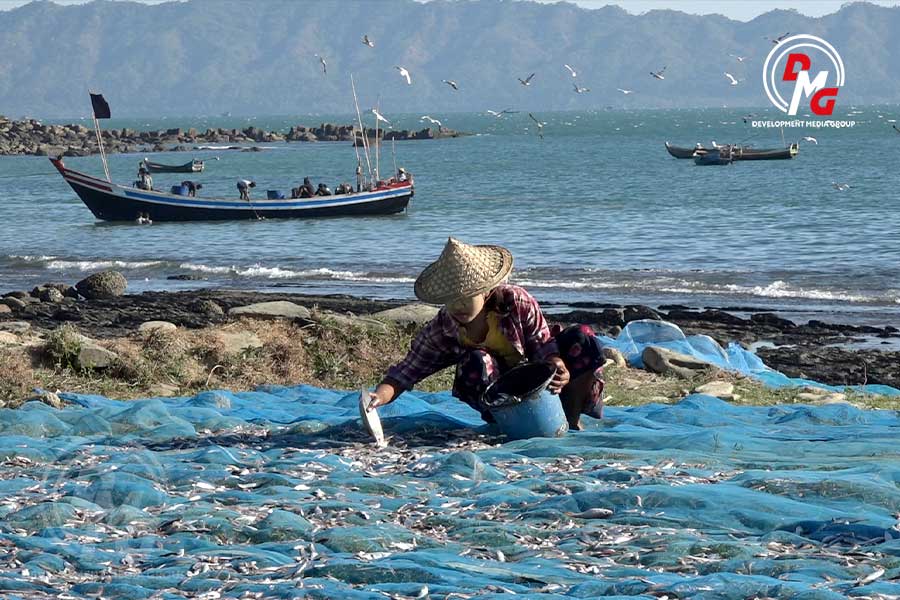
Local fishermen say the fishing industry in Arakan State is facing serious difficulties due to the depletion of water resources in rivers, lakes and the sea, leading to a sharp decline in fish and shrimp production.
12 Jan 2026
DMG Newsroom
12 January 2026, Thandwe
Local fishermen say the fishing industry in Arakan State is facing serious difficulties due to the depletion of water resources in rivers, lakes and the sea, leading to a sharp decline in fish and shrimp production.
Fishing is mainly carried out in Ramree, Thandwe, Gwa, Kyaukphyu, Pauktaw, Sittwe, Rathedaung and Maungdaw townships.
Fishermen in Ramree Township say fish and shrimp stocks have been decreasing for about two years due to water scarcity, while low market prices for their catches are making it increasingly difficult to continue working.
A resident of Thalubyein Village in Ramree Township said that catches have dropped significantly in recent years. "In the past, if you went out fishing for a week, you could get about 20 viss of dried shrimp and other products. Over the last two or three years, it has become much worse. Now, after a week at sea, you might not even get 10 viss, sometimes only five. With low prices, fuel costs and repair expenses, we end up in debt," he said.
Before the military coup, dried shrimp and dried fish from Arakan State were transported to mainland Myanmar and sold for between K80,000 and K150,000 per viss, depending on size. Currently, prices have fallen to around K40,000-K50,000 per viss, creating hardship for fishermen and fish processors.
A woman from Ramree Township said transportation difficulties have further reduced income. "Dried shrimp used to be sold in Yangon, but now the roads are in bad condition, so shipping is difficult. We can only sell locally and can't charge higher prices. Dried fish and fish paste are also sold only here, and there's very little profit left," she said.
In Thandwe and Gwa townships, offshore fishing and night fishing have been restricted by the Arakan Army due to incidents involving Myanmar Navy warships shooting at and arresting fishermen.
Those fishing closer to shore also report declining catches.
A resident of Jeittaw Ward in Ngapali said security concerns have limited fishing activities. "In the past, if you went far out to sea, the price would be good. Now, because we're afraid of navy warships, we don't go far and have to fish near the shore, where there are fewer fish. What we catch doesn't sell for a good price," he said.
In Pauktaw Township, many fishermen have stopped working altogether due to the threat posed by Myanmar Navy warships. Individual fishermen are also facing shortages of food as fish resources continue to decline.
According to surveys conducted by the Department of Fisheries in 2013, 2015 and 2018, Myanmar's surface fish resources have declined by 90 percent over the past 30 years, while underwater resources have fallen by 60 percent.
A Department of Fisheries research report attributes the depletion to overexploitation, stating that 60 percent of underwater resources and 80 percent of surface resources have been exhausted.
"If we go fishing, we don't catch as much as before. Fish have been scarce for years, and military arrests make it difficult to fish. In the past, people could go as far as Thandwe. Now, even fishing near home, we can't afford food and have to borrow," said a Pauktaw resident.
Due to security restrictions, limited access to offshore fishing grounds and declining fish stocks, fishermen are facing food insecurity and are struggling to sustain their livelihoods. Rising fuel prices and the high cost of machinery and fishing equipment have further compounded the problem.
Arakan State is a coastal region where many residents rely on agriculture and fishing for their livelihoods.
The decline in fish resources has been linked to overfishing and the destruction of fish habitats, including during prohibited fishing periods. The spawning season, from May to August, is designated as a no-fishing period in many areas.
Despite warnings, some fishermen continue to fish during the spawning season, which local residents say is a major factor in the depletion of fish stocks.
"There are no strong warnings about the spawning season in some areas, so most fishermen continue to work as usual. If they stop fishing, they have no income, so they don't avoid catching fish during that time, which leads to fewer fish," said a Ramree resident.
The Arakan Army has also issued orders banning the capture and sale of rare aquatic animals, the use of toxic shock fishing methods and prohibited fishing gear, and the cutting of mangroves that serve as feeding grounds for marine life.
Rare species such as sea turtles, sharks, dolphins and whales must not be caught, killed or sold. Violations of these rules are subject to punishment under local regulations.

Top News

APHR opposes Min Aung Hlaing’s Malaysia visit, urges halt to Myanmar returns
By Admin 06 Oct 2026

Junta navy detains, severely beats three fishermen in Myebon Twsp
By Admin 05 Oct 2026
RICE report says Mon state faces deepening socioeconomic, security crisis
By Admin 05 Oct 2026