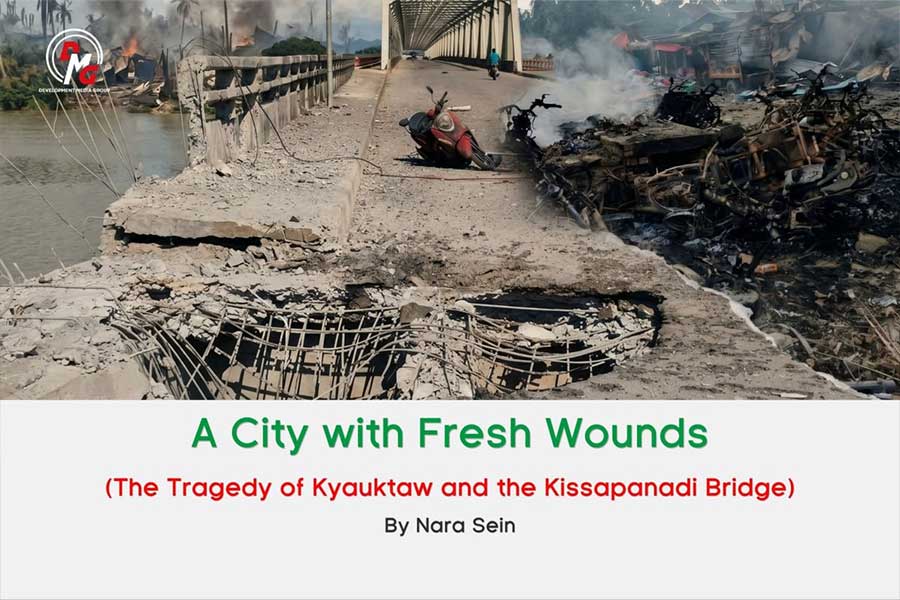

- Kyauktaw market closure disrupts trade and drives up prices across Arakan
- Arakan has Myanmar’s highest multidimensional poverty, 1.66 million affected: UNDP
- Arakan records most armed incidents, second-highest civilian casualty toll in Myanmar: NLTA
- Junta fails to regain territory despite major Arakan offensive: ISP-Myanmar
- Two Myebon fishermen missing after junta troops throw fishermen into sea
Junta shows signs of resurgence as resistance forces face mounting challenges
Meanwhile, resistance forces, grappling with ammunition shortages and financial constraints, face increasing challenges as they attempt to consolidate alliances to counter the regime’s renewed momentum.
11 Feb 2026
DMG Newsroom
11 February 2026, Mrauk-U
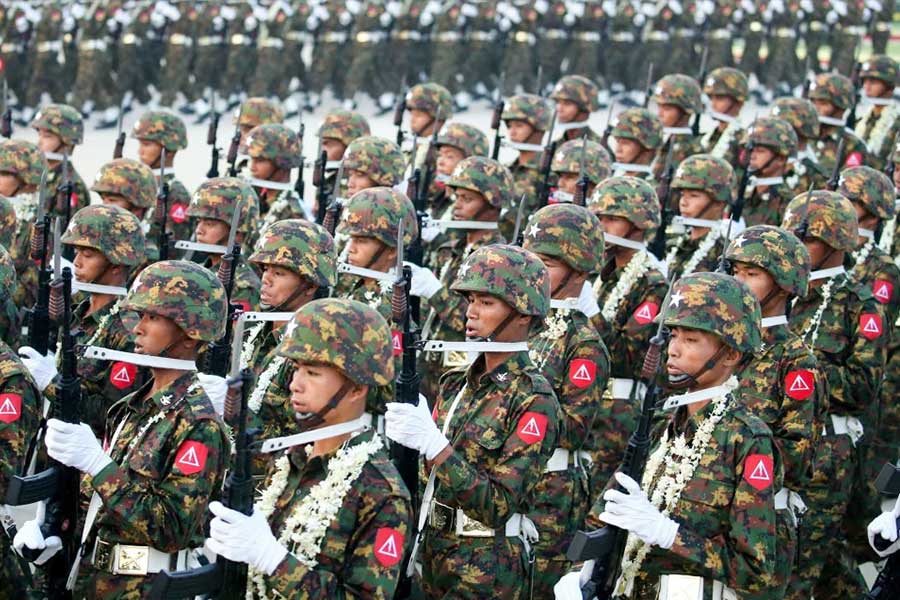
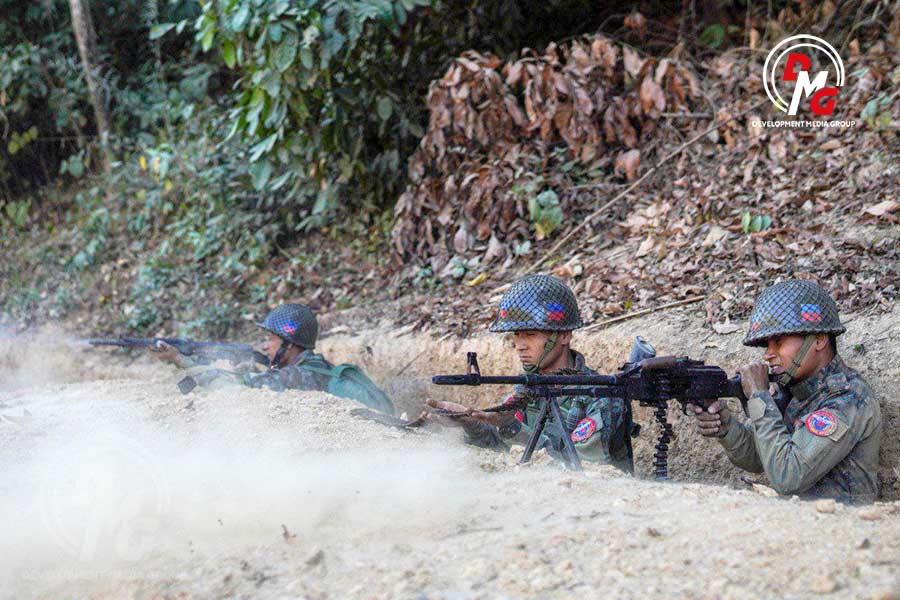
After suffering heavy losses and setbacks during “Operation 1027,” Myanmar’s military regime is showing signs of resurgence, bolstered by Chinese backing and internal restructuring.
By enforcing a national conscription law to replenish its ranks and leveraging military and political support from China, the regime has regained some lost territory and stepped up offensive operations.
Meanwhile, resistance forces, grappling with ammunition shortages and financial constraints, face increasing challenges as they attempt to consolidate alliances to counter the regime’s renewed momentum.
Conscription law and military outlook
Following the loss of extensive territory during “Operation 1027,” the regime enacted the Military Service Law on February 10, 2024, to replenish depleted forces.
The junta has reportedly been recruiting around 5,000 conscripts per batch, with the 20th batch currently underway.
With hundreds of thousands of conscripts now under its command, the regime has launched large-scale counteroffensives in central Myanmar, particularly in Sagaing, Magway and Mandalay Regions, where resistance forces remain active.
“The military regime is increasingly utilizing technology. As everyone knows, they are using drones, chemical agents and other advanced technologies, especially those provided by powerful allied nations. These pose significant challenges for us,” Ko Min Han Htet, spokesperson for the Students Armed Force (SAF), told DMG.
In response, ethnic armed organizations (EAOs) and Spring Revolution forces are also stepping up recruitment. Groups such as the Myanmar National Democratic Alliance Army (MNDAA), the Arakan Army (AA), and the Kachin Independence Army (KIA) are preparing for further military escalation.
However, political observers predict that full-scale clashes may decline this year amid growing pressure for a ceasefire.
“Armed conflict may downscale. While there will be back-and-forth skirmishes, pressure from China and shortages of ammunition will likely lead to talks of a ceasefire,” said U Aung Thu Nyein, director of the Institute for Strategy and Policy-Myanmar (ISP-Myanmar).
Captain Zin Yaw, a participant in the Civil Disobedience Movement (CDM), said the current situation mirrors the period before “Operation 1027.”
“In 2026, it’s not necessarily that the Myanmar military’s combat capability has surged, but rather that resistance forces have experienced a dip in momentum as they focus on rebuilding personnel and replenishing ammunition. The situation will only shift if an alliance member breaks the current ceasefire with the regime,” he said.
Analysts also suggest that any negotiations with EAOs may focus primarily on ceasefires and economic incentives, rather than the broader political agreements seen under former President U Thein Sein’s administration.
Political legitimacy of the junta
The regime has proceeded with elections involving parties under its control, with the military-backed Union Solidarity and Development Party (USDP) claiming victory.
Plans are underway to convene parliament and form a government, alongside efforts to introduce minor amendments to the 2008 Constitution.
Political observers say the regime may be shifting from a “legitimacy crisis” to “legitimacy challenges,” potentially gaining increased international recognition following the election.
“After the election, the regime will likely receive more international recognition, even if challenges remain,” U Aung Thu Nyein said.
In the post-election landscape, China is expected to play a more prominent role in peace processes, economic investment and geopolitics.
With a perceived decline in U.S. leadership globally, analysts say Myanmar’s political trajectory may increasingly align with China’s interests.
While resistance activities are expected to continue through 2026, experts anticipate fewer town-seizure battles and a shift toward political dialogue.
Fighting continues in Bago, Magway and Sagaing Regions, as well as Chin, Arakan, Kachin and Kayin States, though large-scale urban offensives have significantly decreased.

Top News
Kyauktaw market closure disrupts trade and drives up prices across Arakan
By Admin 10 Oct 2026
Arakan has Myanmar’s highest multidimensional poverty, 1.66 million affected: UNDP
By Admin 10 Oct 2026
Junta fails to regain territory despite major Arakan offensive: ISP-Myanmar
By Admin 10 Oct 2026
Clashes intensify near Taung Maw Oo naval station as Arakan Army launches offensive
By Admin 09 Oct 2026