
- Y-12 aircraft, drones circle over Sittwe as clashes intensify
- Panic grips Sittwe after deadly reported Y-12 airstrike
- At least six killed, 37 injured in reported Y-12 bombing of downtown Sittwe
- Junta column heading toward Kyindwe suffers heavy casualties in resistance ambushes
- Junta replaces Arakan State security minister amid escalating battles near Sittwe
Salt farming declines in Arakan State as costs rise and markets falter
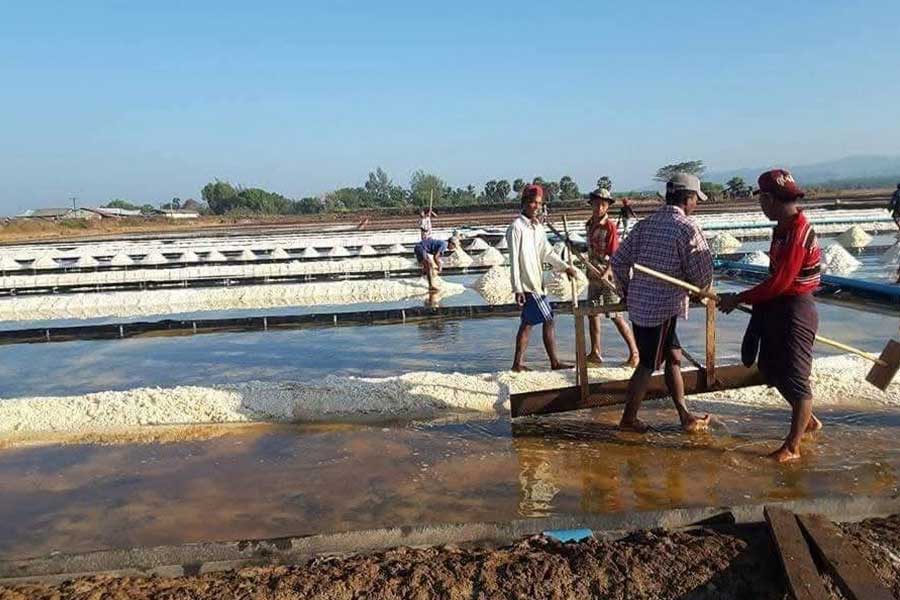
Salt farming, once a major industry in Arakan State, is facing a sharp decline due to market instability, weak demand and soaring production costs, according to local salt farmers.
28 Jan 2026
DMG Newsroom
28 January 2026, Kyaukphyu, Arakan State
Salt farming, once a major industry in Arakan State, is facing a sharp decline due to market instability, weak demand and soaring production costs, according to local salt farmers.
In 2025, more than 1,040 acres of salt farms were recorded across Arakan State. Business owners say the total area under cultivation has dropped by about 40 percent this year.
Farmers attribute the downturn to ongoing conflict, the lack of a guaranteed market and rising investment costs driven by inflation.
“Because of the military situation, high diesel prices and difficulties in obtaining machinery, the active salt farming area has fallen to just 700 or 800 acres,” said U Tun Kywe, chairman of Thanzit Yin Khwin Public Company in Kyaukphyu. “We are also facing price manipulation. Production costs are around K150 per viss, but traders offer only K100. These pressures are forcing people to leave the industry.”
He added that despite it being the salt producing season, there are times when no traders are willing to buy salt, even at the low price of K100 per viss.
The salt industry in Arakan State has been declining for decades. Until 2004, the state had more than 30,000 acres of salt farms. The downturn accelerated after large scale merchants monopolized the trade and exports to Bangladesh came to a halt.
Kyaukphyu remains the main salt producing area in Arakan State, while smaller scale production continues in Thandwe, Gwa, Sittwe, Pauktaw and Rathedaung townships.
“In our area, salt farming used to be a major livelihood,” said a resident of Pauktaw. “Over the past three years, the number of farmers has dropped sharply due to the lack of market guarantees. Our salt does not meet international standards, so we depend on the domestic market. With the war and blocked trade routes, only a few farmers are still operating.”
As fighting expanded last year, the military regime blocked land and water transport routes between townships, preventing salt from being distributed across Arakan State and causing significant losses for producers.
Currently, local production meets only part of demand, with additional supplies imported from India. Indian salt sells for about K3,000 per kilogram, while locally produced Arakan salt is sold for around K1,000 per kilogram.
Salt farming remains an important domestic industry for Arakan State. Farmers say support should focus on rebuilding markets rather than relying solely on loans.
“Instead of only offering loans, authorities should help establish a stable market,” said U Tun Kywe. “If we take loans but cannot sell our salt, it does not help. We have the technology to produce it. What we lack is a market.”
Salt farmers believe that creating a viable domestic market under current conditions would benefit local communities and strengthen the regional economy.

Top News
Y-12 aircraft, drones circle over Sittwe as clashes intensify
By Admin 23 Oct 2026

Panic grips Sittwe after deadly reported Y-12 airstrike
By Admin 23 Oct 2026
At least six killed, 37 injured in reported Y-12 bombing of downtown Sittwe
By Admin 23 Oct 2026

Fighting continues on Ngapyi Island as junta troops remain trapped
By Admin 22 Oct 2026

Junta allows Aung San Suu Kyi to speak with son for first time in over five years
By Admin 22 Oct 2026