


- Telenor charged in Norway over alleged complicity in crimes against humanity in Myanmar
- Junta launches multi-front offensive at five locations in Kyaukphyu
- Heavy fighting enters second week along Sittwe-Ponnagyun border
- 16-year-old sentenced to 10 years for child rape and murder in Maungdaw
- Civilian casualties rise in southern Arakan amid relentless junta bombardments
Weekly Highlights from Arakan (March 9-15, 2026)
In an era when daily news from Arakan is often fragmented and fast-changing, DMG's Weekly Highlights of Arakan brings clarity, depth, and context to the stories that matter most.
16 Mar 2026
In an era when daily news from Arakan is often fragmented and fast-changing, DMG's Weekly Highlights of Arakan brings clarity, depth, and context to the stories that matter most.
Each week, we round up key political, military, social, and humanitarian developments across Arakan State - connecting the dots between events and offering analysis to help audiences see the bigger picture.
This series is designed for readers and viewers seeking a concise yet comprehensive understanding of how ongoing conflict, governance shifts, and community issues continue to shape lives across Arakan.
116 POWs killed in junta airstrike on detention camp in Ann: Arakan Army
At least 116 prisoners of war (POWs) were killed and 32 others injured after the Myanmar military carried out an airstrike on a POW detention camp in the Darlatchaung area of Ann Township, Arakan State, according to the Arakan Army (AA).
In a statement, the Arakan Army said the military launched a sustained aerial assault on March 8, lasting about three and a half hours from 11:02 a.m. to 2:28 p.m.
The attack reportedly involved four jet fighters and four Y-12 transport aircraft conducting continuous bombing runs on the camp.
Preliminary figures indicate that 116 POWs were killed and 32 injured in the airstrike, while many others sustained severe, moderate or minor injuries.
The Arakan Army also said some civilians serving prison sentences were among those killed and injured during the bombardment.
According to the Arakan Army, the incident represents the highest number of prisoners of war identified as junta soldiers killed in a single airstrike carried out by the military regime in Arakan State.
The Arakan Army added that several high-ranking military officers were reportedly killed instantly in the attack.
The Arakan Army said further details are still being verified, noting that some bodies were difficult to identify and others were completely destroyed by the explosions.
Brigadier General Thaung Htun, the former Deputy Commander of the Western Command, told local media outlets that the military had conducted prior reconnaissance and was fully aware that the Darlarchaung area was a prisoner-of-war (POW) camp before carrying out the airstrike.
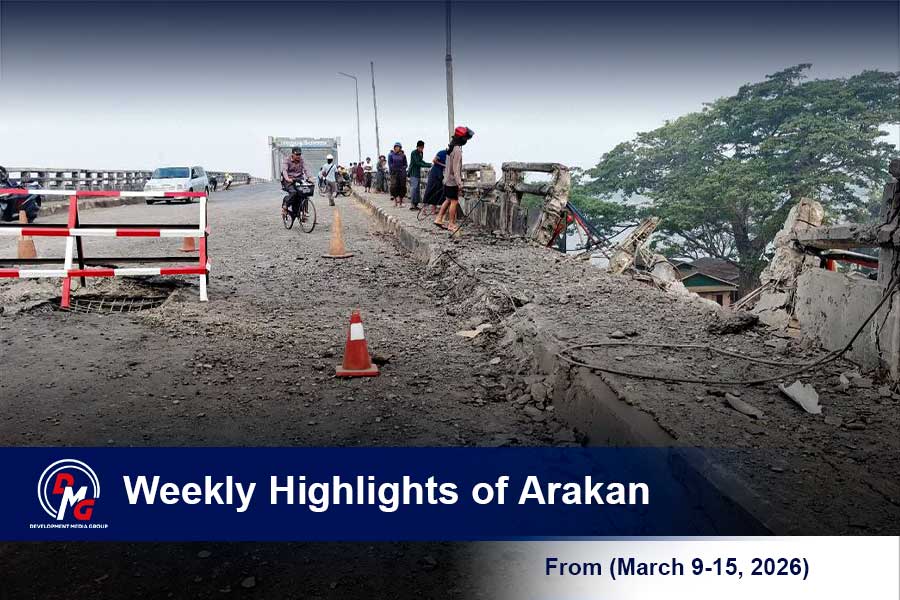
Junta airstrike damages Kispanadi Bridge in Kyauktaw
The Myanmar military regime carried out an airstrike on the Kispanadi Bridge in Kyauktaw Township, Arakan State, at around 10 p.m. on March 12.
Local residents said a jet fighter dropped bombs on the Kispanadi Bridge located at the eastern entrance of Kyauktaw, at the foot of Kyauktaw Hill, causing structural damage at several points.
The bridge is a key transportation route linking Kyauktaw with Mrauk-U, Minbya and Myebon townships, and is widely used by local residents.
In a separate incident on March 8, the military regime carried out an airstrike on a prisoner of war (POW) camp in the Darlatchaung area of Ann Township. The attack killed 116 prisoners of war and injured 32 others.
ARSA resurges with abductions and ambush attacks in northern Maungdaw
The Arakan Rohingya Salvation Army (ARSA) has reportedly resumed activities in northern Maungdaw Township, Arakan State, carrying out abductions and ambush attacks that have raised concerns among local residents.
On March 9, ARSA members allegedly abducted six Chakma men from Meetaik Village in Maungdaw Township while they were checking crab traps, according to local sources.
In a separate incident on March 8, ARSA carried out a landmine ambush on a trawlargy (hand-tractor) returning from Kyeinchaung Village to Wailartaung Village after a shopping trip. The attack left two people dead and one person missing.
Local residents say members of Muslim armed groups including ARSA, the Rohingya Solidarity Organization (RSO), and the Arakan Rohingya Army (ARA) have been infiltrating northern Arakan State by crossing the Naf River and the Mayu Mountain range along the Bangladesh border. These groups frequently carry out ambush attacks on travelers, they said.
Due to ongoing security concerns and threats to their livelihoods, some residents in northern Maungdaw have begun abandoning their villages and relocating to safer areas.
Locals reported that ARSA members have been occupying some of these deserted areas and continuing to carry out abductions, killings and ambush attacks against civilians.
According to local sources, clearance operations targeting Muslim armed groups are ongoing in Maungdaw and Buthidaung townships to improve security for local communities.
The armed groups infiltrating Arakan State from the Bangladesh border had remained largely inactive during the recent political transition in Bangladesh but have recently resumed activities.
In a video released on March 8, an armed ARSA leader claimed the group remains active inside Arakan State and vowed to continue fighting the Arakan Army.
According to a statement released on March 4 by the Humanitarian and Development Coordination Office (HDCO), attacks by Muslim armed groups in Arakan State between November 2023 and January 2026 killed 162 civilians and injured 22 others.
The casualties included 137 Arakanese, 35 Muslims, 34 Hindus, 13 Khami, six Mro and four Chakma people, the report said.
ULA issues order urging Arakanese residents to remain vigilant against airstrikes
The administrative department of the United League of Arakan (ULA) has issued a local order urging residents in areas controlled by the Arakan Army (AA) to remain highly vigilant against the increasing threat of airstrikes, according to local sources.
On March 12, awareness activities were carried out in Mrauk-U, including the installation of warning signs and mobile public announcements via loudspeakers to alert residents about aerial threats.
In Mrauk-U, the order instructs residents to refrain from using bright electric lights between 10 p.m. and 4 a.m. It also requires households to construct bomb shelters and urges residents to sleep on the ground floor of their homes whenever possible.
The order further prohibits loud noises from vehicles such as motorcycles and cars that could drown out the sound of approaching aircraft. It also bans the loud use of amplifiers and the holding of festivals or ceremonies that draw large crowds.
Residents are also encouraged to report any suspicious individuals near their neighborhoods or villages to the nearest administrative offices, security outposts, or party offices.
Local residents said the announcement comes as the military regime has stepped up airstrikes on townships controlled by the Arakan Army in Arakan State in recent days.
In several townships under Arakan Army control, nighttime airstrikes and reconnaissance drone flights have become more frequent. Early warning systems for aerial threats have therefore been implemented in some areas.
Observers noted that as the festival season approaches, authorities need to closely monitor public gatherings to reduce the risk of casualties from potential airstrikes.
The military regime has been carrying out daily bombing raids on townships under Arakan Army control, leading to a steady rise in civilian casualties.
Mizoram Gov’t eyes resumption of Kaladan Project under Arakan Army control
The Mizoram state government in India has expressed its hope to resume the Kaladan Multi-Modal Transit Transport Project (KMMTTP) in Arakan State, currently under the control of the Arakan Army (AA).
He noted that while businesses are already utilizing the Kaladan project route for trade, it remains unofficial and without formal government authorization, making it difficult to regulate or take action under current circumstances.
Recognizing the ground reality, the Chief Minister stated that the majority of areas encompassing the Kaladan project are now under Arakan Army administration, and the Mizoram government has established a positive relationship with the group.
The Indian government initiated the Kaladan project as a strategic gateway to connect India’s landlocked Northeast to the east, west, and south via a new maritime outlet through Myanmar.
The project involves both sea and land routes: a 158-km waterway along the Kaladan River and a 129-km highway connecting Paletwa in Chin State to Zorinpui in Mizoram. Construction by Indian firms began in 2015, extending from Zorinpui to Setpyitpyin Village in Paletwa. However, progress was halted in 2018, 2019, and 2020 due to intense regional conflict.
Currently, the Mizoram government has expressed concerns regarding the increasing number of residents and merchants from Arakan State entering Mizoram via this route.
To manage these border movements, a coordination effort involving district administration, police, Assam Rifles, Border Security Forces (BSF), and civil society organizations will be implemented.
To prepare for the eventual reopening of the project, the Chief Minister announced the formation of an “Impact Study Group” to be led by a member of parliament.
The Kaladan project remains a vital cooperative venture between India and Myanmar, aimed at transporting goods from Sittwe Port in Arakan State through the Kaladan River to Paletwa and onwards to Mizoram.
Analysts monitoring foreign projects in Arakan State observe that India is shifting its policy to prioritize ground realities by recognizing the Arakan Army as a major power.
Furthermore, India is building a strategic understanding and stronger ties with the Arakan Army to balance China’s influence in Arakan State.
However, some analysts warn that the junta may increase military pressure and airstrikes on Arakan State, fearing the project will proceed solely under Arakan Army control.
The Kaladan Multi-Modal Transit Transport Project was initially agreed upon by the Indian and Myanmar governments in April 2008 with a total estimated cost of $484 million.
While infrastructure at Sittwe Port and the waterways through Ponnagyun, Kyauktaw, and Paletwa has been upgraded, the Arakan Army is currently working on road construction from Paletwa to the Indian border.

Opinion
.jpg)
How Can Myanmar’s Political Crisis Be Brought to an End?
By Admin 13 Sep 2026

By Cutting Trees, We Are Killing Ourselves
By Admin 06 Sep 2026

A Modern August We Must Never Forget
By Admin 31 Aug 2026

Arakan’s Political Shifts and the Debate Over Rights and Governance
By Admin 27 Aug 2026

Securing Rights for Bangladesh's Indigenous Peoples is Indispensable
By Admin 09 Aug 2026

POLITICS


BUSINESS
Industry to manufacture finished goods from coconut starting in early 2020
By Aung Kaung Zaw 20 Nov 2019