
Bo Nagar’s defection raises security fears for resistance forces in Myanmar’s heartland
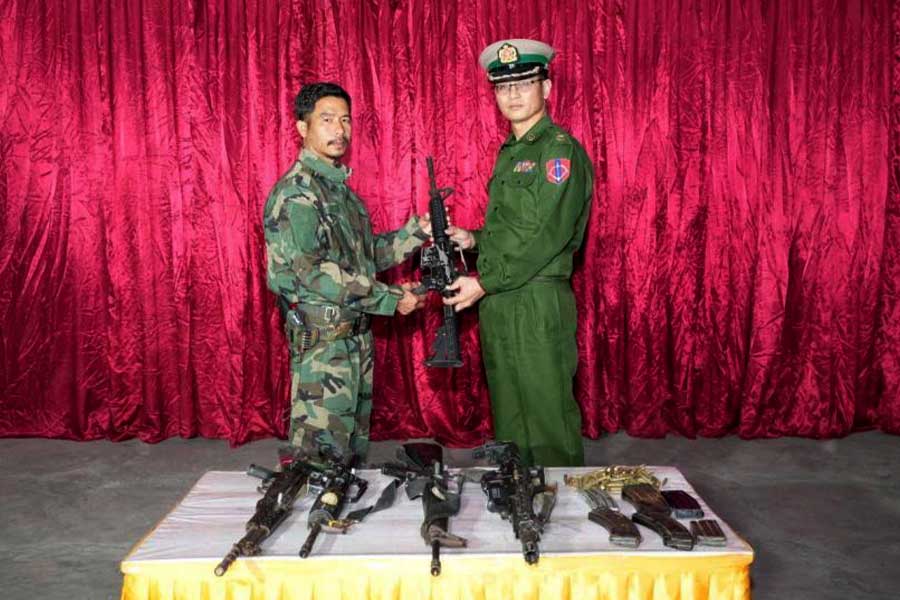
Bo Nagar, leader of the Burma National Revolutionary Army (BNRA), defected to the military regime on February 19, according to an announcement by junta-controlled media.
19 Feb 2026
DMG Newsroom
19 February 2026, Pale, Sagaing Region
Bo Nagar, leader of the Burma National Revolutionary Army (BNRA), defected to the military regime on February 19, according to an announcement by junta-controlled media.
A prominent revolutionary figure in Sagaing Region, Bo Nagar’s defection came one day after his base in Pale Township was attacked and seized by forces under the National Unity Government (NUG).
According to revolutionary groups, the military regime dispatched a helicopter to evacuate Bo Nagar and his family members, transporting them to the Northwestern Command headquarters in Monywa.
Military analysts have warned that the defection poses serious security risks, as sensitive information on supply routes and intelligence networks of resistance forces in Myanmar’s heartland could now fall into the hands of the regime.
“This is extremely dangerous for the revolutionary forces. The military will gain intelligence on troop positions, weapon procurement channels and logistics routes across Lower Sagaing, Chin State and Magway Region. They might also use Bo Nagar as a tool to persuade others to surrender or collaborate,” said Captain Zin Yaw, a participant in the Civil Disobedience Movement (CDM).
Some observers said Bo Nagar’s move was unlikely to have been spontaneous, suggesting a possible pre-existing connection with the military regime, noting that the junta’s helicopter assistance could not have been arranged so quickly otherwise.
Pale Township, where Bo Nagar was based, borders Magway Region and Chin State, making it a strategically important area for military operations in Myanmar’s heartland.
As a former senior revolutionary leader in Sagaing Region, Bo Nagar is believed to possess extensive knowledge of resistance operations and internal structures. Military observers have urged resistance forces in the heartland to urgently review their information security and military strategies.
“The threat of airstrikes is now a major concern, not just for Pale but for the entire Yinmabin District. Bo Nagar was a high-ranking leader before his defection; the scope of his knowledge is vast. We are worried the military regime will use his intelligence to launch targeted ground offensives and aerial attacks,” said Ko Ye Yint, a political activist in Sagaing Region.
Some members of the BNRA have reportedly joined forces under the NUG, while others were killed during recent clashes with NUG troops.
Members of the revolutionary community said the defection of a leader who once vowed to fight until the military dictatorship was uprooted amounts to a betrayal, undermining the sacrifices made by comrades who lost their lives in the revolution.

Top News
Clashes intensify at three locations near Sittwe ROC
By Admin 19 Oct 2026
Junta extends martial law in 55 townships, including AA-held areas
By Admin 19 Oct 2026
Financial hardship limits access to healthcare in Arakan
By Admin 19 Oct 2026

Rice shortages worsen in Taungup as prices soar
By Admin 19 Oct 2026
Junta airstrike kills at least seven, injures many in Paletwa Twsp
By Admin 19 Oct 2026