

- Financial hardship limits access to healthcare in Arakan
- Rice shortages worsen in Taungup as prices soar
- Junta airstrike kills at least seven, injures many in Paletwa Twsp
- Military operations spread despite decline in clashes, BNI report finds
- Junta aerial attacks force school closures across three Arakan townships
Female-headed IDP households in Ponnagyun Twsp struggle as commodity prices surge
Displaced women say that amid scarce job opportunities and soaring commodity prices, their daily income from casual labour , often around K10,000, is no longer enough to keep up with the rising cost of living, triggering a severe livelihood crisis.
21 Feb 2026
DMG Newsroom
21 February 2026, Ponnagyun
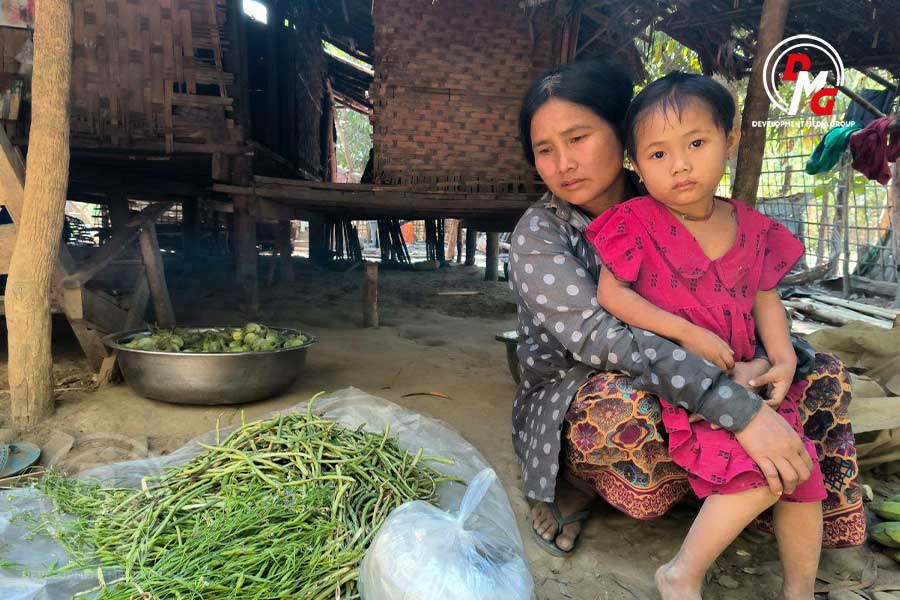
Among those displaced by ongoing military conflict in Arakan State are many women heading households without a male provider.
These women are struggling to meet their families’ basic needs, including food, healthcare and education.
Displaced women say that amid scarce job opportunities and soaring commodity prices, their daily income from casual labour , often around K10,000, is no longer enough to keep up with the rising cost of living, triggering a severe livelihood crisis.
“I weave bamboo trays to support my family. I earn K4,000 per tray. It is not enough to survive. I can only finish about 20 trays a month. With many children, it doesn’t cover our living costs at all,” said Daw Hla Thein Phyu from Aidin Village in Ponnagyun Township.
Daw Hla Thein Phyu, who lives at a displacement camp near Theltaw Village in Ponnagyun Township, supports seven children with the income she earns from weaving bamboo trays.
Due to her large family and extremely low income, she said she had to withdraw her daughter, who was due to attend Grade 10, from school and send her to work.
Since November 2023, the number of internally displaced people (IDPs) in Arakan State has risen to nearly 600,000. They are facing multiple hardships due to limited humanitarian assistance, rising commodity prices and a lack of employment opportunities.
“I survive on the small profit I make from reselling other people’s goods. It’s not enough. We have to live very frugally just to afford food. I can’t work like I used to, so how can we eat like before? It’s very tight and mentally exhausting,” said Daw Hla Saw Nu from Shintaw Village in Ponnagyun Township.
The average daily income for women is around K15,000 at most. Even with strict budgeting, this amount is insufficient to feed a family for a single day, with negative consequences for healthcare and children’s education.

Top News
Financial hardship limits access to healthcare in Arakan
By Admin 19 Oct 2026
Rice shortages worsen in Taungup as prices soar
By Admin 19 Oct 2026
Junta airstrike kills at least seven, injures many in Paletwa Twsp
By Admin 19 Oct 2026
Arakanese politicians face public backlash over junta-backed NCA event
By Admin 17 Oct 2026
Military operations spread despite decline in clashes, BNI report finds
By Admin 17 Oct 2026