

- Kyauktaw market closure disrupts trade and drives up prices across Arakan
- Arakan has Myanmar’s highest multidimensional poverty, 1.66 million affected: UNDP
- Arakan records most armed incidents, second-highest civilian casualty toll in Myanmar: NLTA
- Junta fails to regain territory despite major Arakan offensive: ISP-Myanmar
- Two Myebon fishermen missing after junta troops throw fishermen into sea
ULA purchases paddy from farmers amid market shortage in Arakan State
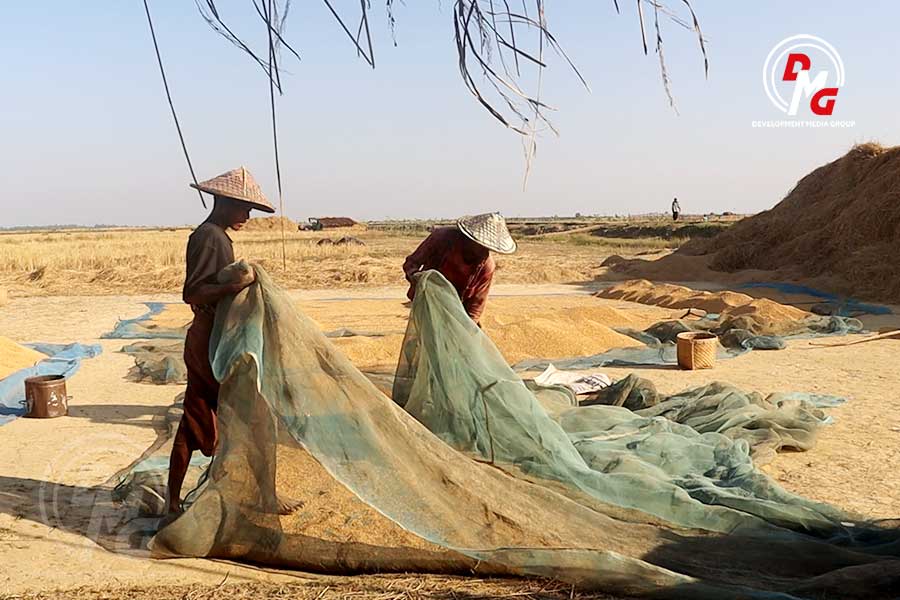
Authorities from the United League of Arakan (ULA) have begun purchasing paddy this month from townships under the control of the Arakan Army (AA), as local farmers struggle with a lack of buyers and limited market access.
12 Feb 2026
DMG Newsroom
12 February 2026, Kyauktaw
Authorities from the United League of Arakan (ULA) have begun purchasing paddy this month from townships under the control of the Arakan Army (AA), as local farmers struggle with a lack of buyers and limited market access.
Although it is harvesting season, farmers have faced a stagnant market with little demand, prompting the ULA to intervene and buy the crops.
“It is convenient for us that they are buying paddy now. Previous buyers haven’t returned, and we couldn’t generate income from the paddy we’ve stored. We were worried about lacking capital for the next season. Selling to the Arakan Army helps us recover costs for next year,” said a female farmer in Kyauktaw Township.
The United League of Arakan has introduced a pricing system that categorizes paddy into four grades based on quality factors, including grain color, purity, moisture content and the percentage of hollow grains.
Official purchase prices per 100 baskets range from K600,000 to K800,000 for high-grade Paw Hsan Hmwe and from K400,000 to K570,000 for India paddy. Thiridon and Kaukkyi varieties are priced between K420,000 and K600,000, while low-grade paddy is being bought at between K380,000 and K550,000.
“Their weighing system is reliable. When I brought 100 baskets, the measurement was accurate and even slightly better than selling elsewhere. It’s convenient to sell in bulk,” said a male farmer in Kyauktaw Township.
To prevent middlemen from reselling paddy, farmers must present a recommendation letter from their village administrator when selling to the ULA/AA.
Last year, 100 baskets of Paw Hsan Hmwe sold for around K750,000, while India paddy fetched about K500,000. However, farmers said the lack of buyers has remained a persistent problem.
Rice and paddy from Arakan State were previously exported to mainland Myanmar and international markets, but trade routes have been disrupted by the military regime’s blockades and ongoing hostilities. As a result, farmers face annual losses due to high input costs and difficulties selling stored produce.
Farmers are urging the Arakan People’s Government to establish a stable and sustainable paddy market to support regional revenue and protect agricultural livelihoods.
“Selling now is good, but we don’t want the market to disappear again next year. We rely on this year’s sales to reinvest in our farms. The Arakan Army should work toward a more stable market that benefits the region in the long term,” said a farmer in Ramree Township.
Farmers in Arakan are currently reducing cultivation areas due to financial losses, rising input costs and ongoing conflict. In an effort to support the agricultural sector, the United League of Arakan has also been providing fertilizer assistance to farmers in Arakan State this year.

Top News
Kyauktaw market closure disrupts trade and drives up prices across Arakan
By Admin 10 Oct 2026
Arakan has Myanmar’s highest multidimensional poverty, 1.66 million affected: UNDP
By Admin 10 Oct 2026
Junta fails to regain territory despite major Arakan offensive: ISP-Myanmar
By Admin 10 Oct 2026
Clashes intensify near Taung Maw Oo naval station as Arakan Army launches offensive
By Admin 09 Oct 2026