

- Junta orders Sittwe residents to dismantle home bomb shelters
- Arakan records most armed incidents as 78 civilians killed across Myanmar: NLTA
- Y-12 aircraft, drones circle over Sittwe as clashes intensify
- Panic grips Sittwe after deadly reported Y-12 airstrike
- At least six killed, 37 injured in reported Y-12 bombing of downtown Sittwe
Arakan farmers struggle as paddy market collapses, debts mount
Farmers in Arakan State are facing severe financial hardship as they struggle to find buyers for their harvested paddy amid a stagnant market and weak demand, local sources said.
05 Feb 2026
DMG Newsroom
5 February 2026, Ponnagyun
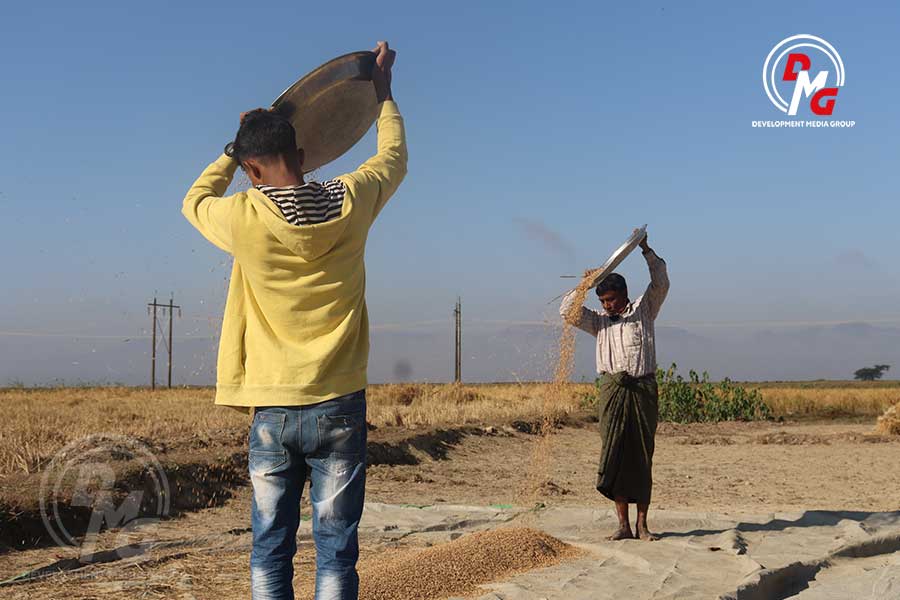
Farmers in Arakan State are facing severe financial hardship as they struggle to find buyers for their harvested paddy amid a stagnant market and weak demand, local sources said.
During the recent harvest season, high-grade Paw Hsan Hmwe paddy sold for about K750,000 per 100 baskets, while Indian paddy varieties fetched around K500,000. Farmers say the market has since come to a standstill, with almost no active buyers.
U Maung Kyaw Sein, a farmer in Ponnagyun Township, said he is unable to repay agricultural loans as sales have dried up.
“There were a few buyers looking to stock up during the harvest, but now there is no one,” he told DMG. “We mostly rely on loans to cultivate our crops. If we can’t sell the paddy, how are we supposed to pay back the debt? It has become an endless cycle of debt for us.”
Historically, rice and paddy from Arakan State were exported to mainland Myanmar and neighbouring Bangladesh. However, following the escalation of regional conflict, Bangladesh has reportedly stopped accepting exports via the Arakanese Chamber of Commerce.
With agricultural input costs continuing to rise, farmers are shouldering mounting losses as their produce remains unsold.
Many are now urging the United League of Arakan (ULA) to establish a systematic rice and paddy market to protect farmers’ livelihoods and the regional economy.
“Farmers in Arakan State have suffered losses for three consecutive growing seasons,” said U Kyaw Than, a farmer in Kyauktaw Township. “With no market this year, we are already heading towards financial ruin. If this continues, it is uncertain whether farmers will even be able to afford to plant next year.”
Arakan State has more than 1.2 million acres of arable land, with agriculture forming the backbone of the local economy.
Despite this, the absence of market guarantees, combined with high commodity prices and input costs, has led to a steady year-on-year decline in cultivated acreage.

Top News
Junta orders Sittwe residents to dismantle home bomb shelters
By Admin 24 Oct 2026
Arakan records most armed incidents as 78 civilians killed across Myanmar: NLTA
By Admin 24 Oct 2026
Y-12 aircraft, drones circle over Sittwe as clashes intensify
By Admin 23 Oct 2026
Panic grips Sittwe after deadly reported Y-12 airstrike
By Admin 23 Oct 2026
At least six killed, 37 injured in reported Y-12 bombing of downtown Sittwe
By Admin 23 Oct 2026