
- Kyauktaw market closure disrupts trade and drives up prices across Arakan
- Arakan has Myanmar’s highest multidimensional poverty, 1.66 million affected: UNDP
- Arakan records most armed incidents, second-highest civilian casualty toll in Myanmar: NLTA
- Junta fails to regain territory despite major Arakan offensive: ISP-Myanmar
- Two Myebon fishermen missing after junta troops throw fishermen into sea
Thet community faces challenges amid population decline
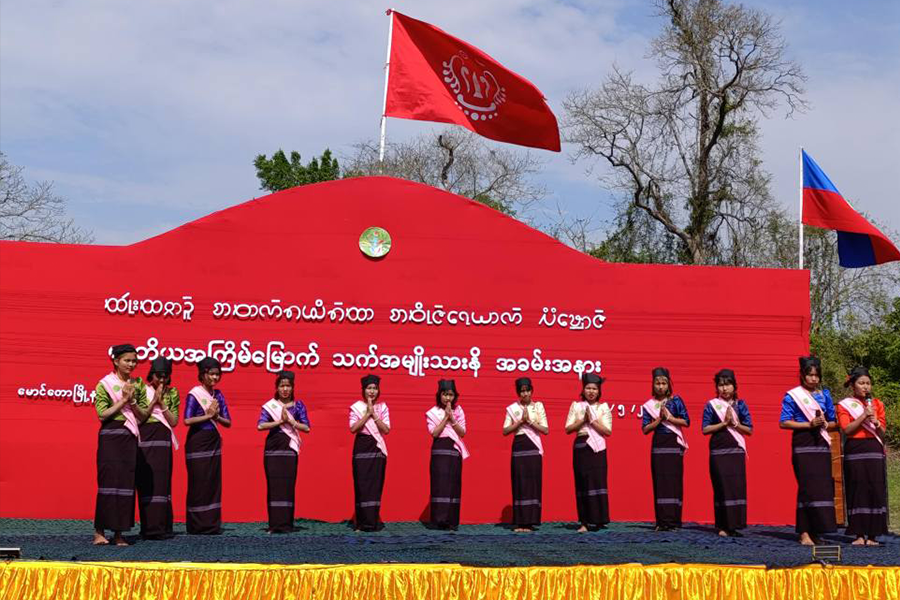
The ethnic Thet community, one of the indigenous groups of Arakan State, is facing growing challenges to its national identity and cultural survival due to migration and a gradual decline in population.
26 Dec 2025
DMG Newsroom
26 December 2025, Maungdaw
The ethnic Thet community, one of the indigenous groups of Arakan State, is facing growing challenges to its national identity and cultural survival due to migration and a gradual decline in population.
Members of the Thet community say they are at risk of gradual extinction as their population has become increasingly dispersed through generations of migration. Their numbers are now estimated at only a few thousand and are expected to continue declining in the coming decades.
“When people move to places like Yangon for education or political reasons, the population left behind is small. There are not enough human resources for work, and young people are lost,” said Ko Pan Kyaw Du, a member of the ethnic Thet community.
He added that the lack of accurate population data in the past has worsened the situation. “When the political situation changed, people moved to places that were more convenient for them. In this area, the Thet people have remained in name only for about a decade, and many are now struggling to find places to live,” he said.
The Thet people consider the Waila Mountains in northern Maungdaw Township to be their ancestral homeland. However, ongoing ethnic and military conflict in the Maungdaw area has forced many to flee to safer locations, accelerating their disappearance from the region.
The Thet are the smallest ethnic group among Arakan’s indigenous communities, with an estimated population of between 3,000 and 4,000 in Arakan State as of 2022.
“We are collecting data to better understand how many Thet people remain in Arakan State,” Ko Pan Kyaw Du said. “We are still conducting a census to obtain more accurate information, including age and gender.”
In recent years, Thet youth have led efforts to preserve and promote their ethnic identity through traditional culture, literature, and celebrations of Thet National Day.
A young Chin man cited multiple factors behind the population decline. “There are people affected by conflict, those who have gone abroad to study or work, and those who fled. Some have also died after being drawn into armed conflict due to the military service law,” he said.
He added, “If all ethnic groups in Arakan State work together to solve shared problems, regardless of ethnicity, we can build a better state in the long run.”
Ethnic activists say the United League of Arakan should cooperate with leaders and activists from smaller ethnic groups, including the Thet, to help address their challenges.
According to community members, Thet people are scattered across Maungdaw, Buthidaung, Rathedaung, Sittwe, Mrauk-U and Ann townships.
Others live in Yangon, Mandalay and Nay Pyi Taw, as well as abroad in countries including Thailand, Malaysia and China.
The Thet are one of the Thet, Bhu and Kanyam ethnic groups, believed to be part of the Tibetan peoples who first entered Myanmar in prehistoric times around 3,000 BC. While their original population size in Arakan is unknown, historical chronicles describe them as a prominent ethnic group in the region’s past.

Top News
Kyauktaw market closure disrupts trade and drives up prices across Arakan
By Admin 10 Oct 2026
Arakan has Myanmar’s highest multidimensional poverty, 1.66 million affected: UNDP
By Admin 10 Oct 2026
Junta fails to regain territory despite major Arakan offensive: ISP-Myanmar
By Admin 10 Oct 2026
Clashes intensify near Taung Maw Oo naval station as Arakan Army launches offensive
By Admin 09 Oct 2026