
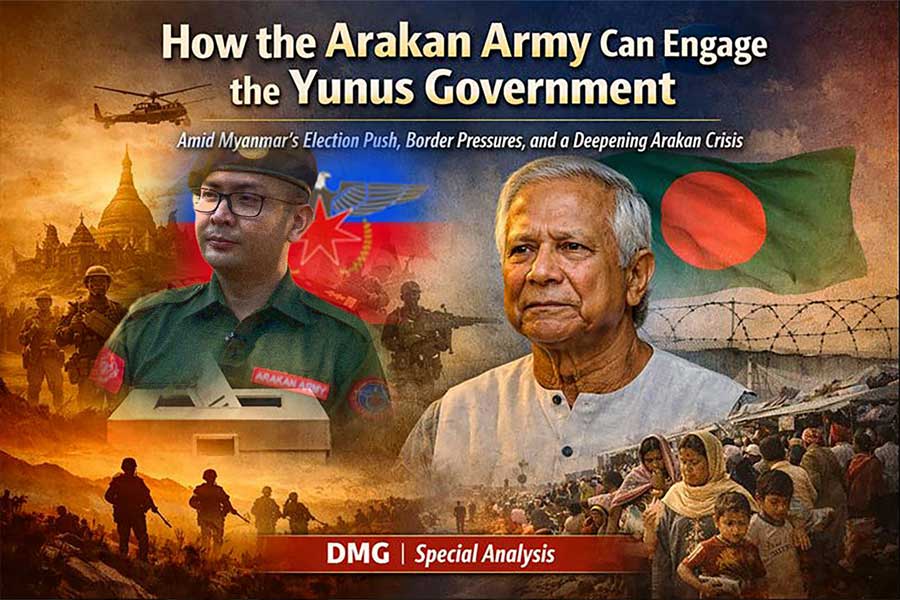
How the Arakan Army Can Engage the Yunus Government Amid Myanmar's Election Push, Border Pressures, and a Deepening Arakan Crisis
The relationship between the United League of Arakan/Arakan Army (ULA/AA) and Bangladesh's interim government led by Nobel laureate Muhammad Yunus has become more complex and more strategic than a simple story of "tension versus cooperation.
03 Jan 2026
DMG | Special Analysis
Executive Summary
The relationship between the United League of Arakan/Arakan Army (ULA/AA) and Bangladesh's interim government led by Nobel laureate Muhammad Yunus has become more complex and more strategic than a simple story of "tension versus cooperation.
" Dhaka faces growing domestic and international pressure over the Rohingya refugee crisis, camp insecurity, and border stability. At the same time, Myanmar's junta is seeking to manufacture legitimacy through a staggered election process beginning in late December 2025, an initiative widely criticized as neither free nor fair.
In Arakan (Rakhine State), the AA's rapid territorial consolidation has shifted the conflict from a frontline contest into an administration-and-legitimacy test. Governance, humanitarian access, inter-communal security, and international scrutiny especially in northern Arakan now shape the battlefield as much as military operations do. The UN Special Rapporteur's October 2025 report underscores the depth of allegations against multiple parties (junta forces, Rohingya militant groups, and the AA) and calls for cross-border aid coordination and credible investigation pathways.
This special analysis maps the current political context and proposes practical engagement options for the ULA/AA to approach the Yunus government without surrendering strategic autonomy and while reducing the risk of being boxed into a "safe zone/save zone" narrative that could internationalize the conflict on unfavorable terms.
Current Political Context: Why This Moment Is Volatile
(1) Myanmar's junta election strategy raises the conflict temperature
Myanmar's military has launched a multi-phase election process amid civil war, with voting held only in a fraction of townships. Reporting highlights turnout claims, additional phases extending into January 2026, and widespread criticism over political exclusion and the risk of intensified violence.
For Arakan, this matters because the junta's election plan incentivizes:
- military pressure and counteroffensives in strategic corridors;
- information operations framing rivals as illegitimate; and
- external bargaining with neighbors to constrain resistance-controlled areas.
(2) Bangladesh's domestic politics are shifting, and the border is securitizing
Bangladesh's political landscape is in flux ahead of elections expected in early 2026. The renewed political role of Jamaat-e-Islami following the lifting of restrictions signals intensifying competition and identity politics. For Dhaka, the Rohingya issue has become an internal political liability: prolonged hosting, donor fatigue, and camp violence create pressure to show progress any progress toward "solutions."
(3) Camp insecurity and militant coercion are rising, and spill across the Naf
Cox's Bazar monitoring has recorded high levels of serious incidents, abduction, extortion, assault, and recruitment within a single quarter of 2025. International Crisis Group and other observers have warned of a deepening insurgency/criminal-network dynamic affecting both Bangladesh and Myanmar's borderlands, with armed actors exploiting the camps and cross-border terrain.
(4) The "humanitarian corridor" debate remains a real lever politically contested
Bangladesh has signaled openness at times to cross-border aid concepts into Arakan, while analysts warn about sovereignty, security risks, and politicization. For the AA, the corridor concept is double-edged: it can reduce suffering and open channels, but it can also become an instrument of coercive diplomacy if framed as an "international solution" to "AA incapacity."
Key Findings
Finding 1: Dhaka's pressure toolkit extends beyond military posturing
The underlying commentary highlights alleged pressure points, border trade restrictions, narrative warfare (including drug-trafficking accusations), and coordinated international advocacy that pushes "save zone" framing. In the current border environment, security dynamics, armed group activity, and international advocacy increasingly interact and reinforce each other.
Finding 2: The AA's central vulnerability is no longer battlefield control, it is international legitimacy
The UN Special Rapporteur's October 2025 report documents severe allegations, emphasizes the difficulty of verification, and stresses the need for credible investigations and rights commitments by all actors, including the AA.
That means any Dhaka strategy that internationalizes pressure through UN mechanisms, "safe zone" narratives, or R2P rhetoric becomes more dangerous if the AA cannot demonstrate verifiable governance safeguards and credible protection measures.
Finding 3: A direct AA-Yunus channel is possible, but must be structured, deniable-to-hardliners, and evidence-based
Bangladesh's decision-making is not centered on one person. Even if Yunus prefers pragmatic humanitarian solutions, domestic parties, security institutions, and geopolitics can constrain him. The corridor debate illustrates how quickly such initiatives become politically contested.
Strategic Options for ULA/AA: A Practical Engagement Playbook
(1) Separate "Border Security" from "Refugee Futures" and propose a stepwise agenda
Instead of one overloaded negotiation ("refugees + repatriation + safe zone + sovereignty"), the AA could propose a sequenced agenda:
Phase A: De-confliction & Communication
- hotline-style contact mechanism (initially through trusted intermediaries);
- incident notification protocol (Naf River events, cross-border fire, kidnappings).
Phase B: Humanitarian Stabilization
- needs-based cross-border aid principles (non-discrimination; monitoring);
- joint humanitarian liaison arrangement (without triggering a political recognition trap).
Phase C: Civilian Protection & Community Dialogue
- local Arakan-Muslim liaison bodies under AA administration;
- transparent rules on movement, livelihoods, detention, and due process.
This sequencing aligns with repeated international calls for needs-based access, reduced coercion, and credible civilian-protection measures.
(2) Use "soft-entry intermediaries" credible in Dhaka without looking like proxies
A practical model is a three-ring channel:
- Ring 1 (Civil society): humanitarian professionals; medical/logistics liaisons
- Ring 2 (Political): acceptable Bangladeshi connectors + neutral regional diplomats
- Ring 3 (Technical/security): border trade and anti-trafficking technical talks
Goal: allow Yunus officials to engage without paying a high domestic political cost at the start.
(3) Preempt "Save Zone" framing with a verifiable alternative: a "Protection & Access Compact"
A compact would be a public, time-bound set of commitments the AA can control and verify, such as:
- published civilian-protection rules for all communities;
- transparent detention standards and complaint mechanisms;
- commitments on aid access and non-diversion;
- independent fact-finding invitations under agreed security protocols.
A credible compact reduces the space for arguments that only a UN-designated "zone" can protect civilians.
(4) Build an evidence portfolio because narrative warfare is now a frontline
If allegations (drug trafficking, militant ties, atrocities) circulate internationally, rebuttals without evidence will not hold. The AA's strongest move is a disciplined evidence architecture:
- incident chronologies and verifiable documentation (where safe);
- controlled media access to selected sites;
- third-party documentation standards and transparent follow-up.
(5) Humanitarian corridor: accept the principle, negotiate the design
The corridor concept is unlikely to disappear. The AA can shape it by insisting on:
- needs-based delivery for all communities;
- monitoring safeguards that do not become political control mechanisms;
- clear separation from coercive repatriation timelines;
- transparency to reduce suspicion within Dhaka's security establishment.
Risks and Scenarios to Watch
Scenario 1: "Election-era escalation + border squeeze"
As Myanmar's election phases proceed, the junta may intensify pressure around strategic nodes; Dhaka may tighten trade/security to project control.
AA implication: prioritize supply resilience, humanitarian access, and de-confliction to prevent a manufactured starvation narrative.
Scenario 2: "Camp militancy spillover + international trigger event"
If major violence erupts in camps or border areas, global attention spikes and "zone" proposals gain momentum.
AA implication: proactive protection commitments and credible investigations become essential not optional.
Scenario 3: "Dhaka's internal politics harden"
If political competition sharpens, policy may swing toward securitized, symbolic actions (pushbacks, tougher rhetoric, high-visibility demands). AA implication: keep engagement technical/humanitarian first; political questions later.
Bottom Line for DMG Readers
The AA's most realistic path to engaging the Yunus government is not maximalist political bargaining. It is a structured, stepwise engagement that lowers Dhaka's domestic risk, strengthens humanitarian credibility, and reduces international "zone" momentum by offering a verifiable alternative rooted in civilian protection and access.
If the AA can combine:
1. disciplined diplomacy,
2. evidence-based communications, and
3. measurable governance protections for all communities,
then Dhaka's pressure toolkit becomes less effective and the AA gains room to shape outcomes rather than be shaped by them.

Opinion
Surviving Amid the Bombs: Arakan's Quiet Resistance
By Admin 19 Oct 2026

Shadows Over Childhood: Confronting the Reality of Missing Children
By Admin 16 Oct 2026
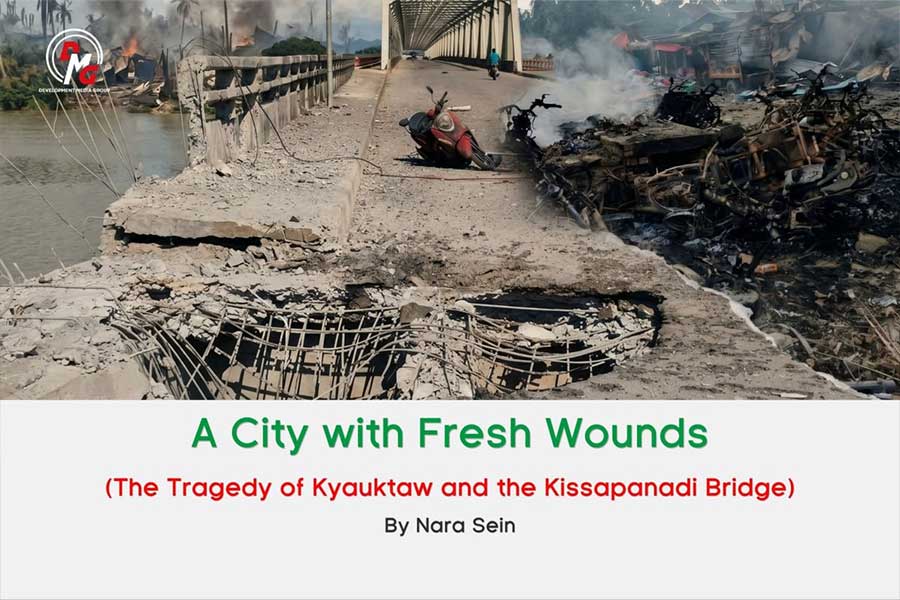
A City with Fresh Wounds (The Tragedy of Kyauktaw and the Kissapanadi Bridge)
By Admin 01 Oct 2026
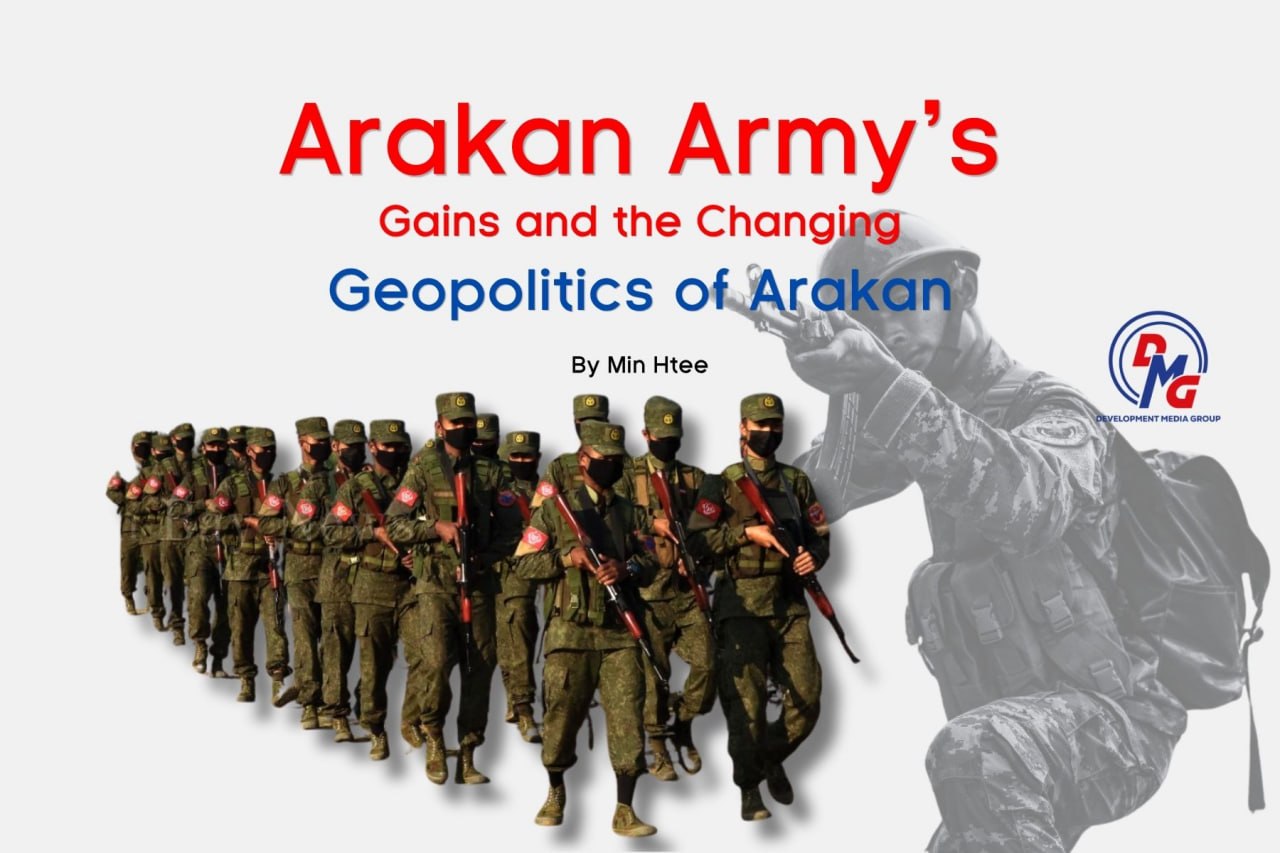
Arakan Army’s Gains and the Changing Geopolitics of Arakan
By Admin 29 Sep 2026
Beyond Military Victory: What Is Myanmar’s Ultimate Political Objective?
By Admin 26 Sep 2026
UN at a Crossroads: Six Priorities for a Shared Future
By Admin 23 Sep 2026
POLITICS

BUSINESS
Industry to manufacture finished goods from coconut starting in early 2020
By Aung Kaung Zaw 20 Nov 2019