

- Over 400 Arakanese deportees remain detained in Yangon under tight security
- Junta attacks disrupt fishing livelihoods in Werathani
- Junta air raids deepen livelihood crisis for displaced people in Ponnagyun
- Extreme heat and water shortages threaten paddy fields across Arakan
- Arakan Army captures junta outposts as fighting intensifies near Sittwe
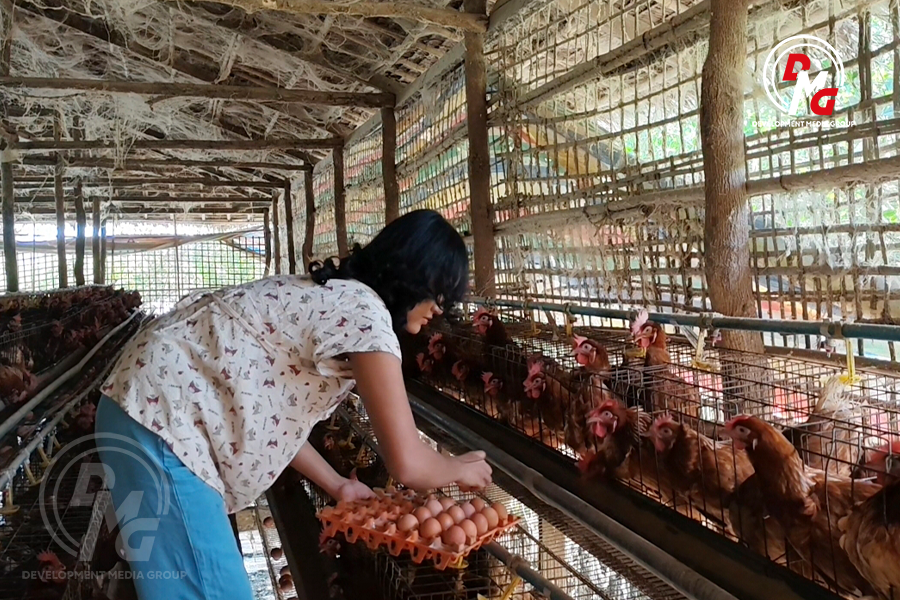
Poultry farmers in Arakan State hard-hit by junta blockades
Poultry farm owners say areas controlled by the Arakan Army are also unable to purchase ready-made chicken feed from mainland Myanmar, forcing them to produce feed locally using available raw materials.
10 Dec 2025
DMG Newsroom
10 December 2025, Mrauk-U
Since November 2023, Arakan State has faced shortages and soaring prices of basic goods as Myanmar’s military regime continues to block trade routes.
Poultry farm owners say areas controlled by the Arakan Army are also unable to purchase ready-made chicken feed from mainland Myanmar, forcing them to produce feed locally using available raw materials.
“In the past, chickens were fed only ready-made company feed. Now we feed them local food from Arakan State. We mix beans, dried fish, broken rice and snails with a little medicine. If we don’t have snails, the eggs will break because the shells are thin. The snails are also local, so we can buy them from Minbya,” said Ma Hnin Aye Shwe, who runs an egg-laying farm in Mrauk-U Township.
Locally made chicken feed typically includes bean sprouts, dried fish, broken rice and shellfish, with added powdered medicine.
Although poultry farming in Arakan State has declined due to conflict, some farmers continue to operate on a manageable scale for local consumption. They say, however, that shortages of chicken breeds, chicks and feed persist.
“Although Bangladeshi chickens are traded, it is not very convenient. They have small factories that can produce only about 300 chickens per day. But those are the wrong breed. If the breed is wrong, they will not lay eggs normally. Big companies, for example in France, have the right breeds. These chickens enter Bangladesh from France and arrive here through Bangladesh. If you get the right breed, the eggs will be good,” Ma Hnin Aye Shwe explained.
She added that local eggs remain popular in Arakan State because they are cheaper than eggs from India and Bangladesh, and therefore sell well across the state.
The farm-gate price of an egg in Arakan State is K750, while the market price is K1,000.
Farmers are also struggling to access vaccines and other medical treatments for poultry health. Livestock and veterinary shops say animal health medicines are being sourced from Bangladesh and mainland Myanmar through various means, but prices have sharply increased.
“Currently, there are difficulties in obtaining all the necessary medicines due to the blockade of trade routes. The medicines that are available are also very expensive. Some medicines used in livestock farming are affected because they cannot be delivered on time. The main thing in livestock farming is vaccines. Prevention is more effective than cure, so vaccines are mainly used,” said a livestock medicine shop owner in Mrauk-U Township.
The price of a packet of chicken feed has risen from K10,000 to more than K60,000. A bottle of antibiotics that once cost K40,000 now exceeds K100,000.
In blockade-affected Arakan State, tobacco, various types of bread, purified water, candles and aquatic products are being distributed and sold in small-scale packages. But producers say they are also struggling to obtain the raw materials needed for proper packaging.
Arakanese entrepreneurs say they hope local authorities will support small businesses to help them survive under current conditions.

Top News
Over 400 Arakanese deportees remain detained in Yangon under tight security
By Admin 16 Oct 2026
Junta attacks disrupt fishing livelihoods in Werathani
By Admin 16 Oct 2026
Junta air raids deepen livelihood crisis for displaced people in Ponnagyun
By Admin 16 Oct 2026
Extreme heat and water shortages threaten paddy fields across Arakan
By Admin 16 Oct 2026
Junta, Arakan Army battle for control of strategic Ngapyi Island
By Admin 15 Oct 2026