
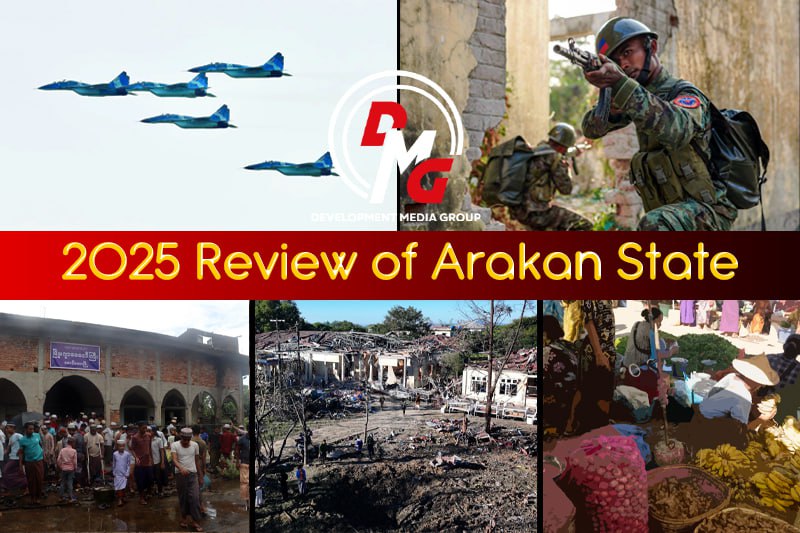
2025 Review of Arakan State
The year 2025 was not a good one for the people of Arakan (Rakhine) State in western Myanmar. Across nearly every sector, economic, social, and humanitarian, residents endured some of the heaviest psychological and physical impacts in recent years.
03 Jan 2026
The year 2025 was not a good one for the people of Arakan (Rakhine) State in western Myanmar. Across nearly every sector, economic, social, and humanitarian, residents endured some of the heaviest psychological and physical impacts in recent years.
In the health sector, Mrauk-U Public Hospital, relied upon by communities across northern Arakan, was struck by an air attack carried out by Myanmar's military council. Patients receiving treatment were killed, and nearly the entire hospital was destroyed.
Because of fighting in Kyaukphyu, the number of people forced to flee in emergency conditions rose into the thousands, and they faced severe hardship. Although some displaced people in areas under Arakan Army (AA) control have returned home, many others still cannot.
Fearing airstrikes and heavy weapons attacks by the military council, residents from Ponnagyun, Pauktaw, and Rathedaung townships were forced to flee again, becoming "double-displaced." Below is DMG's overview of the major changes and challenges that Arakan people faced in 2025 across: military-political developments, the economy, displacement, health, and education.
Military and Political Developments
Since the start of town-seizure fighting in November 2023, and through late 2024, the AA captured 14 townships in Arakan State and Paletwa Township in neighbouring Chin State. As a result, in 2025, most of Arakan State excluding Sittwe, Kyaukphyu, and Manaung remained under AA control.
From early 2025, fighting occurred in Sittwe Township, but unlike earlier phases of the war, there were no clear signs of major ground offensives culminating in base seizures or full city capture. Fighting in Kyaukphyu began in February 2025 and continued relentlessly through the end of the year. Meanwhile, clashes also continued in Myanmar's central regions including Magway, Bago, and Ayeyarwady.
When the Kyaukphyu fighting began, the AA initially intensified its offensive and reportedly reached as far as the perimeter fence of Battalion/Regiment No. 32 near the entrance to Kyaukphyu. However, the military council reinforced heavily and used sustained air support in counteroffensives, forcing the AA to withdraw from some areas it had taken.
Overall, 2025 did not produce major new battlefield victories for the AA. However, it did demonstrate the AA's ability to maintain control and administer its territories without losing overall dominance.
An Arakan conflict observer said: "In 2025, we didn't see particularly dramatic military breakthroughs. One reason may be that the AA was also pushing offensives toward the central regions of Myanmar. And from what we can see, Sittwe and Kyaukphyu appear to have been placed under a form of blockade. It's hard to define the AA's strategy precisely, but it looks like a siege-style approach."
The observer added: "So it didn't reach the level of large-scale city capture. But you can still see that the AA is effectively controlling most of Arakan State. Fighting continues in Kyaukphyu and in Sittwe. In short, although there was no major turning point in 2025, the momentum of the war did not decrease at all."
In May 2025, the AA announced an Emergency National Defense Provision (NDEP) and temporarily restricted eligible youth from leaving Arakan State until the security situation stabilised. After that, authorities also arrested and took action against some young people attempting to leave through various means.
At the same time, the military council conducted repeated attacks against AA-controlled areas using aircraft and drones, as well as naval and ground-based artillery.
In addition, clashes occurred frequently between the AA and Muslim armed groups such as ARSA (Arakan Rohingya Salvation Army) and RSO (Rohingya Solidarity Organisation), which reportedly infiltrated and operated along the Bangladesh border. On the political front, clear public negotiations about the Arakan conflict were not widely visible. However, due to Chinese mediation efforts, meetings between the military council and the AA reportedly took place in China though no concrete, visible outcomes were seen.
Political analyst U Gyi Myint said: "For the people of Arakan, this is a 100 percent success and it contributes almost fully to the Union as well. If I say it clearly, we can already see that the great struggle the people of Arakan have long hoped for achieving democracy will be realised before long."
Economy
Since November 13, 2023, when the town-seizure battles began, the military council has blocked land and water routes and restricted transport of goods and medicine into Arakan. These restrictions have now lasted more than two years.
From mid-2024, the AA began facilitating India-Arakan trade, and by late 2024 it also started Arakan-Bangladesh trade.
However, from early July 2025, Bangladeshi authorities tightened security at trade gates, seized goods coming from the Arakan side, and blocked goods intended to be exported to Arakan. As a result, cross-border trade largely stopped.
This made the India route the main trade corridor for Arakan. Yet because of distance and transport difficulties, the region could not avoid price increases.
In November, a diarrhoea outbreak in Mizoram (India) and Paletwa led authorities on both sides to close the India-Arakan trade route for two weeks, causing a slight rise in prices inside Arakan.
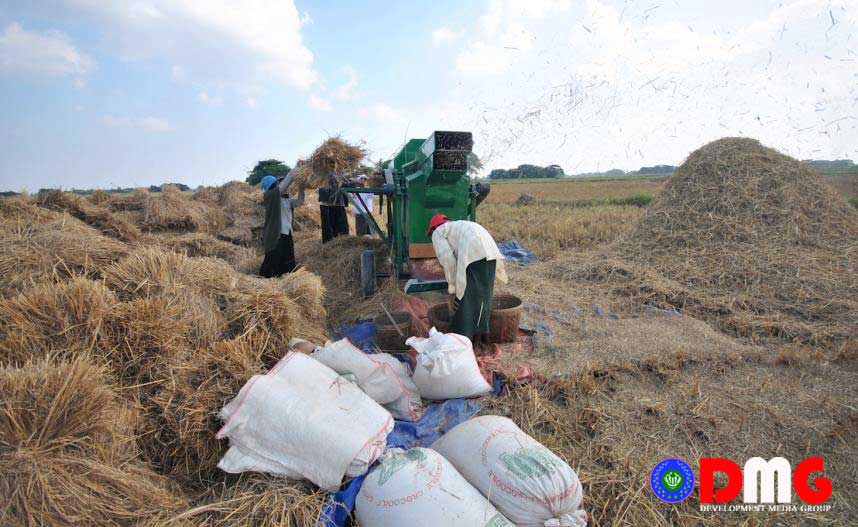
During this year's rainy season, rainfall was strong and some paddy acreage suffered damage. Still, overall yields increased, and rice prices fell in some AA-controlled areas.
U Maung Thein Hla, Chair of the Danyawaddy Rice Seed Cultivation Association, said: "This year the rains were normal, so yields were good. Most planted acres succeeded, and people were able to harvest widely. There were no major weather disruptions or storms. Farmers were pleased, and yields were strong."
Despite that, farmers now face difficulties because, during the harvest season, paddy prices are weak and demand is low.
Meanwhile, in Sittwe, which remains under military council control, rice prices have surged sharply. Rising and scarce firewood and charcoal prices have also created hardship for urban residents.
Arakan's key economic sector, fisheries, has still not returned to normal operations, largely due to repeated naval artillery fire by the military council.
Health
Since the fighting began in Arakan, restrictions by the military council have caused medicine shortages, leaving local communities in serious difficulty. Many have had to rely on India for medical needs.
From early 2025, the AA resumed efforts to ensure vaccination access for pregnant women and children who had missed immunisations. Vaccination has reportedly continued in AA-controlled townships in Arakan and in Paletwa.
However, communities have continued to struggle with blocked travel routes, insufficient medical equipment, and shortages of health workers.
On December 10, the military council bombed Mrauk-U Public Hospital, where civilians from across the region were receiving treatment. The attack killed 33 people and injured at least 78, according to the information presented in this text. Medical equipment and nearly the entire hospital were destroyed.
A Muslim religious leader from Mrauk-U Township, U Adu Saw Maut, said: "At Mrauk-U Hospital, many people who came for treatment from all places were killed. Among the dead were Muslims, and many Buddhists were also killed. I want to report this to UN leaders and security bodies, bombing innocent people like this. Those who committed it deserve punishment."
After the incident, fear spread about seeking treatment at clinics and hospitals, and medical care increasingly shifted toward mobile clinics.
Education
In August 2025, the AA said it was preparing to provide higher education opportunities, university-level education for those who had completed basic education.
However, many observers still view the plan to establish a full university as uncertain, with students continuing in a partial and unclear academic situation.
On September 12, an airstrike hit the Pyinyar Pan Khin private high school in Thayet Ta Pin Village, Kyauktaw Township, killing 21 students and injuring at least 20 in a mass-casualty incident.
A staff member in Kyauktaw Township said: "Because of the danger from air attacks, schools have to close frequently. Parents are afraid to send their children, and students themselves are afraid to attend."
After the incident, schools in Kyauktaw have had to relocate repeatedly, with frequent closures and no stable learning environment.
As a result, education in Arakan in 2025 passed through multiple crises and severe constraints.
Displacement
Due to intensified fighting in Kyaukphyu, during November more than 17 villages in Kyaukphyu Township saw thousands of residents flee urgently to safer places, facing severe and immediate needs.
From March 2025, Ponnagyun Township faced serious water shortages affecting both displaced people and local residents. In displacement camps, people dug for groundwater and used it for drinking and daily needs leading to outbreaks of skin disease and diarrhoea.
Ko Pyay Phyo Naing, Chair of the Ponnagyun Youth Association (PYA), said: "The displacement situation in Ponnagyun is worse than in other areas. Many people don't receive healthcare. Many can't afford even a single medicine tablet, and many have no money to travel to clinics or hospitals. They're facing so many hardships."
Because aid has been limited, displaced people have suffered severe livelihood difficulties. Some were also injured or killed due to air attacks by the military council.
Nearly 900 Civilians Killed or Injured
According to DMG's compiled data presented in this text, during 2025 in Arakan State, conflict-related incidents including attacks by the military council and Muslim armed groups (ARSA), landmines, and unexploded ordnance resulted in up to 880 civilians killed or injured.
Based on DMG's year-long documentation from January 1, 2025 to December 31, the casualties resulted from: air and drone strikes, artillery fire, arrests and killings, landmines and unexploded ordnance, and ARSA attacks.
The figures presented include: 294 civilians killed (including 87 children), 556 injured, plus 21 killed and 9 injured due to ARSA attacks totaling 880 casualties.
Civilian deaths have continued to rise due to the military council's human rights violations and mass killings.
According to DMG's records cited here, in 2025 there were six incidents in which 10 or more civilians were killed in single mass-casualty airstrike events, with total deaths in those events reaching up to 290.
Those mass-death incidents occurred in: three in Mrauk-U, one in Kyauktaw, one in Rathedaung, and one in Ramree. A total of 135 civilians were killed in those incidents, including 43 children and 70 women, according to the figures provided.
Summary
Alongside intense fighting, the people of Arakan have been forced to confront wide-ranging secondary crises and compounding challenges.
With nearly 600,000 displaced people inside Arakan, limited job opportunities, and extreme price inflation, displaced communities have faced deep hardship.
Because the military council continues to target hospitals/clinics, schools, and religious buildings, the threat from air attacks has stripped people of safe access to healthcare.
In education, children still lack security guarantees, and their right to study safely continues to be severely undermined.
Amid a conflict with no clear end date, people in Arakan are struggling not only for food security, but also for basic survival and safety.
Arakan's experience in 2025 was defined by overlapping crises where hardship and resilience, loss and endurance, and the "bad" and the "good," continued side by side.
Prepared by DMG Editorial/Analysis Desk, drawing on field reporting and recent incident compilations.

Opinion
Surviving Amid the Bombs: Arakan's Quiet Resistance
By Admin 19 Oct 2026
Shadows Over Childhood: Confronting the Reality of Missing Children
By Admin 16 Oct 2026
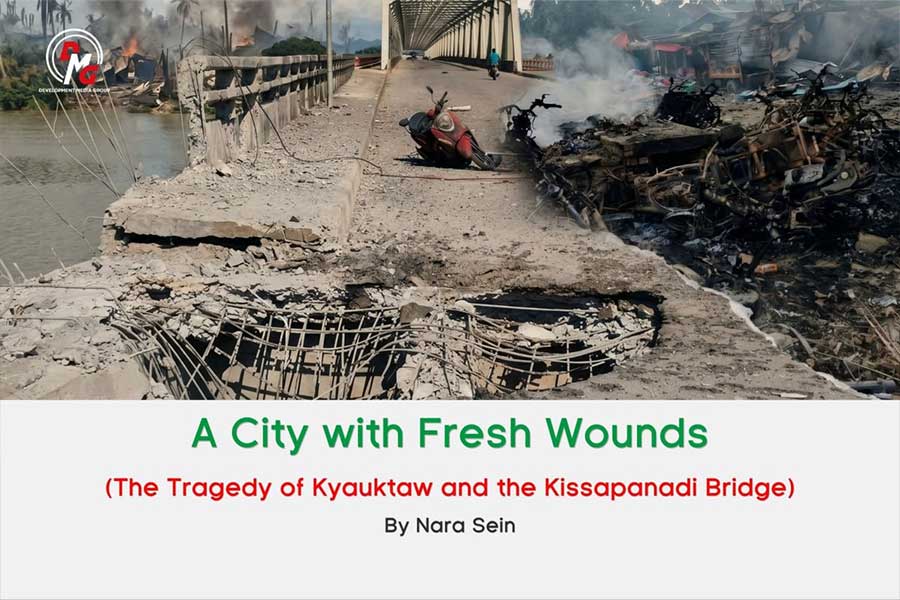
A City with Fresh Wounds (The Tragedy of Kyauktaw and the Kissapanadi Bridge)
By Admin 01 Oct 2026
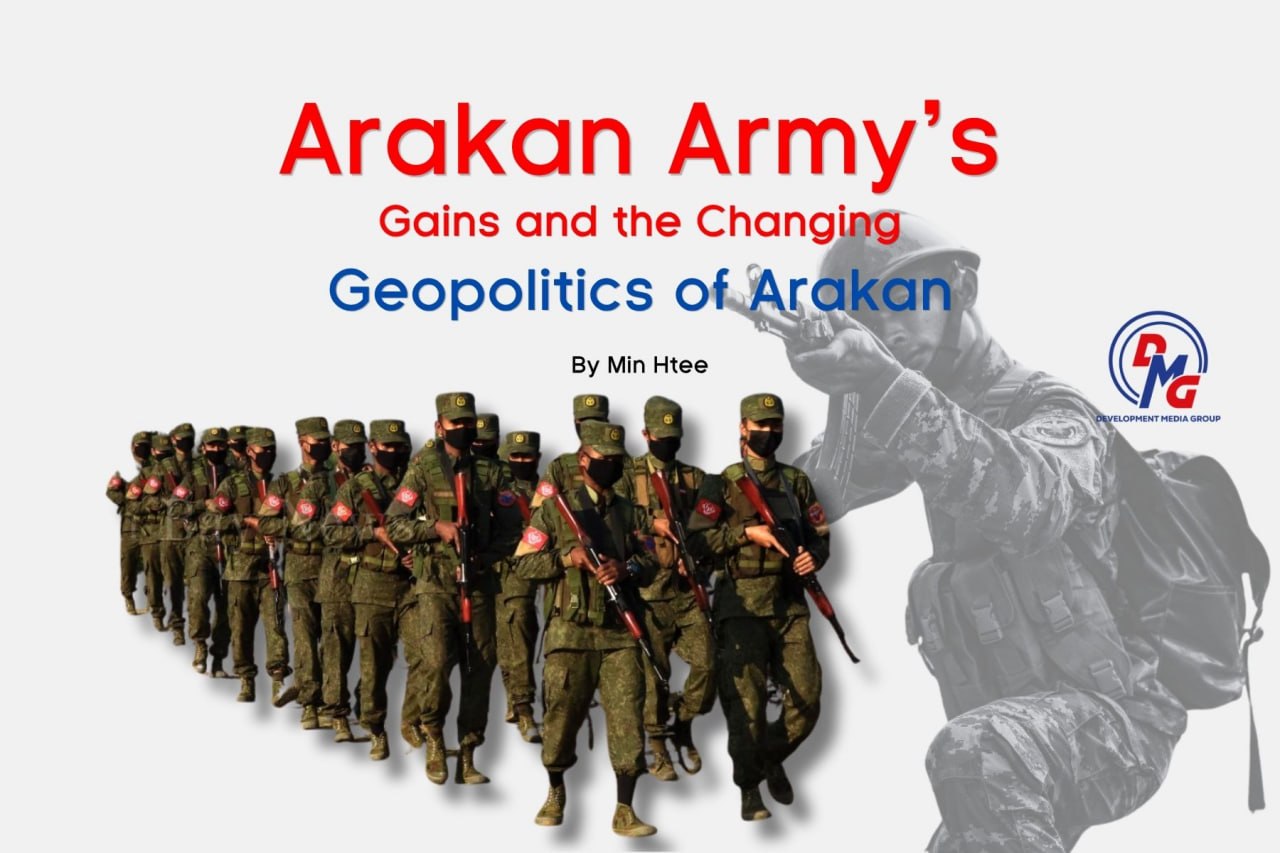
Arakan Army’s Gains and the Changing Geopolitics of Arakan
By Admin 29 Sep 2026
Beyond Military Victory: What Is Myanmar’s Ultimate Political Objective?
By Admin 26 Sep 2026
UN at a Crossroads: Six Priorities for a Shared Future
By Admin 23 Sep 2026
POLITICS

BUSINESS
Industry to manufacture finished goods from coconut starting in early 2020
By Aung Kaung Zaw 20 Nov 2019